English translation of the prose
AI-assisted English translation of the prose; quoted poems remain in Japanese. The Japanese original remains authoritative.
Originally published: 16 February 2020.
A recollection from the Japanese website. The narrative’s dates and sequence have been preserved as told. Quoted song lyrics remain in Japanese.
Memories in the shadow of blossoms
石井秋野, Kume, Nara Prefecture
「十五夜お月様ひとりぼち桜吹雪の花影に花嫁姿のお姉さま車にゆられてゆきました」
Whenever I hear that song, I cannot help remembering my elder sister, who married and went to Asuka. There were eight of us children, brought up in the poor household of a religious missionary. My sister seemed extraordinary to me, rising early to cook and wash in the earthen-floored kitchen. Father hurried here and there as though he had forgotten our own home. Mother was frail. Our eldest sister worked from morning to night without a word of complaint, looking after the younger boys and twisting rope. At last I said to Father, “You are always doing things for other people. Think about your own family!” But he never changed. Even when bandits attacked him on Mount Nijo, he converted one of them. One day he was all smiles. He was marrying off my sister. “They said she is hardworking and they want her as a bride. That is one child settled.”
Mother was in and out of bed. We could barely manage already—what was he thinking?
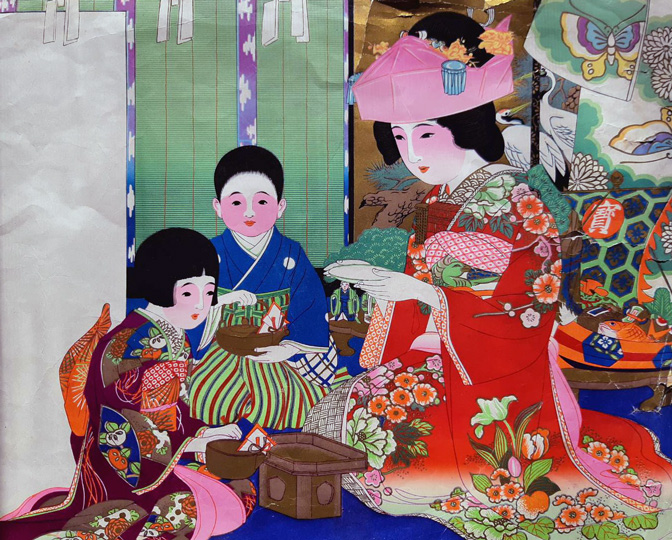
Reluctant to leave us, my sister married into a church household in Okamura, five ri away. Rocking in an ox carriage through the shadow of falling cherry blossoms—it was just like the song.
「十五夜お月様見てたでしょ桜吹雪の花影に花嫁姿の姉様とお別れ惜しんで泣きました」
On the wedding day, the only person laughing tipsily was Father, who could not hold his drink. Once the guests left, the whole household wept. “Every bride cries. Of course she does,” Mother said. “It is as good as parting for life.” My sister’s hand was warm as she said through tearful eyes, “Akino, you must take my place. There is no one else.”
「十五夜お月様一人ぼち桜吹雪の花影に遠いお里のお姉さまわたしは一人になりました」
Later a proposal came for me to become the second wife in a household running a flourishing munitions business in Osaka. “They are very rich,” Father said eagerly. I had obtained a pharmacist’s license and was working at Ishikawa’s pharmacy in Takatori, sending money home, but it was not enough to feed my younger brothers and sisters. I did not mind becoming a second wife if I could send more money home. But my pleasure in dancing sacred kagura at Kashihara Jingu would be over.
With that in mind, I married and went to Osaka—only to discover a baby upstairs. My mother-in-law had thrown the previous wife out, telling her to leave only the baby. From that day I was raising a child. The baby was innocent, I told myself, as I changed nappies and cooked and washed for the employees. I had been deceived into the marriage. Yet the child grew attached to me. That angered my mother-in-law, who said in front of me, “That woman is not your mother.” If she said such a thing, what was I to do? Sister, what should I do? It was a snowy day. I thought of going to Okamura, but soldiers were attacking the prime minister’s residence and other places in Tokyo. It was the February 26 Incident, and we were forbidden to go out.
My husband began spending all his time at a geisha’s house in Shinmachi. His mother bullied and bullied me. Perhaps he disliked seeing it. I too decided to do as I pleased. I could not bear that house any longer, and went home.
At our house in Kume, I stood before the mirror after a bath and noticed that my nipples had turned purple. “It has happened. You have a baby inside you. Go back to Osaka, even if you must force yourself. Will you bear a fatherless child?” Mother drove me out, and I returned to Osaka. “But I want to go to Okamura.” “Why?” “Do you not know? Sister says her breast hurts. It might be breast cancer. I want to examine her.” “No. If you go visiting the sick, they will divorce you,” Mother said.
After the New Year, when the cherry blossoms opened, a boy was born. Holding him beneath the blossoms, I was happy. But that December a great war began in Hawaii. A great victory, they said. Perhaps my husband had a monopoly on manufacturing steel wire for the military; the munitions factory prospered enormously, and he made money upon money. People called him “the general,” and he even went to Gion for pleasure. They said he had fathered a child with a geisha. I had this child. I clasped my son in the detached sitting room. It was a life for just the two of us, my darling boy and me. Yet who knew when I would be told to go home? Sister, help me, help me. I had to go and see her. No—you would abandon the older child, at this time of national emergency? The following spring, when the blossoms opened, a telegram arrived: “Sister in Okamura critically ill.” Soon afterward came another telegram: “Dead.”
I had my child, but the song’s closing words about being left alone expressed exactly how I felt.
Transcribed from an oral account based on a diary.
Original source images
Select an image to open its source. Text within images remains in its original language.
Original wording, author credits, notes and source materials are preserved there.