English translation of the prose
AI-assisted English translation of the prose; quoted poems remain in Japanese. The Japanese original remains authoritative.
AI-assisted English translation. The Japanese original remains authoritative.
Originally published:
This material was published on the Japanese website. Dates and notices in the text reflect the original publication.
Misaki Hakushu Society
On Hakushu's “Jogashima no Ame”
August 2, Reiwa 2 (2020) — Seishu Hamano
1. “Jogashima no Ame” and the Misaki Hakushu Society
Poetry makes friends. Its spirit is passed on and blossoms.
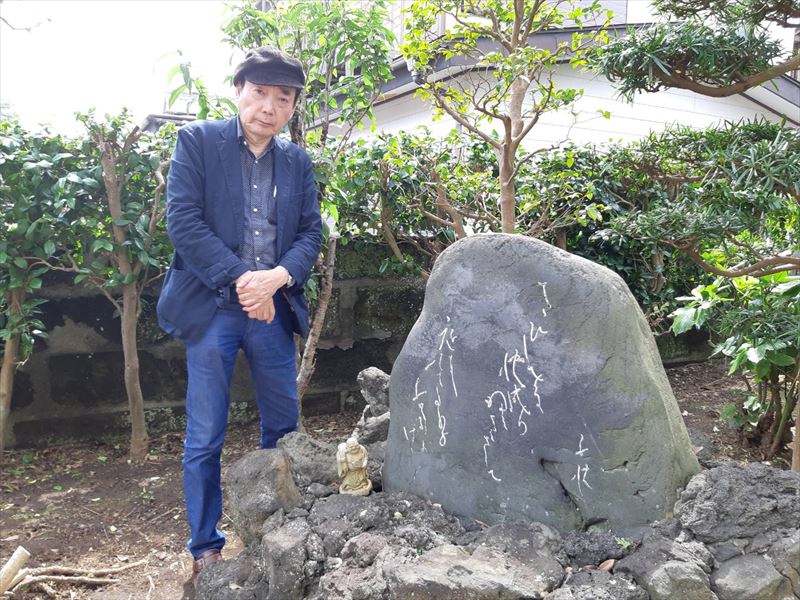
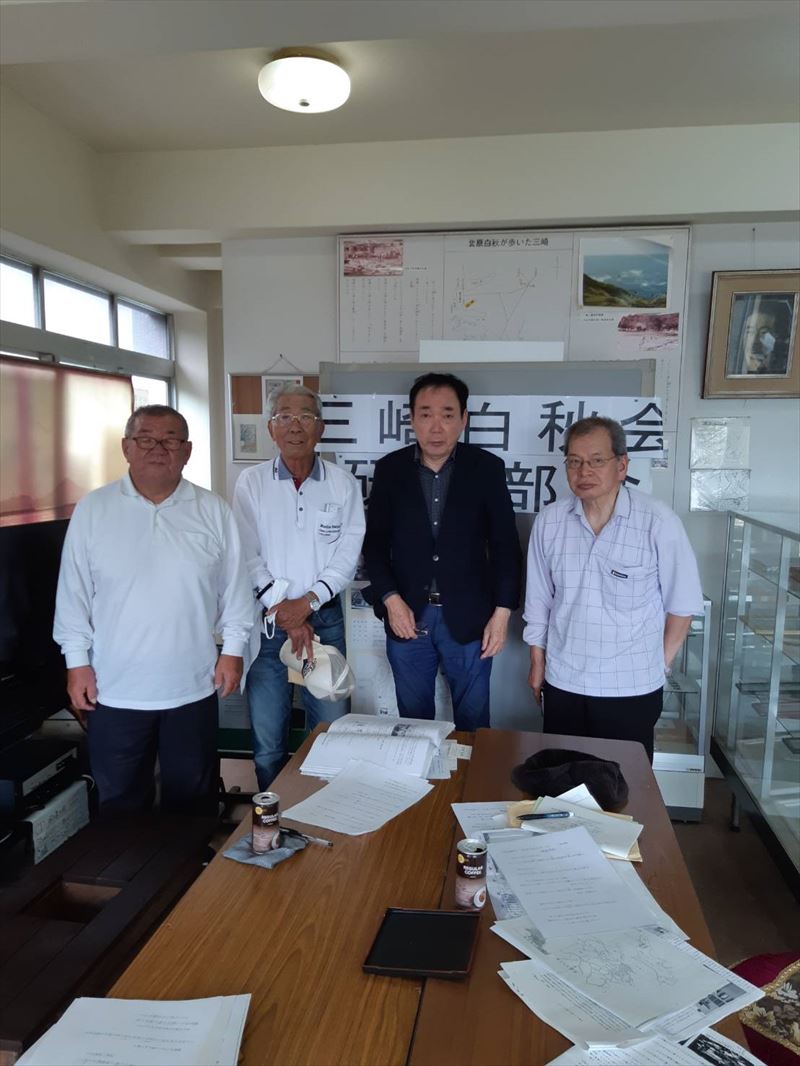
It was in precisely this spirit that I came to meet the people of the Misaki Hakushu Society. They protect Hakushu's poetry monument, carry on his spirit and have even established a study group, to which I was invited.
Perhaps another reason I wanted to go was that “Jogashima no Ame,” the poem Hakushu wrote in melancholy after coming to Misaki at the end of an illicit love affair, recalled my own life without firm support. It first struck deep into my heart when I was still in my twenties. What should I do over the course of my life? To what should I devote this life that comes only once? Unable to discern an answer in those confused days, I kept my doubts deep within and taught part-time at a certain high school. At a banquet there, which ought to have been festive, the principal sang this dark-toned song. Everyone fell silent. He came from Kofu and had the bearing of an old warrior. His everyday counsel sank into my heart, and I could assent to every word; each phrase of this song therefore pierced me until I could hardly bear it.
When that elderly man stood with his chest out like an old warrior and began to sing, his pitch was superb. There was no fear of his forgetting the words. With the look of a man who understood life, he admonished me in my confusion. Hakushu had been in his late twenties when he wrote it, and I was of the same generation. His honest heart and that of the principal before me, whom I deeply loved and respected, resounded quietly in the depths of my own.
Afterward, I heard the song on many occasions, and each time I recalled the principal's voice. I felt ashamed of my immaturity and confusion, pitiful and painfully inadequate. It was around this time that I rediscovered literature and began to engage with it squarely.
Looking back, perhaps Hakushu too could move on to his Odawara period only after facing himself in Misaki and writing poetry. Carrying both his youthful lover and the declining fortunes of his family in Yanagawa, he wandered to Miura: was this a turning point in his life? Standing on the shore at the tip of Miura's fishing harbor and looking offshore, one sees Jogashima veiled in a passing shower. Under low, dark clouds, the downpour smokes deep green.
One can more than imagine such a feeling of being hemmed in on every side in life.
Surely anyone who hears this song, not just I, must remember their own days of uncertainty. Now that the great bridge has been built, the scenery of Misaki and Jogashima may not cloud the heart as it did in Hakushu's time. Yet living in this town and meeting its people, one would discover that one's own heart, too, breathes here in Misaki.
Hakushu did not stay long. He wrote many of his children's songs in Odawara instead. Yet, as the verse says, ながらえばまたこの頃やしのばれむ: it was good for him that his first poetry monument was erected in Misaki. This must have been his second cherished homeland.
2. Though Hakushu Would Pass into Rest
Showa 16 (1941): the year Japan wandered into the Pacific War. The poet's delicate senses apprehended the dark clouds lowering before his eyes. Feeling in his very skin the reckless descent into an abyss, unable to stop it, was his state of mind that of a tiny bamboo-leaf boat adrift on a stream? His sight was impaired and his body heavy. In old age he made his way to this place, the scene of youthful folly. What did he feel? I wrote the following tanka, imagining his helpless sorrow.
この生おぼろ入寂なむひと歳を
超へて伏す身の耐へ難かりき 成秋
Speaking of old age, Mokichi also wrote this love poem:
老びととなりてゆたけき君ゆゑに
われは恋しよはるかなりとも
Hakushu, being a poet too, may have felt something close to Mokichi. What passed through the depths of his heart lies beyond conjecture, but there is no denying that Misaki remained unforgettable to him throughout his life.
Surely that is why the Misaki Hakushu Society and the Miura Tanka Society continue to live and flourish today.
I hurried toward the Hakushu Memorial Museum, murmuring 「帰去来の辞」 and remembering first encountering it as a junior-high-school student in my hometown of Sakai.
山門はわが産土
雲騰がる
南風のまほら…
Near the end of this poem, Hakushu writes:
帰らなむ、いざ鵲
Standing in a foreign place, he turns his thoughts toward distant Yanagawa with the feelings of 陶淵明.
A place of wandering?
The romantic poet 藤村 also spent his wandering days at the place the source calls 台町協会 and at Komoro Gijuku, making each a home for his heart at the time. Hakushu must likewise have loved Misaki deeply and looked back fondly on days that passed like a flash of light.
Let us settle here too and send our thoughts into the past. We should hold firm in our purpose. With that resolve I hurried onward, imagining our Online Manyoshu, now developing and expanding worldwide, blossoming in this town of Misaki.
That was how my connection with the Misaki Hakushu Society began.
The study meeting took place in the Hakushu Memorial Museum on Jogashima, where the surf could be heard. As an expression of President 加藤's warm kindness, I received a splendid melon grown on the president's own farm as a gift to take home.
I spoke at length about the Online Manyoshu: the importance of conveying Japan's spirit of harmony to the West, and the possibility of words being read forever, overcoming the fate of books in which every word eventually decays and lies buried. Human thoughts also vanish from this world with the death of the bodily organism. Yet words written online remain. Available to be read at any moment, they are reanimated and continue to live…
されど書籍も人工品。
オンラインも人工品。
中に想念が言の葉となってたゆたい
人間不可解有機体
がこの人工品に生命を吹き込む。
未来永劫は誰の手に渉る
創る者だけが守り人か?
イニグマは無残な破壊者か?
創るが故に
破壊を歓ぶか?
Thus human beings, fragile things themselves, have built this Online Manyoshu here as creators rather than destroyers, and we have come to publish works from this tanka society founded through its connection with Hakushu.
3. The Life of the Heart, Forever
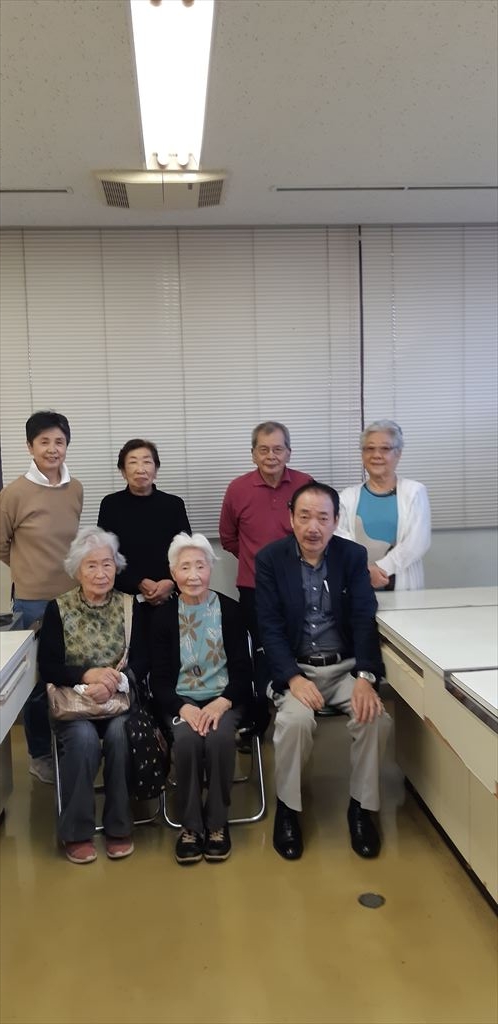
Perhaps it was Hakushu who brought us together: warm exchanges of feeling created a bond with the study group of the Misaki Hakushu Society and the Miura Tanka Society.
三宅尚道 arranged the occasion for this lecture and has also worked for many years to sustain the Miura Tanka Society.
Hearing its history, I understood why it is so carefully carried forward. It has published no fewer than five joint poetry collections.
Volume 1: Showa 23 (1948); Volume 2: Showa 24 (1949); Volume 3: Showa 27 (1952); Volume 4, 『群礁』: Showa 50 (1975); Volume 5: Heisei 26 (2014).
The earliest members have all passed away.
The society has rules, including this undertaking:
“Regardless of affiliation with any poetry association, and without appointing a particular instructor, this society keeps the works themselves at its center. Through criticism and appreciation, without falling into self-righteousness, we continue to study tanka composition and cultivate friendship.”
Let me introduce poems by earlier members. The commentary is by 長崎三郎.
外灯をめぐりて翔べる夜の蟲
灯を消さばいずこにのがれん 飯島誠司
A poem from the very last years of the author's life, reflecting on insects flying around an outdoor light. If the light is understood as life, where will I go when the body's life is gone? 長崎 reads it as a poem that leads from a visible particular to an invisible, universal world. I also heard that 飯島 came from a family that had run a medical practice in Misaki for generations.
Doctors constantly face death. Perhaps they cannot remain indifferent to the lives of moths gathering around a streetlight, living and dying without conscious thought.
I have lived with literature as my sustenance, and from early childhood I felt affection for earthworms and tiny creatures lying by the roadside, all dried up and dead.
Adults say “die like a worm” or “a dog's death.” Even as a child, I resisted: do not inflict such coarse expressions on insects or dogs. My body was weaker even than the earthworm's, and I too would soon dry up and die like this. From childhood I deeply pondered life's transience.
Rereading this poem through those eyes, I am overcome by weariness throughout my body.
I was intensely troubled by where my soul would go after my body withered away. As a child I told myself I need not understand; it was still far off. As an adult I deceived myself: a little farther off, a little farther off.
Only recently have I seriously begun to think that a moth gathering at a moth-attracting lamp is what I will become in my next life.
My life is almost over; next I will probably appear as a moth. Alongside others who have met that fate, in desperation I will race into the fire, seize a license for rebirth and rush into the next, slightly better life. Once you have tried being human, that life seems rather good. I want to be born human again after all. No moths for me, God, I say. Moths—all moths—must hope to become human too. But it cannot be so easy: become a fish and be eaten by a whale, or an earthworm and be used as fish bait. No, wait… Are human beings such superior creatures in the first place? That is questionable. Humans may simply be one form of vermin. This fundamental question too remains unanswered. Still without an answer, and moving toward death every moment, I waste time diligently composing tanka…
The next work:
石油危機きびしき日々に獣糞を
焚く草原の生活を憶ふ 水谷壽子
The author was in Manchuria, China, during the war. After repatriation from Manchuria, postwar life began, and then came the oil crisis. Life dependent on petroleum is convenient, but convenience is tied to inconvenience, and she recalls her earlier life in Manchuria.
The preceding comment is 長崎's.
Manchuria reminds me how popular haiku and tanka were there during the war. A nationwide poetry collection, comparable to today's Online Manyoshu, received masses of submissions from Manchuria. This continued until just before the tragedy of repatriation, only to be torn apart by war. Peace is precious. Precisely because it is precious, we must not become complacent about it.
ふるさとに汀つながる海の声
やさしく今日の目ざめを誘ふ 松本文男
松本文男 evacuated to Miura after the Great East Japan Earthquake. He had composed tanka since youth and had a long history as a poet. He wrote many poems about the disaster, but this was the last draft he submitted to the tanka society. Even after experiencing the great tsunami, he sang of the sea at the end, and we find consolation in that. — 長崎三郎
The words ふるさとに汀つながる recall a scene to me. About twenty years ago, on Kauai, one of the Hawaiian Islands, I was staying at a temple while researching the history of Japanese immigration. I was introduced to a second-generation Japanese American who said he had come to Japan after the war. A veteran of the celebrated Nisei unit, he was nearly eighty but still as energetic as a young man. Hearing about my research, he said he would show me the first-generation immigrants' graves and set off in his jeep. Racing furiously through the red earth of the sugarcane fields, raising scarlet clouds of dust, he seemed to be back in wartime. And what was blasting from the car radio but 坂本冬美's 「火の国の女」! Its menacing, underworld-inflected manner suited the immediate atmosphere perfectly. At last the view opened ahead. Then came a thunderous roar: the vast sea, its waves surging back upon themselves. It was the title background of a Toei film!
“Why do you think the gravestones stand on this sheer cliff, facing the open sea?” asked the former Nisei soldier. “W-well… I see. Beyond these raging waves…”
“Exactly. There is Japan. Their homeland is there. When they die, they all want to go home by way of the sea!”
I cannot forget the roar of the sea that day.
They were no great poets or anything of the kind: people who crossed to Hawaii in the early Meiji years and died in that foreign land while it was still Meiji; others who died early in Taisho, others in Showa… Reading the gravestones one after another, I looked out at the rough sea twice, three times, four times.
No one came to visit the graves anymore. Each stone rose solemnly.
This is death. I too will soon be like this.
Even on a foreign shore after the Great East Japan Earthquake, one's thoughts turn only to home.
As Hakushu says, 汀づたいに帰りなむ、いざ鵲.
Misaki Hakushu Society, Miura Tanka Society—may you endure forever.
The poems left behind are weighty: truly weighty and deep. (End of Part 1.)
Scope: all prose and photo captions are translated. Tanka, poetry quotations and the lineated meditation beginning 「されど書籍も人工品」 remain Japanese. The source spelling 台町協会 is retained without silently changing the named institution. Dates, organizational descriptions and the narrative “today” belong to the original material.
Original source images
Select an image to open its source. Text within images remains in its original language.
Original wording, author credits, notes and source materials are preserved there.