English translation
AI-assisted English translation. The Japanese original remains authoritative.
Originally published: 11 February 2021.
A historical report from the Japanese website. Dates, roles, and descriptions refer to the time of publication.
河内裕二, Acting Vice President, Japan Romanticism Society
10 February 2021
The Japan Romanticism Society works to convey to the world and to future generations the Japanese spirit cherished by our predecessors. President Seishu Hamano has maintained a close friendship with the Izumi school’s head family for thirty years. I accompanied him to their recent kyogen performance at Kanda Myojin. Kyogen is a classical performing art with a history of some six hundred years. What does it mean to preserve and pass on a tradition? We attended as part of the activities of the Online Man’yoshu. The following are my reflections.
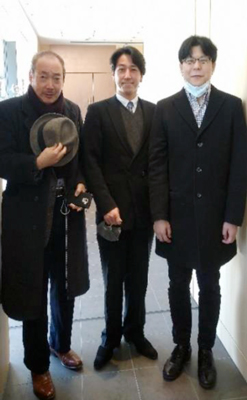
Photograph before the performance with the twentieth head: from left, President Seishu Hamano; Motoya Izumi, twentieth head of the Izumi school; and Acting Vice President 河内裕二.
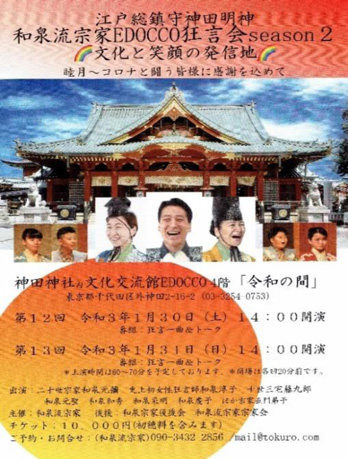
At 14:00 on 31 January 2021, the Izumi Head Family EDOCCO Kyogen Performance took place in Reiwa no Ma, on the fourth floor of the EDOCCO cultural exchange center within Kanda Myojin, Sotokanda, Chiyoda-ku, Tokyo. This was the thirteenth performance in a series begun the previous July.
Founded in 730, Kanda Myojin is one of Tokyo’s oldest shrines. Since the Edo period it has protected the people of Edo as the city’s principal tutelary shrine. On the performance day, too, a long line of worshippers stood before the shrine building.
The subtitle was “Mutsuki: with gratitude to everyone fighting COVID-19,” and the program included the new kyogen short dance Amabie. Performing kyogen, originally a sacred observance, in this place expressed the head family’s and organizers’ fervent hope for an early end to the pandemic. A state of emergency had been declared again just after the New Year. Amid the oppressive mood spreading through society, I was moved by their generosity in seeking to brighten people’s hearts through kyogen’s laughter. Above all, I admired the whole family’s united determination to overcome every obstacle and preserve the tradition. I was especially touched that all the sons and daughters were following the path of kyogen and growing into such strong performers. Their dignified singing and dancing conveyed neither compromise nor hesitation. An art can only be learned through the body. The resolve and daily effort required to inherit an intangible art such as kyogen must be immense.
Performance poster.
Performing arts cannot exist without the living space of a theater. Kyogen in particular uses minimal staging, requiring spectators to build the stage world through imagination. The forms demonstrated by the performers carry six hundred years of history, whose weight the audience receives solemnly. A taut atmosphere fills the space; laughter relaxes it in an instant. Such an atmosphere is felt on the skin and can only be experienced at a live performance. With restrictions on going out and the spread of telework, we now have fewer direct meetings with others and fewer opportunities to feel bodily the energy and atmosphere generated by people and places. This was a precious and deeply enriching time.
After the performance we moved elsewhere to talk with the head family, President Hamano, and myself. Setsuko Izumi, chair of the Soke-kai, spoke about many subjects, from the family’s history to her views of life, death, and religion. Always cheerful and energetic, she told us that this year marked fifty-four years since her marriage into the family. She has overcome many hardships, forged powerful family bonds, and brought the head family to where it stands today. How difficult it is to pass on a tradition. Encountering her character left me feeling warm at heart.
A talk about kyogen
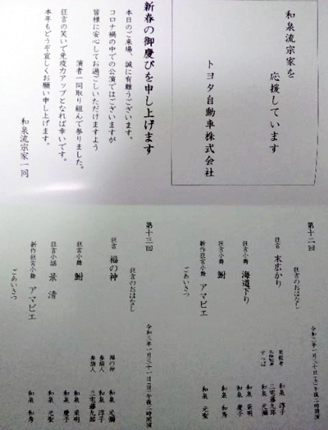
Performance program.
In her talk, Tokuro Miyake X explained the characteristics of kyogen, with its roughly six-hundred-year tradition, and the pieces on this program. I was particularly struck by what she said about the pine tree. The pine on the stage is modeled on the yogo no matsu, the pine at which a deity appears. Since kyogen was offered facing that pine, performers still act with the belief that a deity is present onstage. I have seen Izumi-school kyogen many times and have never sensed even a tiny lapse in the acting, let alone a mistake. Even while playing comic characters, the performers maintain a tension that must derive from the spirit inherited from its sacred origins. Kyogen conveys to its audience the hearts of Japanese people who have lived with the gods.
Kyogen: Fuku no Kami (The God of Good Fortune)
The god was played by Motoya Izumi, twentieth head of the school; the worshippers by Junko Izumi and Tokuro Miyake, the first women kyogen performers in history. The setting is Izumo Taisha.
The god of good fortune appears before two men who visit Izumo Taisha at each year’s end, scattering beans to see in the New Year. When they pray for wealth and prosperity, he tells them that wealth requires capital. They retort that they have come precisely because they have none. He explains that capital does not mean gold, silver, rice, or money: it means observing the five constant virtues, respecting the gods, being compassionate, and remaining honest. Talking has made him thirsty, he says. He asks the worshippers for sacred sake, offers it to Japan’s deities great and small and to Matsunoo’s great deity of sake, and drinks it himself. If they want prosperity, they should rise early, show compassion, and maintain good relations with their spouses and other people. Moreover, if they offer plenty of sake to a god of good fortune like himself, enjoyment is assured. Laughing, the god departs.
As the saying goes, good fortune comes to a laughing household. The god enters laughing and leaves laughing. Motoya’s bright laughter still rings in my ears.
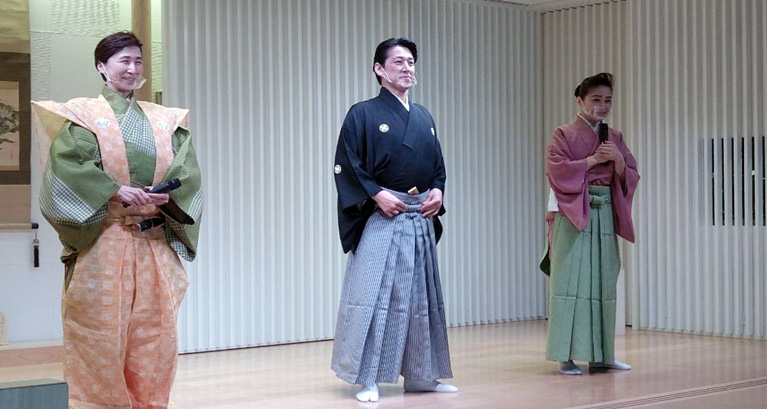
The three performers in Fuku no Kami: from left, Tokuro Miyake X, Motoya Izumi, twentieth head, and Junko Izumi, one of the first women kyogen performers.
Kyogen short dance: Funa (Crucian Carp)
和泉采明 and 和泉慶子 danced together, with Motoya Izumi providing the accompanying chant.
Kyogen short dances form the basis of its movement. In Funa, a crucian carp, a water deity of Lake Biwa, appears before a boat carrying a party of itinerant holy men collecting donations and dances.
As Tokuro Miyake explained in her talk, short dances do not involve acting a role, so performers do not wear character costumes. Since this was a special New Year gathering, they danced in formal crested kimono and kamishimo.
Their movements were beautiful and full of vitality. The young pair’s perfectly coordinated dance brought before my eyes the sight of crucian carp leaping.
Kyogen short song: Kagekiyo
The singers were 和泉元聖 and Motoya Izumi.
Kyogen short songs form the basis of vocal production for its dialogue. Kagekiyo is an episode from The Tale of the Heike, chosen for its connection with Kanda Myojin, revered by the warriors of the eastern provinces.
Even for father and son, could the coordination be so perfect? Their singing together was splendid.
New kyogen short dance: Amabie
和泉和秀 danced, accompanied by Junko Izumi’s chant.
This short dance was created to pray for an end to COVID-19 and the dispersal of epidemic disease.
Through this dance I learned that Amabie was said to have appeared in the sea off Higo Province. With his impressive physique, 和秀 delivered a dynamic dance and forceful lines that surely ought to drive the coronavirus away. He inspired confidence. I later learned that he was only twelve years old. I was astonished.
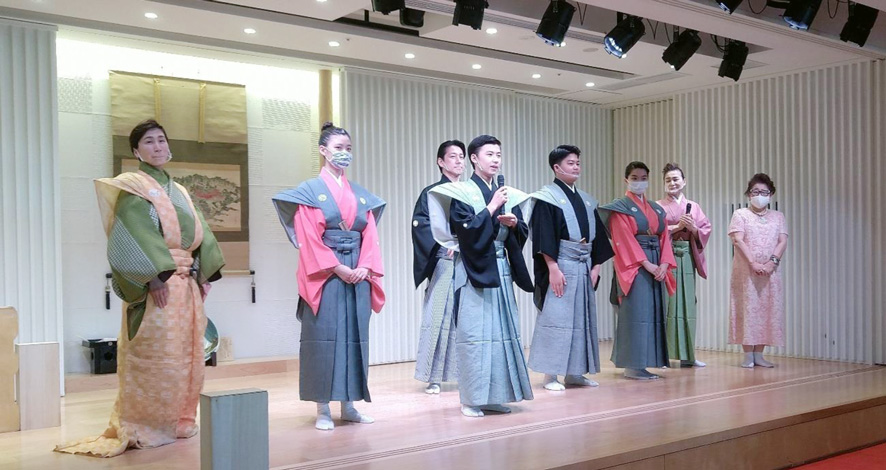
The Izumi head family. 和泉元聖 gives the greeting in the center. From left: Tokuro Miyake X, 和泉采明, Motoya Izumi, twentieth head, 和泉和秀, 和泉慶子, Junko Izumi, one of the first women kyogen performers, and Setsuko Izumi, chair of the head family’s Soke-kai.
Original source images
Select an image to open its source. Text within images remains in its original language.



Original wording, author credits, notes and source materials are preserved there.