English translation of the prose
AI-assisted English translation of the prose; quoted poems remain in Japanese. The Japanese original remains authoritative.
Japan Romanticism Poetry Circle — Spring, March
Recorded March 27, 2021
Record and commentary: 河内裕二, Japan Romanticism Academia
Every year, the Japan Meteorological Agency announces the opening of Tokyo's cherry blossoms. This year it was March 14, the same as last year and, for the second consecutive year, the earliest date on record. Cherries reach full bloom about a week to ten days after opening. On March 27, when the meeting took place, the flowers were in their glory; on some trees they had begun to fall a little, their petals dancing modestly. It was an ideal day for admiring them—an unexpected benefit of global warming, perhaps. The meeting began at 11 a.m. at the Deguchisō guesthouse in Misaki, Miura, with a cherry-blossom banquet in the second part. From the Miura Tanka Society came its president, 三宅尚道, and the three members 嘉山光枝, 嶋田弘子, and 玉榮良江. From Japan Romanticism Academia came President Seishu Hamano and 河内裕二. The two Miura Tanka Society members 加藤由良子 and 清水和子 also sent poems.
コロナ禍で自粛の日々も桜咲き
鶯鳴きて暫しの癒し 光枝
The author, 嘉山光枝, lives in a place rich in nature. At this season, she says, when she looks at the cherry blossoms near her home she hears bush warblers singing. Even when the pandemic has transformed our lives into ones requiring restraint, nature's activities continue as always. Spring comes, trees bud, birds sing. Let us find healing and peace in the beauty of nature close at hand. This is probably her message to a society made somewhat constricted and unsettled by the pandemic.
Among birds, it is surely the bush warbler whose voice is most beautiful and memorable. In appearance, the Japanese white-eye is actually closer to the color called “warbler green”; the warbler is more brownish than green. Everyone agreed: for looking at, the white-eye; for listening to, the warbler. When white-eyes came up, President Hamano told us of a custom called “catching white-eyes” that he had heard about in Ōme, Tokyo. Someone would enter another person's garden saying, “Please let me catch white-eyes.” The woman of the house would invite them onto the veranda and serve tea. After a while, a daughter of marriageable age would appear and greet them. In fact, this was an inquiry concerning marriage. The visitor adopted the guise of catching white-eyes, and the household understood and responded accordingly. It was a custom particular to Ōme, famous for its plum blossom.
There is something endearing about plum blossom. The white-eye certainly suits it. What bird suits cherry blossom? If we speak of cherries and bush warblers, how about these poems?
世の中に絶えて桜のなかりせば
春の心はのどけからまし 在原業平
Ryōkan made an allusive variation on Narihira's famous cherry-blossom poem.
鶯のたえてこの世になかりせば
春の心はいかにかあらまし 良寛
Next comes another poem on cherry blossom.
潮風とお湯の温度が絶妙と
露天に入る桜と共に 由良子
The author is 加藤由良子, absent today. Cherry petals float in an outdoor bath overlooking the sea, and the sea breeze makes the temperature perfect. Told that much, anyone would want to go at once. In the comment she sent, she explained: “I won a ticket through a newspaper offer, went to a hot-spring hotel in Aburatsubo, enjoyed the outdoor bath, and wrote this poem. It was spring in name only: cold outside and the water hot. A large cherry tree in front of me had begun shedding its blossoms. Bathing outdoors with the sea ahead was wonderful.” Everyone present envied her and wished her continued good health.
あの人もこの人も「いい人ね」って
思える今日の元気な証拠 弘子
The author, 嶋田弘子, said that she had recently come to feel that tanka need not always be classical. Inspired by the freedom of Machi Tawara and younger poets, she too composed without being bound by the five-seven-five-seven-seven form. Experience had taught her that when she cannot think well of others, she herself is not in very good condition. She made that personal barometer into a poem. It is difficult for anyone to know themselves; one's feelings toward others reveal one's own state. Certainly, without room in our own hearts, we cannot be kind to other people.
President Hamano told us that 上田三四二's discussion of tanka, Tanka Isshō, includes an essay entitled “The Color of the Heart.” 上田 says that the phrase he learned from the Noh play Yuya, 「思ひうちにあれば、色ほかにあらわる」, applies exactly to tanka. The technique of tanka is nothing other than finding how to give outward form to inward feelings; a work's stature corresponds to the breath of the author's way of living at that time. In other words, the color of the heart appears in a poem. Could there be a clearer theory of tanka? It also connects with Ki no Tsurayuki's words in the Japanese preface to the Kokin Wakashū: “Japanese poetry takes the human heart as its seed and grows into countless leaves of words.”
嶋田's poem is wonderful in the directness with which the color of her heart emerges.
春は惜し薨る師の影時移り
桜吹雪の日和も疎まし 成秋
President Hamano composed this after losing two beloved teachers and an elementary-school classmate this spring. Spring brings Saigyō's poem to his mind, he said. Saigyō says that if he must die, he wishes to do so beneath the blossoms; yet, spring or not, it is unbearable to lose so many important people at once. He said quietly that cherry petals are not the only things spring makes fall.
願はくは花の下にて春死なむ
そのきさらぎの望月のころ 西行
The happy days remembered with his teachers have passed, and the day has come when he must join his hands before their departing forms—in spring, moreover. When so many people are dying, he cannot look at the cherry blossom and think what fine weather it is. President Hamano said that coming to this gathering today had finally let him emerge from those dark feelings, appreciate the blossom, and feel glad that spring had arrived.
I had never seen the character 薨 before. 身罷る is the usual written form of mimakaru, to die; I had not known that a character combining part of 夢 with 死 could be read the same way. Looking it up, I found the word 薨去, used when members of the imperial family and others die. Not 身罷る but 薨る: a single character expresses how deeply President Hamano revered his teachers. Japanese has great depth.
雨は降る舟よ動けと念じても
舟は繋がれ 白秋を恋う 和子
A work by 清水和子, who again could not attend because permission to go out was not granted. Perhaps she likens herself, unable to leave during the pandemic, to the boat. According to 嘉山, the home where she lives stands directly before Moroiso Bay, so she may have composed while looking at its boats. I wondered what connection the final phrase about longing for Hakushū might have. 三宅 suggested that it referred to Jōgashima no Ame, with lyrics by Hakushū containing phrases such as 「雨はふるふる」 and 「舟はゆくゆく」, and that she had thought of him through that song.
On looking it up, I found that Jōgashima no Ame is a boat song made from a poem Hakushū wrote while living in Misaki in 1913, set to music by 梁田貞, who also composed such songs as Donguri Korokoro. I think the poem expresses Hakushū's difficult state of mind at the time. Perhaps making it a boat song expressed a wish to embark anew himself. Today, at the foot of Jōgashima Bridge, there is a monument bearing the poem in Hakushū's own handwriting.
病む友の恢復願ひ宮参り
梅の匂ひのけふは柔らか 裕二
Hearing that an acquaintance was ill and receiving treatment, I visited a shrine, wishing for the earliest possible full recovery and return to ordinary life. This is the poem I wrote then. 快復 is used for recovery from illness, but my acquaintance is an active person who was always busy. Wishing not only for the illness to improve but also for that active life to return, I chose 恢復 instead.
Everyone said the soft impression of the latter part conveyed my feelings for my friend. Chrysanthemums have kaori, but plums do not: choosing nioi rather than kaori for their scent is good, President Hamano said. He added that the poem even has elegance.
枇杷の花、梅の花へとくる野鳥
しばらく群れて直ぐに飛び立つ 良江
Miura has many wild birds. The author, 玉榮良江, said that the behavior of kites had impressed her recently. On a mountain near her home stood a large tree in which kites had nested. When it was being felled, a kite flew toward the workers, as though protesting. Small kites were also flying around the mountain, so perhaps they had been born and fledged in that tree. I did not ask why it was cut down, but where did the kites go after losing their nest?
The part about flocking briefly and immediately flying off is exactly right: birds are present only for a moment, then quickly disappear. Haiku is often called sketching from life, but carefully observing nature and things is surely the basis of tanka too, said 三宅. Speaking of such poems brings a famous one by Masaoka Shiki to mind.
瓶にさす藤の花ぶさみじかれば
たゝみの上にとゞかざりけり 子規
It appears to be casual, objective description. Yet anyone who knows that Shiki was bedridden in his later years will consider where he is looking at the flowers from, and can even see the author himself, though he is not depicted in the poem. The description also begins to feel somehow like the voice of his heart. A fine poem sketched from life tells us much.
五十円大根二本求めると
傷ある大根一本おまけ 尚道
What an individual poem. It uses many numbers—fifty yen, two, one—and the only object to appear is the daikon. Ordinarily, this would be mere explanation; it is strange that it becomes a poem.
This is by 三宅尚道, who said that he had written about “fifty-yen daikon” before. Vegetables have yielded a good harvest this year, but COVID has reduced demand, leaving farmers unable to sell them. Better to sell them for fifty yen than throw them away. Misshapen or damaged ones cannot be shipped, so they are added as extras. Since this is Miura, perhaps they are Miura daikon. The supermarkets in Tokyo where I live have only green-neck daikon; I never see the Miura variety. Everyone told me how delicious it is simmered.
My thought that a large, delicious daikon for fifty yen was a tremendous bargain probably proves that I am an outsider here. Low prices are welcome to anyone, but seeing a daikon that is a source of local pride sold off cheaply brings sadness and pain. Questions and quiet anger arise toward the society that makes this happen. All the more when it is stated dispassionately, like supermarket advertising copy. The author has calculated that far.
After the fulfilling meeting, we moved to another room and began our spring banquet, enjoying the locally renowned food of Deguchisō. This was my third visit; the others seem to come often. Miura is blessed with the produce of both sea and hills, and every dish making use of local ingredients was superb. Alongside seafood—sashimi including Misaki tuna, simmered splendid alfonsino, and turban shells grilled in their shells—came dishes from the land: dressed vegetables, simmered beans, tempura, and savory steamed egg custard. There were many dishes as well as delicious ones. The mixed tempura included butterbur. It was my first time eating it as tempura; it had a satisfying texture and was very tasty. Perhaps the crunchy daikon pickles were made from Miura daikon. For dessert, we had homemade tokoroten jelly from seaweed gathered in Moroiso Bay right before us, finishing the meal thoroughly satisfied.
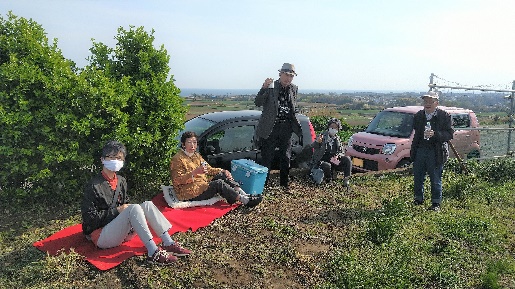
We all then headed for the Thirteen Mounds, which 嶋田 had told us about at the previous meeting. After driving uphill for a while, we reached her vegetable garden atop a hill with views in every direction. The scenery was simply wonderful. Standing there and looking at the sky, I could indeed understand the feelings that had prompted her poem.
三宅 had researched the Thirteen Mounds and gave us material. Miura no Sanpomichi, published by the Miura Guide Association, contains a reference to them by 田中健介. According to him, the Shinpen Sagami no Kuni Fudoki Kō (1841) describes the mounds as “standing side by side to the east of the village, about six shaku high.” He writes that, guided by a local historian, he was able to locate only one.
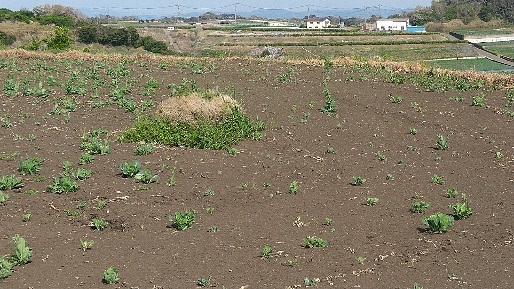
嶋田 had already spoken with the owner of the land and knew a good deal about the mounds. With her guidance we visited three places. At one, unfortunately, we could only hear that a mound had once existed; no trace remained. At the other two, small mounds less than a meter high could be identified, and one had a wooden memorial tablet standing on it. Six shaku in the Shinpen Sagami no Kuni Fudoki Kō is about 180 centimeters, so presumably these were not the mound it described.
The Thirteen Mounds are said to be the burial mounds of thirteen retainers of Miura Dōsun. About five hundred years have passed since their deaths, and only a few faint remnants now survive. Were the retainers actually buried in the mounds? Where are the others? Facts would matter to a historian. Coming here, however, I felt that remembering those who came before us might matter more than facts. Thinking that they too had seen the same sky, 嶋田 wrote 「時の動きを中宙に視ゆ」. 上田三四二 says that the color of the heart appears in a poem: feelings for people become poetry. President Hamano thought of his teachers, I of my sick friend, and 清水 of Hakushū. If we extend the idea to all living beings, including plants, every poem submitted today expressed feelings for them. These thoughts came to me at our nonalcoholic “drinking party” beneath the clear sky, looking out over the landscape and the flowers in the field. It was a fine day that cleansed the heart.
Photograph Captions
At 嶋田's vegetable garden. From left: 嶋田弘子, 嘉山光枝, President Seishu Hamano, 玉榮良江, 三宅尚道.
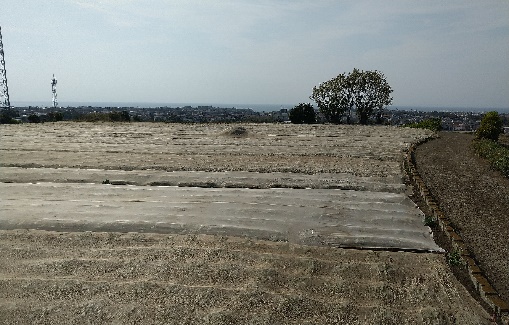
Another mound. It is difficult to see under the grass, but a wooden memorial tablet stands there too.
One of the Thirteen Mounds. The raised area in the middle of the field is the mound.
Original source images
Select an image to open its source. Text within images remains in its original language.
Original wording, author credits, notes and source materials are preserved there.