English translation of the prose
AI-assisted English translation of the prose; quoted poems remain in Japanese. The Japanese original remains authoritative.
Originally published: 25 May 2023.
Japan Romanticism Society: the 25th “Romantic Journey through Poetry”
A historical exploration: in search of the origins of the Izumo Amago clan
福田京一, Japan Romanticism Society
Translation follows the original’s historical narrative and conjectures. Dates, names, and apparent inconsistencies are retained as printed; this is not a corrected historical edition. Quoted poems remain in Japanese.
近江の海夕波千鳥汝が鳴けば
心もしのに古思ほゆ 柿本人丸
さざなみや志賀の都は荒れにしお
昔ながらの山桜かな 平忠度
定めなき世をうき鳥の水隠れて
下やすからぬ思ひなりけり 道誉法師
At Gassan Toda Castle
If, on 28 June 1578, Nobunaga had ordered Hashiba Hideyoshi not to abandon the Amago army besieged in Kozuki Castle in Harima, but to continue fighting the Mori together, the Amago might have revived under Nobunaga’s protection. Instead, after Hideyoshi withdrew, the isolated castle surrendered to the Mori. When Katsuhisa, the Amago’s last commander, took his own life with his elder brother Ujihisa, everything ended.
Looking at the monument to Yamanaka Yukimori on Gassan’s summit, one sees the ironic fate of a Sengoku warrior in the ending of the Amago family, which disappeared from the historical stage late in that era. For a time, the Amago were great lords in the Chugoku region, surpassing the Ouchi and Mori, the military-governor houses. Their roughly 150-year history closed with Yukimori’s violent death, as though following his lord.
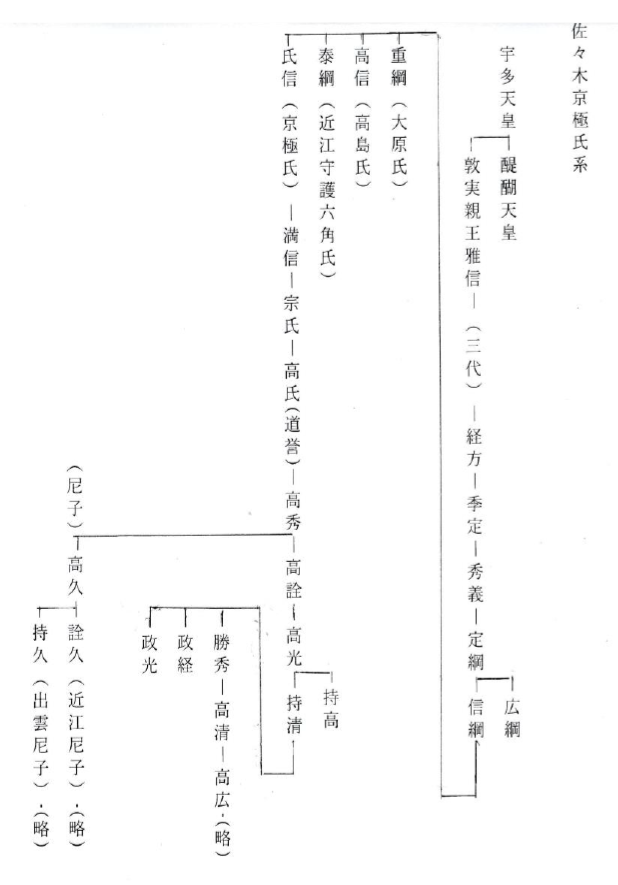
The Amago, the main house of Yukimori’s own family, had come long before from Omi. Yet investigation shows that, although many historical facts about the Izumo Amago have been established, far too much remains unknown about the Amago in their place of origin, Omi. Adjacent to Kyoto, Omi saw ceaseless conflict from antiquity to the early modern period among the court, aristocrats, powerful local families, temples and shrines, warrior bands, and shogunates. Perhaps records concerning the Amago were destroyed in warfare from around the Onin War through the Sengoku period. Setting that aside, I traced their Omi origins as far as possible, including visits to the area. First, a genealogy for reference.
View the original Sasaki–Kyogoku genealogy. Names remain in Japanese in this diagram. Its labels identify Emperor Uda (宇多天皇), Emperor Daigo (醍醐天皇), Prince Atsumi (敦実親王), the Ohara (大原), Takashima (高島), Rokkaku (六角, military governors of Omi), and Kyogoku (京極) branches, and the Omi Amago (近江尼子) and Izumo Amago (出雲尼子). 三代 indicates three generations; 略 indicates omitted descendants.
The origin of the name Amago
Prince Oama, younger brother of the 38th emperor, Tenji (reigned 668–671), who moved the capital to Omi Otsu Palace in 667, ascended in 673 as the 40th emperor, Tenmu (reigned 673–686). Until he moved the capital to Asuka Kiyomihara Palace in 672, Omi was the political center.
Tenmu made Tenji’s daughter Princess Unonosarara, later Empress Jito, his empress. He had already fathered Prince Otsu with her elder sister, Princess Ota. He also took Nakatomi no Kamatari’s daughter, Hikami no Iratsume, as a consort, and had Princess Tochi with Princess Nukata. There was also Amago no Iratsume, from whom Amago village took its name.
She was a daughter of Munakata no Tokuyen, a powerful figure in Munakata district, Tsukushi. Called Amago no Iratsume, she became an imperial hin—a rank below the higher consorts, serving in the bedchamber—and mother of Prince Takechi. Today’s Amago in Kora, Inukami district, acquired its name because she moved to that area.
From the Uda Genji to the Sasaki
Masanobu, third son of Prince Atsumi, the eighth son of Emperor Uda, the 59th emperor (reigned 887–897), received the surname Minamoto when reduced to subject status in 936 and became founder of the Uda Genji. His grandson Nariyori became a deputy military governor and went to Omi. In the time of Nariyori’s grandson Tsunekata, the family became lower estate stewards of Sasaki estate in Gamo district, lived in Kowaki, and adopted the surname Sasaki.
Sasaki Shrine in Azuchi, the clan’s tutelary shrine, enshrines Prince Atsumi. When Minamoto no Tsunekata entered Sasaki estate, a powerful family called Sasakiyama had long been established in Gamo, making expansion extremely difficult. Gradually, however, the Sasaki deepened relations with them, intermarried, and absorbed them.
Tsunekata’s grandson Hideyoshi sided with Minamoto no Yoshitomo in the Heiji rebellion. After Yoshitomo’s defeat and the Taira’s rise, he was pursued and fled as far as Shibuya estate in Sagami. When Minamoto no Yoritomo raised troops in 1180, Hideyoshi hurried to him with four sons and distinguished himself in the Genpei War. When the Kamakura shogunate began, members of the Sasaki family—the four brothers Sadatsuna, Tsunekata, Moritsuna, and Takatsuna, as listed in the source—received military-governor posts. Their provinces extended from Omi to Nagato, Iwami, Oki, Awaji, Awa, Tosa, Kozuke (Gunma), Echigo, Iyo, Bizen, Aki, Suo, Inaba, Hoki, Izumo, and Hyuga.
In the Jokyu War of 1221, however, many Sasaki sided with Retired Emperor Gotoba, were defeated, and lost most governorships. Sadatsuna’s heir Nobutsuna, married to Hojo Yasutoki’s younger sister, supported the shogunate and was subsequently favored, receiving the Omi governorship. The Sasaki again became close to the Kamakura government while maintaining court connections as shogunal retainers resident in Kyoto. For a shogunate wishing to preserve good relations with the court, their connections were valuable.
The rise and decline of the Sasaki Rokkaku
Nobutsuna had four sons: Shigetsuna, Takanobu, Yasutsuna, and Ujinobu, founders respectively of the Ohara, Takashima, Rokkaku, and Kyogoku houses. Third son Yasutsuna inherited the Sasaki headship as Sasaki Rokkaku and became military governor of Omi. Though third-born, he alone was a son of the principal wife from the Hojo family. Cadet houses developed independent branches, and from the mid-Kamakura period Sasaki lines became rooted throughout Omi.
The Sasaki Rokkaku continuously inherited the Omi governorship except during the tenures of two Kyogoku men, Takauji and Mochikiyo. Omi was governed in an irregular fashion: the Rokkaku served as governors in southern Omi, centered on Gamo, while the Kyogoku, without being governors, exercised gubernatorial functions in the north.
Rokkaku Yasutsuna could not unite all the Sasaki as their central pillar, but established a major power in Omi, almost an independent state. Through the Northern and Southern Courts period, the family navigated complicated relations with the court and Ashikaga government, internal conflicts, and opposition to the Kyogoku before entering the Sengoku age. Faced with Oda Nobunaga’s advance in 1568, father and son Rokkaku Yoshikata and Yoshiharu abandoned their seat, Kannonji Castle, without fighting and moved to Ishibe Castle in Koka. They continued resisting there, but Oda forces under Shibata Katsuie captured it in 1574 and the family fled. After various reversals, their descendants became Kaga-domain retainers in the Edo period and continued into Meiji.
The Sasaki Kyogoku line
What happened to the Kyogoku? Nobutsuna’s fourth son Ujinobu received land from his father in Kashiwabara estate, around present-day Kashiwabara in Maibara, and established his base there as founder of the Kyogoku. His great-grandson Sasaki (Kyogoku) Takauji, also called Doyo (1303–1373), later known as a basara lord for his flamboyance, served the Rokuhara Tandai as a Kyoto-based shogunal retainer while also holding the court office of kebiishi, a policing post. He guarded Emperor Godaigo during imperial journeys and was also responsible for guarding the retired emperor on the journey to Oki in 1332, described in the source as after the Jokyu War. Takauji loyally fought for Ashikaga Takauji and made a major contribution to establishing the shogunate. In the Muromachi period, the Kyogoku alternated with the Akamatsu, Yamana, and Isshiki as heads of the Samurai-dokoro, the military office. They also became governors of Izumo, Oki, and Hida, and of the northern Omi districts of Azai, Ika, and Sakata. They thus wielded power exceeding that of the main Rokkaku house, Omi’s governors. It is said that the Muromachi government favored the Kyogoku to restrain Rokkaku power in Omi.
After Doyo’s time, Mochikiyo regained the Omi governorship in 1449, but continuing succession disputes gradually weakened Kyogoku prestige. After his death in 1470, Masatsune contested succession with his elder brother Masamitsu and nephew Takakiyo in the Kyogoku disturbances. Masatsune inherited, but fighting continued until 1505, when he and his son Kimune were defeated by Takakiyo’s forces, supported by the Toki governors of Mino and others. Masatsune then took refuge with Amago Kiyosada in Izumo and is said to have died there in 1508 (?).
As head of the Kyogoku, Takakiyo moved from Taiheiji Castle on Mount Ibuki to a castle he built at Joheiji below. His own sons then fought over succession, and Kyogoku authority in northern Omi declined.
From around 1532, retainer Azai Sukemasa strengthened his control in northern Omi. To restrain Kyogoku counterattacks, he became a Rokkaku vassal and made peace with father and son Kyogoku Takakiyo and Takanobu. His heir Hisamasa and grandson Nagamasa likewise consolidated their northern base under Rokkaku protection while containing the Kyogoku. When the Rokkaku suffered the Kannonji family disturbance in 1563, Nagamasa broke away. The Rokkaku invaded northern Omi, but he repelled them.
In 1567 (?), Nagamasa married Nobunaga’s sister Ichi, creating an Azai–Oda alliance. Before Nobunaga invaded Omi, despite friction between Nagamasa and Kyogoku Takatsugu, he had made peace while honoring the senior Kyogoku house and had effectively become northern Omi’s leader. Thus, when Nobunaga advanced from Sawayama Castle to Takamiya in 1568, sent the Rokkaku at Kannonji a request for cooperation in his march on Kyoto, and awaited their reply, the Kyogoku followed him together with Nagamasa. Amago, a stone’s throw from Takamiya, was presumably then under Azai control.
At the Honnoji Incident, however, the Kyogoku supported Akechi Mitsuhide. This placed them in difficulty, but Takatsugu gained pardon by offering his elder sister Tatsuko as Hideyoshi’s concubine. Hideyoshi in turn gave him Hatsu as principal wife, one of the three Azai sisters—Chacha, Hatsu, and Go—from a family formerly serving the Kyogoku. As Hatsu was Yodogimi’s younger sister, strong bonds joined the Kyogoku and Toyotomi, and the Kyogoku received Otsu with an assessed income of 60,000 koku. At Sekigahara they initially belonged to the Western Army, then changed to the Eastern Army and were rewarded with 85,000 koku in Wakasa. After becoming lords of Matsue in Izumo, they became lords of Marugame in Sanuki, worth 60,000 koku. Takatsugu was Hideyori’s uncle by marriage and later became brother-in-law to Tokugawa Hidetada, who married Go. Thus the main Kyogoku line tenaciously survived the wars and continued into Meiji.
Where did the Kyogoku Amago go?
The Omi Amago emerged within this history. Takahisa, younger brother of Kyogoku Takanori, a grandson of Doyo and fifth-generation descendant of Kyogoku founder Sasaki Ujinobu, received Amago village in Kora estate as a retainer. Around 1347, he built Amago Castle as a forward fortification for the main Kyogoku house’s Shorakuji and adopted the place-name as his surname. His eldest son Norihisa became founder of the Omi Amago. Norihisa’s younger brother Mochihisa went to Izumo as Kyogoku deputy military governor and founded the Unshu, or Izumo, Amago.
Unlike the Izumo line, the senior Omi Amago lack sufficient historical records. Even evidence that the Kyogoku governed Kora estate, including Amago village, extends only from Doyo’s time for about 150 years, to the Onin–Bunmei War of 1467–77 (Ota, pp. 136–37). Concerning the Amago, Kora’s municipal website says only that during the second generation, Ujimune, their castle fell in warfare, and the Omi Amago disappeared from history together with the castle or residence, exceptionally extensive for its time.
Where, then, did Ujimune go after losing his seat?
The information board in the earthworks park discussed below, made by the Amago community-development committee in 1996, says that in 1428 Ujimune “built a castle at Enjoji in Kora estate, where subsequent generations resided.” It gives no account of the following four generations. Seventh-generation Munemitsu “thereafter built a residence at 雨降野 in Kora estate because of Oda Nobunaga’s war in Omi.” This would mean the Amago lived at Enjoji from 1428 to 1568. Assuming this is true, how did they survive the struggles for supremacy among powerful clans from the Onin War through the Sengoku period? And what became of their branches?
The board says eighth-generation 宗貞 “served under” Ishida Mitsunari, suggesting a relatively low-ranking retainer. Ninth-generation Munenari “became a retainer of Ii Naotaka, lord of Hikone; for a certain reason, he changed his surname from Amago to Higuchi, a maternal relative’s surname.” Yet without a reliable genealogy including collateral branches, the family’s fate after second-generation Ujimune remains mysterious.
For now we can only conjecture from circumstantial evidence.
During the Sengoku period, Inukami district, where Amago lies, is generally thought to have been under Rokkaku rule. But from around 1530, the Azai, rising in northern Omi, and the Kyogoku continually contested supremacy with the Rokkaku in the south. Possession of Sawayama Castle in Inukami, between the two sides, became decisive. Its beginning was a residence built at the mountain’s foot around the late twelfth century by Tokitsuna, Sasaki Sadatsuna’s sixth son. In 1535 Rokkaku Sadayori attacked Azai Sukemasa and Kyogoku Takanobu and captured the castle. In 1552 Kyogoku Takahiro, formerly Takanobu, counterattacked and recovered it from Rokkaku Yoshikata. The man who actually entered it was not a Kyogoku but Dodo Kuranosuke, sent by the Azai as castellan.
In 1563, Azai Nagamasa confirmed Shorakuji’s rights to the three Kora villages and other lands, making it certain that Kyogoku control over Amago village had disappeared.
Even if the Omi Amago of Kora estate, between northern and southern Omi, survived until around 1550, they must in some fashion have been caught in the three-way Rokkaku–Kyogoku–Azai struggle. One hypothesis is that after Ujimune they were absorbed into the main Kyogoku house. If so, they shared its fortunes after the Oda–Toyotomi period and survived safely until the end of Edo.
Alternatively, did some members dispersed by warfare become retainers of the Azai, who replaced the Kyogoku, and die in the defeat at Anegawa in 1570? Or, since the Kyogoku had lost control in Inukami by Takakiyo’s Sengoku-era tenure, perhaps some entered Rokkaku service and had already fled south when Nobunaga entered Sawayama.
Another possible choice for a weak warrior group amid struggles between major powers was migration to Izumo or Okayama—Bizen, Bitchu, Bingo, and Mimasaka—as the source groups them, under Unshu Amago control. Since the early Kamakura government, Sasaki relatives had been military governors not only of Omi but also Oki, Izumo, Inaba, Iwami, and Hoki, stationing deputies locally. It is reasonable to think there were several branches in that direction on which Sasaki descendants could rely.
After the end of the Onin War, dated 1447 here in the source, the Rokkaku governed Omi as military governors, but conflict over supremacy with the northern Kyogoku and Azai never ceased. In these circumstances, it is said that the Omi Amago, a Kyogoku branch situated between the opposing camps, fled warfare between the Onin and Sengoku periods, moved to Chugoku, and entered Unshu Amago service. Some such migration appears to have occurred, but apparently no firm historical document demonstrates migration of the Omi Amago family to San’in or Chugoku.
What is certain is that after Nobunaga defeated the Azai–Asakura coalition, which had broken its alliance with him, at Anegawa in 1570, and installed 丹羽秀長 [the name printed in the source] in Sawayama Castle, Inukami between northern and southern Omi was pacified. After 丹羽秀長, it became the domain of Hashiba Hideyoshi and then Ishida Mitsunari, changing lords repeatedly; after Sekigahara, it belonged to Hikone until Meiji.
The rise and fall of the Izumo Amago
Amago Takahisa’s second son Mochihisa entered Gassan Toda Castle in 1395 as deputy to Kyogoku Takanori, military governor of Izumo, and founded the Unshu Amago. Under Tsunehisa, the clan broke free of Kyogoku control entirely. Around 1508 it pacified Izumo and became a Sengoku power rivaling the Mori and Ouchi for supremacy in Chugoku.
In 1566, however, during Amago Yoshihisa’s tenure, Mori Motonari captured even the supposedly impregnable Toda Castle and the Amago fell. Brothers Yoshihisa, Tomohisa, and Hidehisa became Mori retainers. Lacking an heir, Yoshihisa adopted Tomohisa’s son and had him take the name 久佐元和. Later, in 1624, from his son 就易 onward, the surname reverted to Sasaki.
After Toda’s fall, Yamanaka Shikanosuke Yukimori supported Katsuhisa, from a collateral Unshu Amago line, in an attempted restoration. Their 1569 attempt to retake Toda from the Mori failed. They reorganized and challenged the powerful Mori again, but in 1578 at Kozuki Castle the dream ended. Incidentally, Shikanosuke Yukimori was himself another Sasaki descendant.
Thus, in the 1570s, these later branches of the Omi Genji completely lost their territories in western Japan and Omi.
Remains of the Omi Amago
During the Onin War, the Kyogoku and Rokkaku joined the Eastern and Western armies and fought as enemies. Amago village, directly in front of Shorakuji’s mountain castle and at the boundary of their spheres, became a battlefield. Both houses also experienced constant internal strife and defections. Weak local lords such as the Amago had to choose their path through the changing complexity of power relations. Somewhere within this history, the Omi Amago must have dispersed.
In 1988 the Shiga Prefectural Board of Education discovered earthworks and moat remains and identified them as part of Amago Castle, which had fallen around Ujimune’s time. In 1996, more than 650 years after construction, part was restored through the Amago settlement’s community-development project and is now preserved as an earthworks park. Masazo Tanaka writes that what appears to be an Amago gravestone stands in a corner of nearby Jusenji Temple, but I could not confirm it.
Photographs and captions
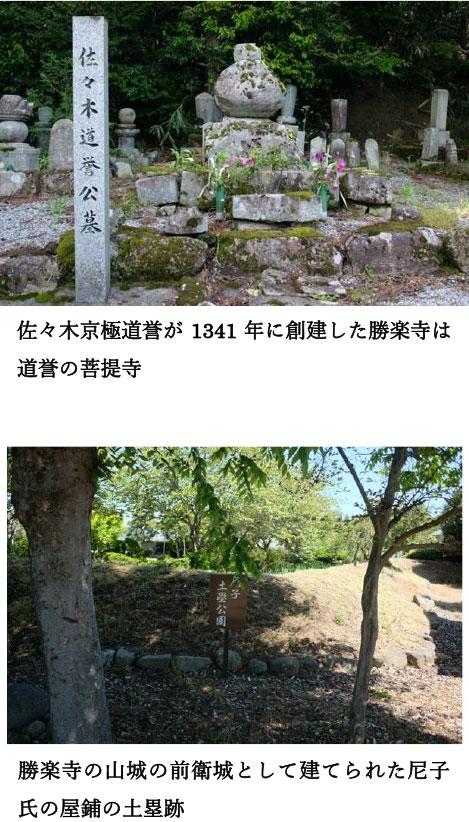
View photographs of the tomb and earthworks. Top: Shorakuji, founded by Sasaki Kyogoku Doyo in 1341, is his family temple; the stone marker identifies his grave. Bottom: earthworks of the Amago residence, built as a forward fortification for Shorakuji’s mountain castle.
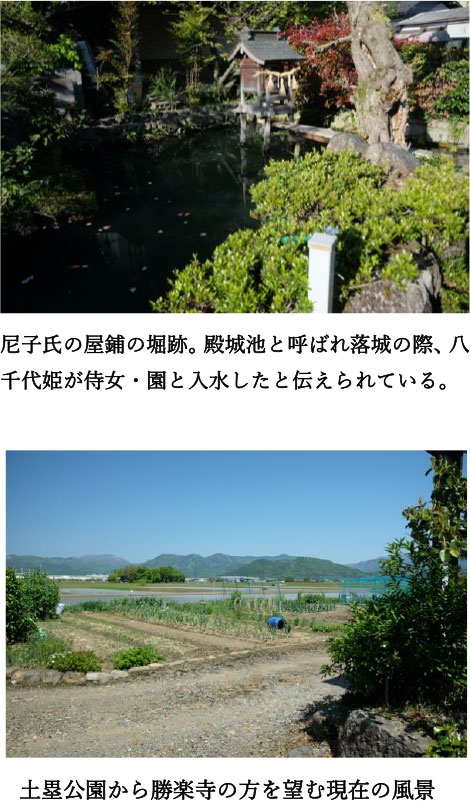
View photographs of the moat and landscape. Top: remains of the Amago residence’s moat, called Tonoshiro Pond. Legend says that when the castle fell, Princess Yachiyo drowned herself there with her attendant Sono. Bottom: the present landscape looking toward Shorakuji from the earthworks park.
Like a dream or illusion, and yet…
Sasaki (Kyogoku) Takauji, or Doyo, was an exceptional strategist and cultivated man whose astonishing conduct and attire were described in the Taiheiki as exhausting every extravagance of basara elegance. After his eventful life, he left these verses:
ことし猶花を見するは命にて
古郷は月や主になりぬらん
人はむかしの秋にかわらず
The linked-verse poet Sogi (1421–1502), said to come from the Iba family, senior retainers of the Sasaki Rokkaku, left these three:
はなにしてしりぬ世のはるかぜ
世の中よいづれが先といひいひ
世にふるもさらにしぐれのやどりかな
These verses offer a glimpse of how warriors understood living through the turbulent medieval world.
To survive, warriors served two lords or repeatedly changed masters; relatives and brothers fought, and children or sisters were often handed over as hostages. At times they abandoned subordinates and begged enemies for their lives. Yet at each moment they also risked their lives in battle and lived for a great cause. A trio of blossoms, the floating world, and life itself was played according to place, moment, and person. Their poems seem to conceal a strong will to live out a short life, accepting the world as it was and life’s brevity with a dignified ethical sense, without escaping harsh reality. They arose from a sensibility somewhat different from what is commonly called elegant refinement.
Omi has always enjoyed a beautiful lake and fertile land. But positioned at the capital’s gateway from the Hokuriku, Tosan, and Tokai routes, it was continually a political crossroads from antiquity into early modern times, repeatedly becoming a battlefield where much blood flowed. Besides the blood of innocent farmers, that of many warrior groups destroyed by larger powers reddened the earth.
An intense struggle for survival, unimaginable in today’s peaceful scenery, unfolded in Omi. Yet if we listen closely, we seem to hear the groans of the dead who have fallen out of historical memory. Looking at the world’s present circumstances, listening to those voices may not be entirely meaningless.
Sources of waka and linked verse; reference materials and bibliography
Original Japanese titles and author names are retained for identification, with English descriptions supplied. Bibliographic details follow the source.
- 『万葉集』, Man’yoshu.
- 『小倉百人一首』, Ogura Hyakunin Isshu.
- 『千載和歌集』, Senzai Wakashu.
- 『新撰古今集』, Shinsen Kokinshu.
- 『菟玖波集』, Tsukubashu.
- 『新撰菟玖波集』, Shinsen Tsukubashu.
- 『信長公記』, Shincho Koki, chronicle of Nobunaga.
- “中世の石部 第一章第一節近江守護佐々木氏の成立,” medieval Ishibe, chapter 1, section 1, establishment of the Sasaki governors of Omi, in 『新修石部町史通史篇』, revised Ishibe town history, general-history volume. Konan City Digital Archive, 1989.
- 『近江源氏と沙沙貴神社』, the Omi Genji and Sasaki Shrine. Azuchi Castle Archaeological Museum, 2002.
- 『図録 戦国大名尼子氏の興亡展図録』, exhibition catalogue on the rise and fall of the Amago Sengoku lords. Shimane Museum of Ancient Izumo, 2012.
- 『甲良町誌』, Kora town history. Kora Town History Compilation Committee, 1984.
- 『法養寺誌』, history of Hoyoji. Kora Hoyoji History Editorial Committee, 2004.
- 山田徹 and others, 『鎌倉幕府と室町幕府』, the Kamakura and Muromachi shogunates. Kobunsha Shinsho, 2022.
- 田中政三, 『近江源氏』, the Omi Genji, volume 2. Kobundo, 1980.
- 徳永眞一郎, 『近江源氏の系譜』, genealogy of the Omi Genji. Sogensha, 1981.
- 林屋辰三郎, 『佐々木道誉』, Sasaki Doyo. Heibonsha, 1995.
- 村井裕樹, 『戦国大名佐々木六角氏の基礎研究』, foundational research on the Sasaki Rokkaku Sengoku lords. Shibunkaku, 2012.
- 寺田英視, 『婆娑羅大名佐々木道誉』, the basara lord Sasaki Doyo. Bunshun Shinsho, 2019.
- 下坂守, “京極氏の系譜と事歴,” Kyogoku genealogy and history, in 『室町幕府守護職家事典 上巻』, dictionary of Muromachi military-governor houses, volume 1. 新物往来社 [publisher as printed], 1988.
- 北村圭弘, “南北朝期・室町期の近江における京極氏権力の形成,” formation of Kyogoku power in Omi during the Northern and Southern Courts and Muromachi periods, in 『滋賀県文化財保護協会紀要31』, bulletin 31 of the Shiga cultural-properties protection association, 2018.
- 太田浩司, “京極家の流れと京極道誉,” the Kyogoku line and Kyogoku Doyo, in 『甲良の賜』. Kora Board of Education, 2009.
- 妹尾豊三郎, 『尼子物語』, the Amago story. Harvest Publishing, 2003.
- 妹尾豊三郎, 『尼子氏関連武将事典』, dictionary of military figures associated with the Amago. Harvest Publishing, 2017.
Original source images
Select an image to open its source. Text within images remains in its original language.
Original wording, author credits, notes and source materials are preserved there.