English translation
AI-assisted English translation. The Japanese original remains authoritative.
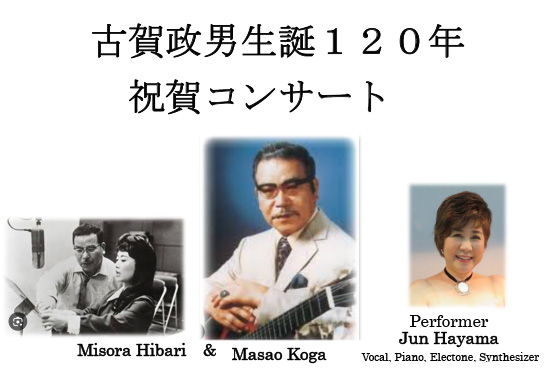
Masao Koga 120th Birthday Celebration Concert
Welcome, everyone.
Koga's 1930s stood in the middle of the Great Depression. American shares plunged: for example, the giant U.S. Steel fell from $261 to $21, and GE from $396 to $34. Ordinary people had bought shares with money borrowed against their homes; when their holdings became worthless, they were left on the streets. Banks also failed in large numbers, and trade-dependent Japan was full of unemployed people. The sad story of disappointed love behind Koga's first work, 「影を慕ひて」, begins there too.
This evening, Jun Hayama, renowned in Ginza's jazz world, will sing Koga melodies with love, conveying the heartbeat of Japanese song together with history. Rather than the spirit of an age, it is the heart of an age that Jun will trace, entering into Masao Koga's feelings.
Programme
Tuesday, June 25, 2024, 6–8:30 p.m.
Sazanami Hall, Zushi Cultural Plaza.
Performer: Jun Hayama.
Programme commentary: Kahori Tachibana.
Theme: Popular Songs of the 1930s and Their Times.
Part One
No. 1 — Koga Melody: 「影を慕ひて」
Born into a poor farming family in Fukuoka in 1904, Masao Koga lost his father while young. Bearing his mother's hardships, he traveled with his siblings as far as Incheon in Korea. Nothing came to fruition; he felt like an empty cicada shell. In despair, Koga went to Aone Hot Springs in Miyagi, his heart seized by helpless sorrow.
No. 2 — 「酒は泪か溜息か」
Koga composed by grasping the feelings in the lyrics of 高橋掬太郎. It appeared in 1931, when Casino Folies and Moulin Rouge were bustling. Ichizō Kobayashi, the foster father of the Takarazuka Girls' Revue, laughed heartily at the Casino Folies light-comedy theater in Asakusa. In Shinjuku, Moulin Rouge opened, and writers such as 伊馬春部wrote scripts for a middlebrow audience.
No. 3 — 「青い背広で」
The lyricist was Sōnosuke Satō. He could write weighty songs but also lyrics suited to a light, lively tune like this. Sung in 1937, when going to newsreels and having tea were fashionable, it also coincided with war. The tenor Ichirō Fujiyama is said to have sung it cheerfully in the war zone, stirring the soldiers' homesickness.
No. 4 — Peggy Lee, “Johnny Guitar”
We leap to the American West, to North Dakota at the northern end of the Rocky Mountain system. Passionate Peggy Lee sings in rough English, something like a North Dakota version of Carmen. Of course, she inhabits a different world from Koga, yet this song is compelling because, intentionally or not, she fills it with the poignant sorrow of a Koga melody.
No. 5 — 「二人は若い」
In 1935, Masao Koga and Hachirō Satō teamed up to create this theme song for the exuberantly cheerful film Nozokareta Hanayome, sung as a duet by Dick Mine and Reiko Hoshi. It was the age of Jun'ichi Nakahara's dreaming young women. America was rising from the Depression and Benny Goodman's swing was immensely popular. Japan saw the military ascending, one year before the February 26 Incident.
No. 6 — Jun Hayama: 「鎌倉ラバーズ」
Kamakura Lovers: a small bar in a backstreet of old Kamakura. A second date with him. After a brightly colored cocktail, the swelling excitement can no longer be held back. Depicting the beginning of such an adult love story, this is a signature Jun Hayama song, featured many times on television. Please enjoy the performance's headlong energy and the dramatic singing.
No. 7 — Jun Hayama, New Work: 「涙の観音さま」
Jun repeatedly clashed with a strict mother who was an educator, and followed an independent path. Jun's younger brother knew this too. Was Jun, unable to obey Mother, an unfilial child? One day Mother fell seriously ill. Jun went to care for her every day. But her condition suddenly changed. On that day alone, Jun was late. Rushing from Ōfuna Station by monorail … entering the sickroom under the eyes of the siblings gathered around Mother … and Mother …
What do you think she did?
That concludes Part One. There will be a fifteen-minute comfort break. Please enjoy talking together in the lobby.
Part Two — Into the Age of Ryōichi Hattori
Born in Osaka in 1907, Hattori joined a band run by the city's Izumoya eel restaurant, but it broke up after two years. In 1926 he joined the Osaka Philharmonic as a flautist. Discovered by the Ukrainian Emanuel Metter, he received musical instruction for four years. Through an introduction by Dick Mine in 1933, he became active from his thirties. He composed many Romantic songs—「別れのブルース」, 「東京ブギウギ」, 「青い山脈」, 「銀座カンカン娘」, and 「蘇州夜曲」—with a mood different from Koga melodies. Noriko Awaya's emergence stands out.
Opening Part Two is the new work 「なぎさ橋ブルース」, composed by Jun Hayama. Nagisa Bridge is the bridge in Zushi where the lovers' sorrowful parting takes place. The lyrics are by Kahori Tachibana and the music by Jun Hayama. Still holding an unfulfilled love in her heart, a woman stands at Nagisa Bridge in the rain, embracing memories. Please listen to her feelings.
No. 8 — New Work: 「なぎさ橋ブルース」
With lyrics by Kahori Tachibana and music by Jun Hayama, we dedicate this seaside love story from Zushi in Shōnan wholeheartedly to Koga and Hattori. At Nagisa Bridge is a world-famous café, and this is an old love story that blossomed there. Surely, after some years, the day of fulfillment will come. Believing that … please listen.
No. 9 — 「雨のブルース」
Hattori's strength lies in his Romantic mood. Compared with Koga melodies, the degree of misery is lighter. Yet he likens dark despair to incessant rain and weaves it into the heart's pain. The lyricist, 野川香文, skillfully turns the rain's inexpressible oppressive weight into words. Individual character is brought out through the feelings of the woman who sings. Whether in Awaya's style or Shimakura's, adding spoken lines suited to the singer's personality shows uncommon care.
No. 10 — 「蘇州夜曲」
Hattori's song has lyrics by 西城八十. The love of a man apparently an Imperial Navy officer and a Chinese girl is depicted through a boat excursion in the water city of Suzhou. They love one another, but the love will not be fulfilled. They are fated someday to become enemies. An entrancing moment turns to foam and disappears like a reflection on the water. How sorrowful. In wartime Suzhou, not far from Shanghai, such poignant love arose between a Japanese officer and a young Chinese woman.
No. 11 — 「別れのブルース」
Noriko Awaya was visiting a special-attack base in Kyūshū to entertain the troops. During her song, boys of fifteen and sixteen received orders to sortie. One, then another, saluted and left. The roar of the aircraft propellers. As Awaya sang 「別れのブルース」, she pictured those gallant boys in their cockpits, hands gripping the controls. She desperately held herself together and tried to sing, but no voice came. She broke down in tears. At Chiran and other special-attack bases, even now this song can be heard riding on the wind.
No. 12 — 「もう一度直球勝負」 — All the Women Sing Together
This is a woman's song of rousing herself to be strong-willed. Men of the world, do not underestimate women. How frightening! You may know that the fashionable term “feminism” is nothing new. It was already advocated by Raichō Hiratsuka and Seitō in the Meiji thirties. It is not only the pitcher Ueno with a 160-kilometer-an-hour ball: endearing Jun, too, faces the challenge head-on with a straight pitch!
No. 13 — 「東京ラプソディ」 — At Last, the Finale!
Look at the attached lyrics and let us all sing together in a great chorus.
Original image captions: Misora Hibari & Masao Koga. Performer: Jun Hayama — Vocal, Piano, Electone, Synthesizer.
Original source images
Select an image to open its source. Text within images remains in its original language.
Original wording, author credits, notes and source materials are preserved there.