English translation
AI-assisted English translation. The Japanese original remains authoritative.
Originally published:
This is an original event notice and record. The event date and original publication date are preserved separately.
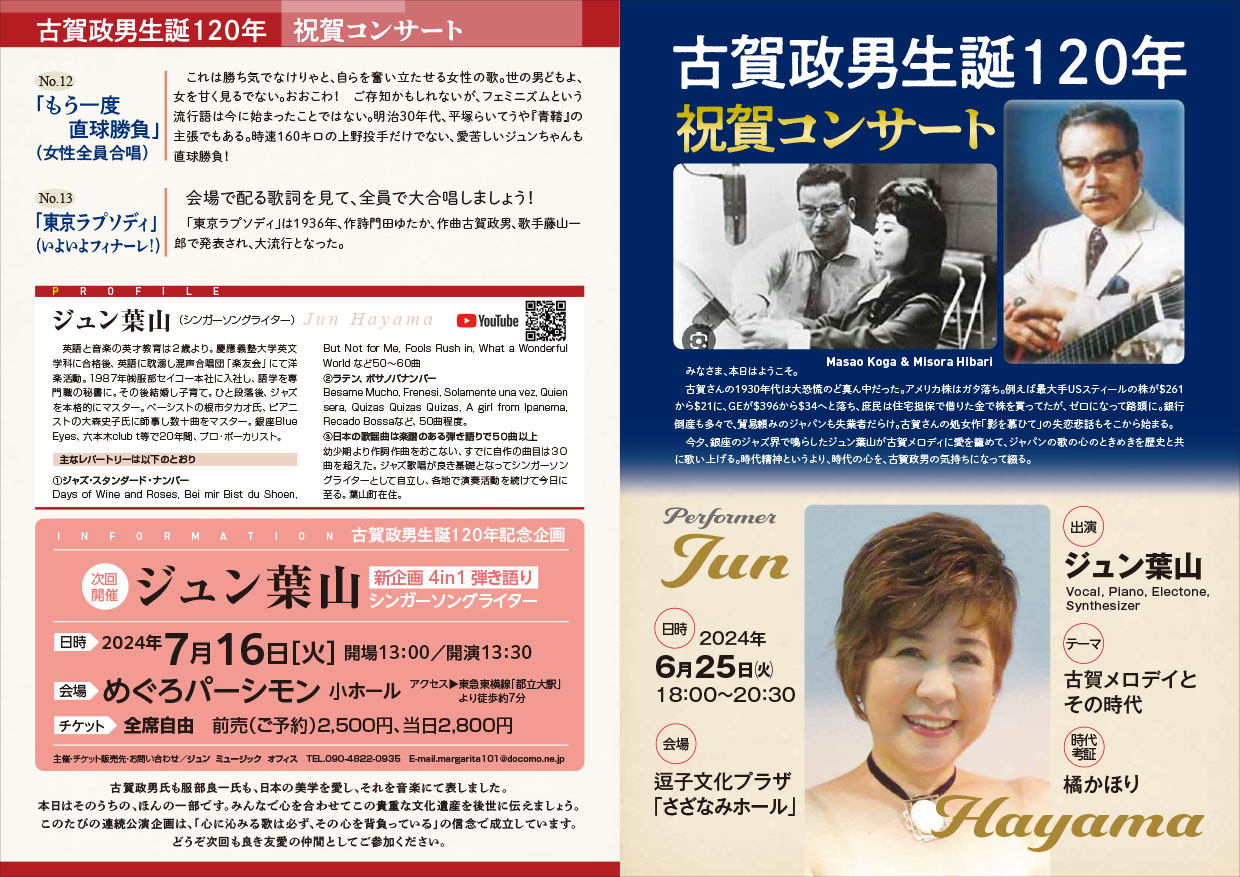
Koga Melodies and Their Times — Jun Hayama
Tuesday, June 25, 2024, 18:00–20:30
Zushi Cultural Plaza, Sazanami Hall
Celebration Concert: 120 Years since the Birth of Masao Koga
Performer: Jun Hayama
Vocal, Piano, Electone, Synthesizer.
Theme: Koga Melodies and Their Times
Historical commentary: 橘かほり
Photo caption: Masao Koga & Misora Hibari
Welcome
Welcome, everyone, and thank you for coming today.
Koga's 1930s were right in the midst of the Great Depression. American share prices collapsed. For example, shares in the giant U.S. Steel fell from $261 to $21, and GE from $396 to $34. Ordinary people had bought shares with money borrowed against their homes, but the shares became worthless and they were left on the streets. Many banks failed, and Japan, which depended on foreign trade, was full of unemployed people too. The story of disappointed love in Koga's first work, “影を慕ひて,” begins here as well.
This evening, Jun Hayama, who made a name in Ginza's jazz world, will pour affection into Koga melodies and sing the heart's stirrings in Japanese song together with their history. Rather than the spirit of an age, we will explore the heart of the age by entering into Masao Koga's feelings.
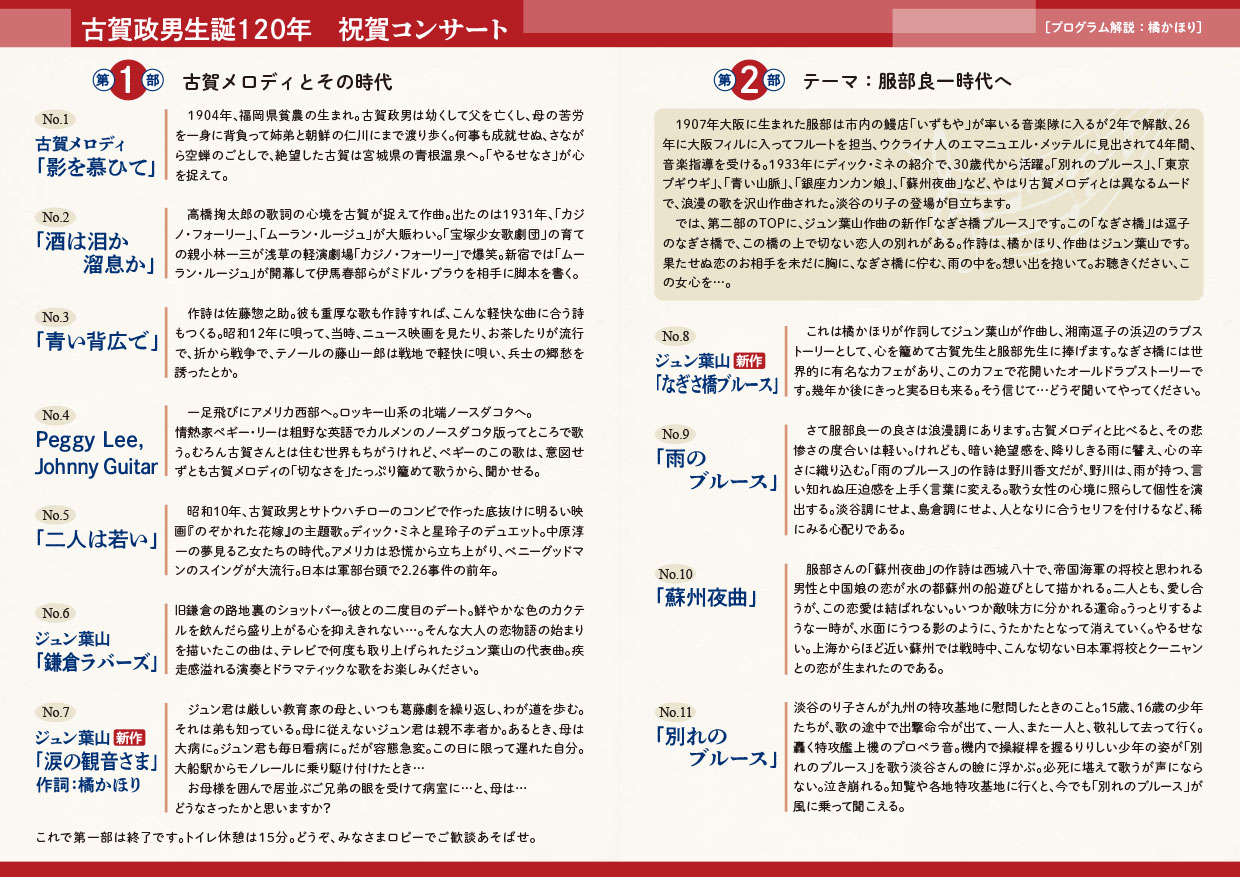
Part 1 — Koga Melodies and Their Times
No. 1 — Koga Melody: “影を慕ひて”
Born into a poor farming family in Fukuoka in 1904, Masao Koga lost his father as a child. Bearing the full burden of his mother's hardship, he wandered with his sisters as far as Incheon in Korea. Nothing came to fruition; it was as though he were an empty cicada shell. In despair, Koga went to Aone Hot Springs in Miyagi Prefecture. A feeling of helpless sorrow seized his heart.
No. 2 — “酒は泪か溜息か”
It was in 1931 that Koga grasped the state of mind in 高橋掬太郎's lyrics and composed the music. “カジノ・フォーリー” and “ムーラン・ルージュ” were flourishing. 小林一三, the founding figure behind the Takarazuka Girls' Revue, was convulsed with laughter at the light-entertainment theater カジノ・フォーリー in Asakusa. In Shinjuku, ムーラン・ルージュ opened, and 伊馬春部 and others wrote scripts for a middlebrow audience.
No. 3 — “青い背広で”
The lyricist was 佐藤惣之助. He wrote weighty songs, but also lyrics suited to a light and lively melody like this one. Sung in Showa 12, it came at a time when watching newsreels and going out for tea were fashionable. With war then under way, tenor 藤山一郎 apparently sang it briskly at the front, stirring the soldiers' longing for home.
No. 4 — Peggy Lee, Johnny Guitar
Now a leap to the American West, to North Dakota at the northern end of the Rocky Mountains. Passionate Peggy Lee sings in rough-hewn English, like a North Dakota version of Carmen. Of course, her world is different from Koga's. Yet Peggy fills this song, even unintentionally, with the aching sadness of Koga melodies, and makes us listen.
No. 5 — “二人は若い”
In Showa 10, Masao Koga and サトウハチロー teamed up to create this irrepressibly cheerful theme song for the film のぞかれた花嫁. It is a duet by ディック・ミネ and 星玲子. This was the age of the dreaming women in 中原淳一's world. America was rising out of the Depression, and Benny Goodman's swing was all the rage. In Japan the military was gaining power; it was the year before the February 26 Incident.
No. 6 — Jun Hayama: “鎌倉ラバーズ”
A shot bar in a backstreet of old Kamakura. A second date with him. After a brilliantly colored cocktail, she cannot hold back her rising excitement. This song, portraying the beginning of an adult love story, is one of Jun Hayama's signature pieces and has been featured on television many times. Please enjoy its driving performance and dramatic singing.
No. 7 — Jun Hayama, New Work: “涙の観音さま”
Lyrics: 橘かほり
Jun repeatedly clashes with a strict mother who is an educator, and walks an independent path. Jun's younger brother knows this too. Is Jun, who does not obey this mother, an unfilial child? One day, the mother becomes gravely ill. Jun visits her every day, but then her condition suddenly changes. On that particular day, Jun is late. Taking the monorail from Ofuna Station and rushing to the hospital…
Entering the room under the eyes of the siblings gathered around their mother, Jun finds that the mother…
What do you think she did?
This concludes Part 1. Please take a fifteen-minute comfort break, and enjoy chatting together over coffee.
Part 2 — Toward the Era of 服部良一
Program commentary: 橘かほり
Born in Osaka in 1907, 服部 joined the musical band led by the city's eel restaurant いずもや, but it disbanded two years later. In 1926 he joined the Osaka Philharmonic as a flutist, was noticed by the Ukrainian エマニュエル・メッテル, and received musical instruction for four years. In 1933, through an introduction by ディック・ミネ, he began the activities that marked his thirties. He composed many Romantic songs in a mood distinct from Koga melodies, including “別れのブルース,” “東京ブギウギ,” “青い山脈,” “銀座カンカン娘” and “蘇州夜曲.” 淡谷のり子's emergence stands out.
To open Part 2, here is a new work composed by Jun Hayama, “なぎさ橋ブルース.” Its Nagisa Bridge is the bridge in Zushi, and the song tells of a painful parting between lovers on that bridge. The words are by 橘かほり and the music by Jun Hayama. Still holding an unfulfilled love in your heart, pause at Nagisa Bridge in the rain, embrace your memories, and listen to this woman's heart.
No. 8 — Jun Hayama, New Work: “なぎさ橋ブルース”
With words by 橘かほり and music by Jun Hayama, this love story on the shore at Zushi in Shonan is dedicated wholeheartedly to Koga and 服部. There is a world-famous cafe at Nagisa Bridge; this is an old love story that blossomed in that cafe. Surely, some years later, a day will come when it bears fruit. Believing that, please listen.
No. 9 — “雨のブルース”
The appeal of 服部良一 lies in his Romantic tone. Compared with Koga melodies, the degree of misery is lighter. Yet dark despair is entrusted to the pouring rain and woven into the heart's pain. The lyrics of “雨のブルース” are by 野川香文. 野川 skillfully turns the rain's indescribable oppressive feeling into words, creating an individual character in light of the woman singer's feelings. Whether in 淡谷's manner or 島倉's, adding spoken lines suited to the performer's personality shows a rare attentiveness.
No. 10 — “蘇州夜曲”
The lyrics of 服部's “蘇州夜曲” are by 西城八十, as written in this program. The love between a man thought to be an officer in the Imperial Navy and a Chinese girl is portrayed through a boat excursion in the water city of Suzhou. They love each other, but this love cannot be fulfilled. They are destined someday to stand on opposing sides. Their entrancing moment disappears like foam, like a reflection on the water. It is unbearably sad. During the war, in Suzhou not far from Shanghai, such a poignant love arose between a Japanese military officer and a Chinese girl.
No. 11 — “別れのブルース”
This was when 淡谷のり子 visited a special-attack base in Kyushu to entertain the troops. During her song, fifteen- and sixteen-year-old boys received orders to sortie; one after another they saluted and left. The roar of the special-attack carrier planes' propellers, and the gallant boys gripping their controls inside, rose in the mind of 淡谷 as she sang “別れのブルース.” She sang, desperately trying to hold herself together, but no voice came. She broke down in tears. Go to Chiran or the other special-attack bases, and even now “別れのブルース” can be heard on the wind.
No. 12 — “もう一度 直球勝負” — All the Women Sing Together
This is the song of a woman rousing herself: I have to be strong-willed. Men of the world, do not underestimate women. How formidable! As you may know, the fashionable word feminism did not begin today. It was also the assertion of 平塚らいてう and 青鞜 in the thirties of the Meiji era. It is not only pitcher 上野, with a speed of 160 kilometers an hour; lovable Jun too takes on the challenge with a straight fastball!
No. 13 — “東京ラプソディ” — At Last, the Finale
Look at the lyrics distributed in the hall, and let us all sing together!
“東京ラプソディ” was released in 1936, with words by 門田ゆたか, music by Masao Koga and vocals by 藤山一郎, and became a great hit.
Profile — Jun Hayama, Singer-Songwriter
Special education in English and music began at age two. After admission to Keio University's Department of English Literature, Jun took a keen interest in English and performed Western music in the mixed choir 楽友会. In 1987 Jun joined the head office of Hattori Seiko, specializing in languages. After marriage and raising children, Jun studied jazz in depth, learning from bassist 根市タカオ and pianist 大森史子 and mastering several dozen pieces. For twenty years Jun has worked as a professional vocalist at Ginza's Blue Eyes, Roppongi's club t and other venues.
Main Repertoire
- Jazz standards: Days of Wine and Roses, Bei mir Bist du Shoen, But Not for Me, Fools Rush in, What a Wonderful World, and others—50–60 songs.
- Latin and bossa nova: Besame Mucho, Frenesi, Solamente una vez, Quien sera, Quizas Quizas Quizas, A girl from Ipanema, Recado Bossa, and others—around 50 songs.
- Japanese popular songs: more than 50, sung with feeling while self-accompanying.
Jun has written words and music since childhood, and the number of original songs already exceeds thirty. Jazz singing provided a sound foundation for establishing an independent career as a singer-songwriter. Performances in many places have continued to the present. Jun lives in Hayama.
The profile includes a YouTube logo and QR code in the original program.
Historical Notice of the Next Concert
Masao Koga 120th Anniversary Project
Jun Hayama, singer-songwriter
New project: 4 in 1, singing with self-accompaniment
Tuesday, July 16, 2024
Doors open 13:00; performance begins 13:30
Meguro Persimmon Hall, Small Hall
Access: approximately seven minutes on foot from Toritsu-daigaku Station on the Tokyu Toyoko Line.
All seats unreserved. Advance tickets (reservations): ¥2,500. On the day: ¥2,800.
Organizer, ticket sales and inquiries: Jun Music Office
Telephone: 090-4822-0935
Email: [email protected]
Both Masao Koga and 服部良一 loved Japanese aesthetics and expressed them through music. Today's performance is only a small part of that heritage. Let us join our hearts to pass this precious cultural legacy on to future generations. This series of concerts is founded on the belief that songs which resonate in the heart surely carry that heart within them. Please join us next time too, as companions in warm friendship.
This English version translates the complete readable prose of both original program images. The June 25 concert and July 16 “next concert” notice are historical information. Their dates, prices, contacts, program order and the author's historical interpretations are preserved as printed, without making them current offers. The name 西城八十 is the spelling printed in the source.
Original source images
Select an image to open its source. Text within images remains in its original language.
Original wording, author credits, notes and source materials are preserved there.