English translation of the prose
AI-assisted English translation of the prose; quoted poems remain in Japanese. The Japanese original remains authoritative.
Original Web Announcement
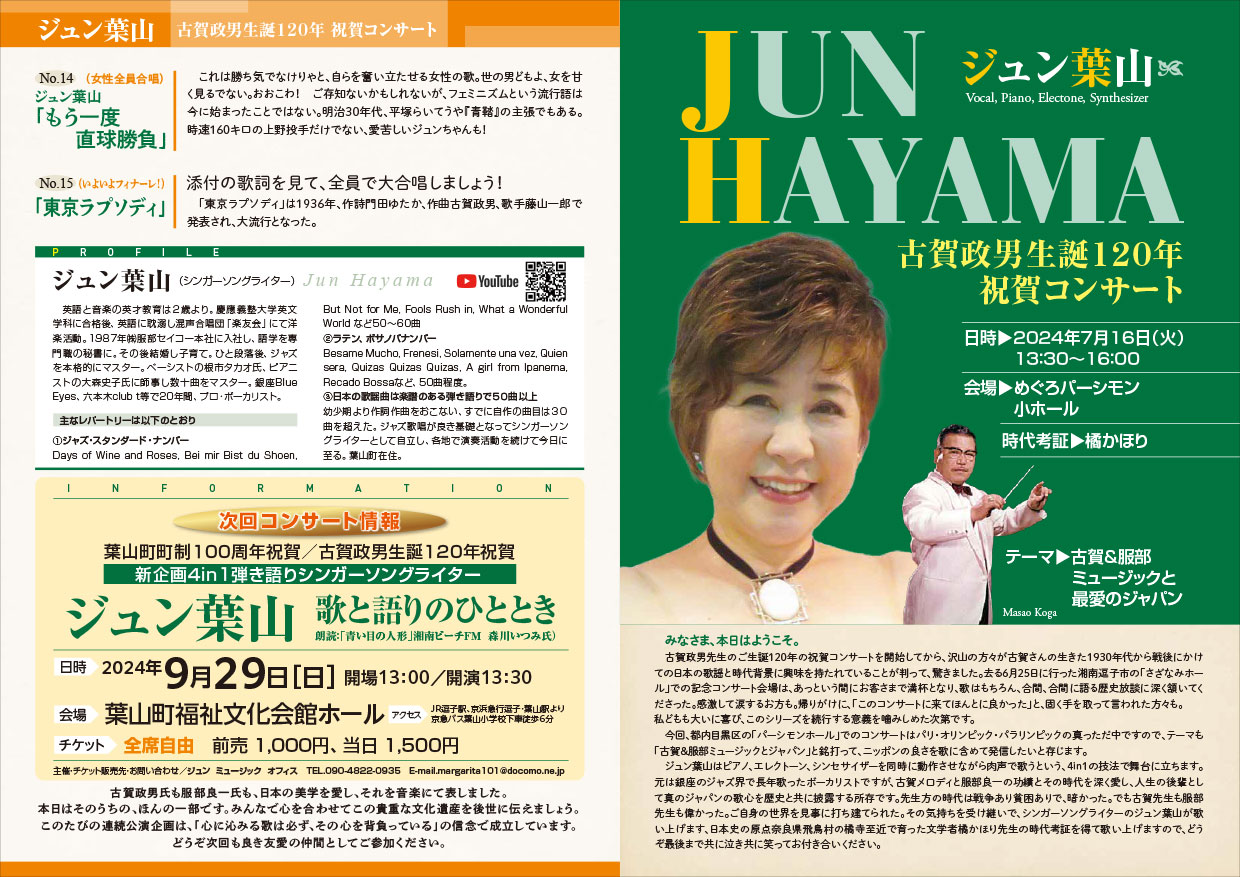
Jun Hayama — Project Commemorating the 120th Anniversary of Masao Koga’s Birth.
Tuesday, July 16, 2024. Doors open at 1 p.m.; performance begins at 1:30 p.m.
Meguro Persimmon Hall, Small Hall. Seven minutes on foot from Toritsu-daigaku Station on the Tōyoko Line.
Translation of the Two-Page Printed Programme
Masao Koga 120th Birthday Celebration Concert — Jun Hayama
Tuesday, July 16, 2024, 1:30–4 p.m.
Small Hall, Meguro Persimmon Hall
Theme: The Music of Koga and Hattori, and Our Beloved Japan
Historical research: Kahori Tachibana
Welcome, everyone.
Since beginning these concerts celebrating the 120th anniversary of Masao Koga's birth, we have been surprised to discover how many people are interested in Japanese popular song and its historical background from the 1930s, when Koga lived, through the postwar years. The commemorative concert at Sazanami Hall in Zushi, Shōnan, on June 25 filled with guests in no time. They nodded deeply not only to the songs but also to the informal historical talks between them. Some were moved to tears. Others firmly took our hands as they left and said, “I'm so glad I came to this concert.”
We were delighted too, and deeply appreciated the significance of continuing this series.
This concert at Persimmon Hall in Meguro, Tokyo, is, in the programme's words, right in the midst of the Paris Olympic and Paralympic Games. We have therefore called the theme “Koga and Hattori Music and Japan,” hoping to communicate Japan's good qualities through song.
Jun Hayama takes the stage with a four-in-one technique: simultaneously playing piano, Electone, and synthesizer while singing live.
Originally a vocalist who sang for many years in Ginza's jazz world, Jun deeply loves Koga melodies, Ryōichi Hattori's achievements, and their times, and intends, as a member of a later generation, to present the true spirit of Japanese song together with its history. Their era was dark, marked by war and poverty. Yet Koga and Hattori were great: each splendidly built a world of his own. Inheriting that spirit, singer-songwriter Jun Hayama will sing with historical research by the literary scholar Kahori Tachibana, who grew up near Tachibana Temple in Asuka, Nara, a place at the origins of Japanese history. Please stay with us to the end, crying and laughing together.
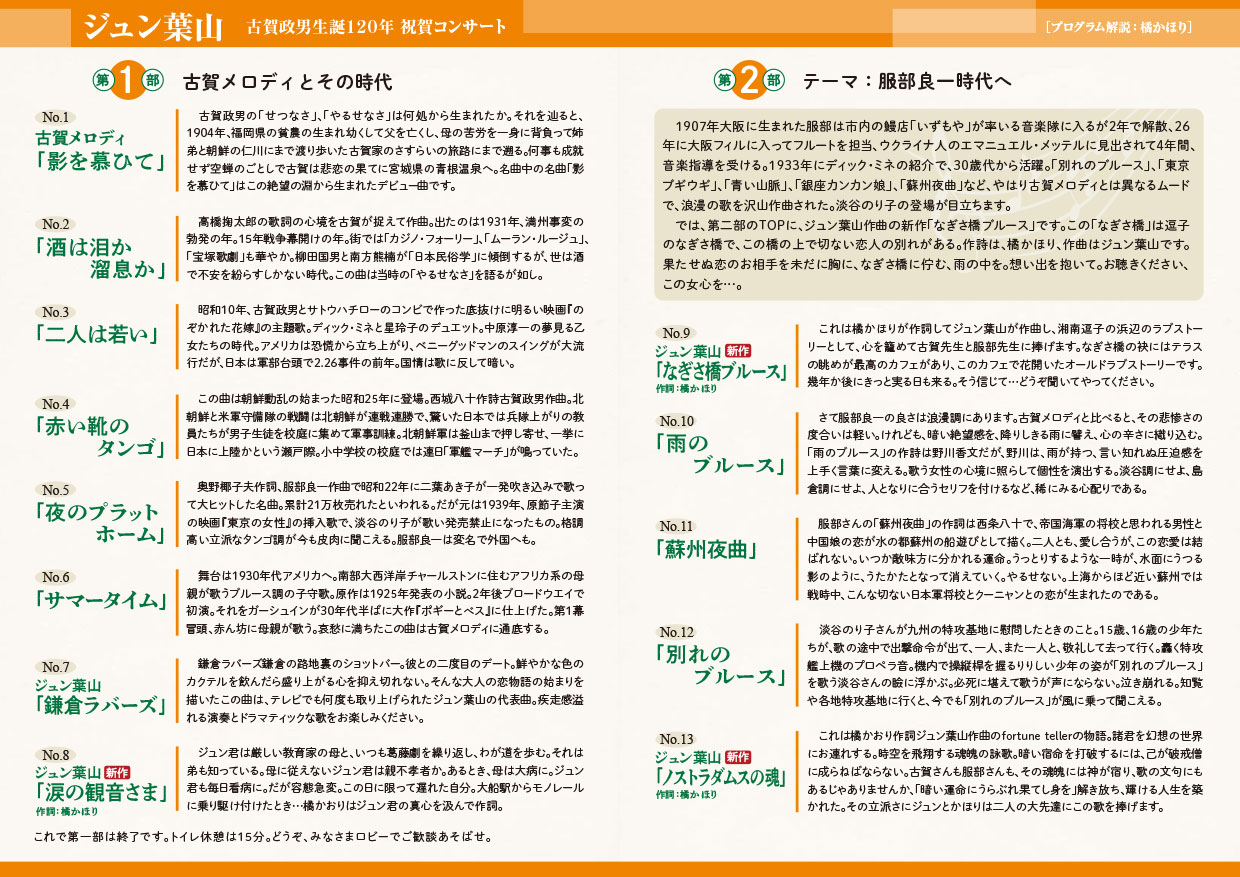
Part One: Koga Melodies and Their Times
No. 1 — Koga Melody: 「影を慕ひて」
Where did Masao Koga's poignancy and helpless sorrow come from? Tracing them leads back to the wandering journey of the Koga family. Born in 1904 into a poor farming family in Fukuoka, he lost his father while young, shouldered his mother's hardships, and traveled with his siblings as far as Incheon in Korea. Unable to accomplish anything, feeling like an empty cicada shell, Koga went to Aone Hot Springs in Miyagi after an unhappy love. This masterpiece among masterpieces was his debut song, born from that abyss of despair.
No. 2 — 「酒は泪か溜息か」
Koga composed by grasping the feelings in the lyrics of 高橋掬太郎. The song appeared in 1931, the year the Manchurian Incident broke out and the Fifteen-Year War began. The streets were bright with Casino Folies, Moulin Rouge, and the Takarazuka Revue. Kunio Yanagita and Kumagusu Minakata devoted themselves to Japanese folklore, yet it was an age in which people could only drown their anxiety in drink. The song seems to speak the helpless sorrow of those times.
No. 3 — 「二人は若い」
In 1935, Masao Koga and Hachirō Satō teamed up to create this theme song for the exuberantly cheerful film Nozokareta Hanayome, sung as a duet by Dick Mine and Reiko Hoshi. It was the age of Jun'ichi Nakahara's dreaming young women. America was rising from the Depression and Benny Goodman's swing was immensely popular, but in Japan the military was ascending, one year before the February 26 Incident. Contrary to the song, the national situation was dark.
No. 4 — 「赤い靴のタンゴ」
This song appeared in 1950, when the Korean War began, with lyrics credited in the source to 西城八十 and music by Masao Koga. In fighting between North Korean forces and the American garrison, North Korea won repeatedly. In alarmed Japan, teachers who had been soldiers gathered boys in schoolyards for military training. The North Korean army pressed as far as Busan, bringing the situation to what seemed the brink of a sudden landing in Japan. The Warship March sounded daily in elementary and middle-school playgrounds.
No. 5 — 「夜のプラットホーム」
With lyrics by 奥野椰子夫 and music by Ryōichi Hattori, this celebrated song became a major hit when Akiko Futaba recorded it in a single take in 1947. Total sales are said to have reached 210,000. Originally, however, it was an insert song in the 1939 film Tōkyō no Josei, starring Setsuko Hara, sung by Noriko Awaya and banned from sale. Its dignified, splendid tango style still sounds ironic. Hattori, under another name, even abroad …
No. 6 — “Summertime”
The stage moves to 1930s America. An African American mother living in Charleston on the southern Atlantic coast sings a blues-like lullaby. The original novel was published in 1925 and first staged on Broadway two years later. In the mid-1930s, Gershwin developed it into the major work Porgy and Bess. At the opening of Act One, the mother sings to her baby. The melancholy of this song runs deep into the same ground as Koga melodies.
No. 7 — Jun Hayama: 「鎌倉ラバーズ」
Kamakura Lovers: a small bar in a backstreet of Kamakura. A second date with him. After a brightly colored cocktail, the swelling excitement can no longer be held back. Depicting the beginning of such an adult love story, this is a signature Jun Hayama song, featured many times on television. Please enjoy the performance's headlong energy and the dramatic singing.
No. 8 — Jun Hayama, New Work: 「涙の観音さま」
Jun repeatedly clashed with a strict mother who was an educator, and followed an independent path. Jun's younger brother knew this too. Was Jun, unable to obey Mother, an unfilial child? One day Mother fell seriously ill. Jun went to care for her every day. But her condition suddenly changed. On that day alone, Jun was late. Rushing from Ōfuna Station by monorail … Kahori Tachibana wrote the lyrics with an understanding of Jun's true feelings.
That concludes Part One. There will be a fifteen-minute comfort break. Please enjoy talking together in the lobby.
Part Two: Into the Age of Ryōichi Hattori
Born in Osaka in 1907, Hattori joined a band run by the city's Izumoya eel restaurant, but it broke up after two years. In 1926 he joined the Osaka Philharmonic as a flautist. Discovered by the Ukrainian Emanuel Metter, he received musical instruction for four years. Through an introduction by Dick Mine in 1933, he became active from his thirties. He composed many Romantic songs—「別れのブルース」, 「東京ブギウギ」, 「青い山脈」, 「銀座カンカン娘」, and 「蘇州夜曲」—with a mood different from Koga melodies. Noriko Awaya's emergence stands out.
Opening Part Two is the new work 「なぎさ橋ブルース」, composed by Jun Hayama. Nagisa Bridge is the bridge in Zushi where the lovers' sorrowful parting takes place. The lyrics are by Kahori Tachibana and the music by Jun Hayama. Still holding an unfulfilled love in her heart, a woman stands at Nagisa Bridge in the rain, embracing memories. Please listen to her feelings.
No. 9 — Jun Hayama, New Work: 「なぎさ橋ブルース」
With lyrics by Kahori Tachibana and music by Jun Hayama, we dedicate this seaside love story from Zushi in Shōnan wholeheartedly to Koga and Hattori. At the foot of Nagisa Bridge is a café whose terrace has a superb view. This is an old love story that blossomed there. Surely, after some years, the day of fulfillment will come. Believing that … please listen.
No. 10 — 「雨のブルース」
Hattori's strength lies in his Romantic mood. Compared with Koga melodies, the degree of misery is lighter. Yet he likens dark despair to incessant rain and weaves it into the heart's pain. The lyricist, 野川香文, skillfully turns the rain's inexpressible oppressive weight into words. Individual character is brought out through the feelings of the woman who sings. Whether in Awaya's style or Shimakura's, adding spoken lines suited to the singer's personality shows uncommon care.
No. 11 — 「蘇州夜曲」
Hattori's song has lyrics by 西条八十. The love of a man apparently an Imperial Navy officer and a Chinese girl is depicted through a boat excursion in the water city of Suzhou. They love one another, but the love will not be fulfilled. They are fated someday to become enemies. An entrancing moment turns to foam and disappears like a reflection on the water. How sorrowful. In wartime Suzhou, not far from Shanghai, such poignant love arose between a Japanese officer and a young Chinese woman.
No. 12 — 「別れのブルース」
Noriko Awaya was visiting a special-attack base in Kyūshū to entertain the troops. During her song, boys of fifteen and sixteen received orders to sortie. One, then another, saluted and left. The roar of the aircraft propellers. As Awaya sang 「別れのブルース」, she pictured those gallant boys in their cockpits, hands gripping the controls. She desperately held herself together and tried to sing, but no voice came. She broke down in tears. At Chiran and other special-attack bases, even now this song can be heard riding on the wind.
No. 13 — Jun Hayama, New Work: 「ノストラダムスの魂」
With lyrics by Kahori Tachibana and music by Jun Hayama, this is a fortune teller's story, taking you into a world of fantasy: the singing of a spirit flying through time and space. To break a dark destiny, one must become a monk who breaks the precepts. Both Koga and Hattori had a god dwelling in their spirits. As the song's words have it, 「暗い運命にうらぶれ果てし身を」: they set that self free and built radiant lives. In admiration, Jun and Kahori dedicate this song to those two great predecessors.
Additional Material in the Printed Programme
No. 14 — Jun Hayama: 「もう一度直球勝負」 — All the Women Sing Together
This is a woman's song of rousing herself to be strong-willed. Men of the world, do not underestimate women. How frightening! You may know that the fashionable term “feminism” is nothing new. It was already advocated by Raichō Hiratsuka and Seitō in the Meiji thirties. It is not only the pitcher Ueno with a 160-kilometer-an-hour ball: endearing Jun, too, faces the challenge head-on with a straight pitch!
No. 15 — 「東京ラプソディ」 — At Last, the Finale!
Look at the attached lyrics and let us all sing together in a great chorus.
「東京ラプソディ」 was presented in 1936 with lyrics by 門田ゆたか, music by Masao Koga, and singing by Ichirō Fujiyama, and became a major hit.
Profile — Jun Hayama, Singer-Songwriter
Gifted education in English and music began at the age of two. After gaining admission to Keio University's English department, Jun became immersed in English and pursued Western music in the mixed chorus Gakuyūkai. In 1987 Jun joined Hattori Seiko headquarters, working as a secretary specializing in languages. Marriage and raising children followed; once that stage settled, Jun mastered jazz in earnest. Studying with bassist 根市タカオ and pianist 大森史子, Jun mastered many dozens of songs and worked for twenty years as a professional vocalist at Ginza Blue Eyes, Roppongi club t, and other venues.
Main repertoire
- Jazz standards: “Days of Wine and Roses,” “Bei mir Bist du Shoen,” “But Not for Me,” “Fools Rush in,” “What a Wonderful World,” and others—fifty to sixty songs.
- Latin and bossa nova: “Besame Mucho,” “Frenesi,” “Solamente una vez,” “Quien sera,” “Quizas Quizas Quizas,” “A girl from Ipanema,” “Recado Bossa,” and others—about fifty songs.
- More than fifty Japanese popular songs, with practiced self-accompaniment.
Jun has written lyrics and composed since childhood, with more than thirty original songs already completed. With jazz and popular song as a firm foundation, Jun became an independent singer-songwriter and has continued performing in many places to the present. Resident of Hayama Town.
Next Concert Information — As Printed in 2024
Celebrating the centenary of Hayama's establishment as a town and the 120th anniversary of Masao Koga's birth.
New project: a four-in-one singer-songwriter, singing with self-accompaniment.
Jun Hayama — A Time for Songs and Stories.
Recitation: 「青い目の人形」 (“The Blue-Eyed Doll”), by Itsumi Morikawa of Shōnan Beach FM.
Sunday, September 29, 2024. Doors open at 1 p.m.; performance begins at 1:30 p.m.
Hayama Town Welfare and Culture Hall.
Access: from JR Zushi Station or Keikyu Zushi-Hayama Station, bus to Hayama Elementary School; six minutes on foot.
All seating unreserved. Advance: ¥1,000; at the door: ¥1,500.
Organizer, ticket sales, and inquiries: Jun Music Office.
Telephone: 090-4822-0935.
Email: [email protected]
Masao Koga and Ryōichi Hattori loved the beauty of Japan and expressed it in music. Today is only a small part of that—one drop. Let us all join our hearts and pass this precious cultural legacy to later generations. This continuing concert series rests on the conviction that songs which touch the heart always grow that heart. Please join us many times as friends who love good music.
Original programme image: cover and back
Original programme image: programme notes
Original source images
Select an image to open its source. Text within images remains in its original language.
Original wording, author credits, notes and source materials are preserved there.