English translation of the prose
AI-assisted English translation of the prose; quoted poems remain in Japanese. The Japanese original remains authoritative.
AI-assisted English translation. The Japanese original remains authoritative.
Originally published:
This material was published on the Japanese website. Dates and notices in the text reflect the original publication.
A Century in Song with Jun Hayama — September 29
This is an original event notice and record. The event date is preserved separately from the source posting date.
Celebrating the centenary of Hayama's incorporation as a town and the 120th anniversary of Masao Koga's birth.
Jun Hayama: a time of song and storytelling.
- Sunday, September 29, 2024. Doors 13:00; performance 13:30.
- Venue: Hayama Town Welfare and Culture Hall. Get off the Keikyu bus at Hayama Elementary School. The web notice prints the walking time as 「徒67分」; the images give six or seven minutes.
- Tickets: ¥1,000 in advance; ¥1,500 on the day. Unreserved seating.
Image 1: Cover and Program, Continued
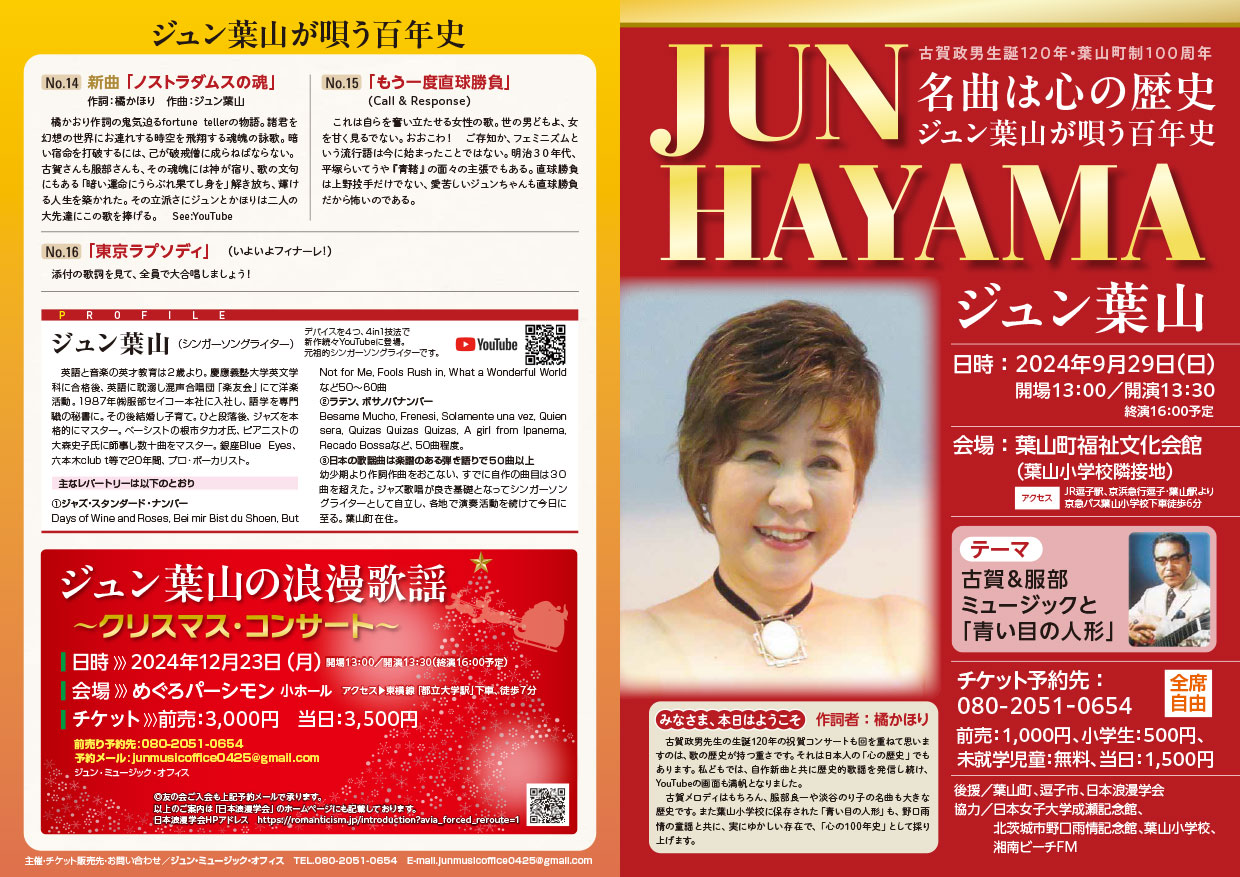
JUN HAYAMA — Great Songs Are a History of the Heart
A Century in Song with Jun Hayama. The 120th anniversary of Masao Koga's birth and Hayama town's centenary.
Sunday, September 29, 2024. Doors 13:00; performance 13:30; scheduled finish 16:00. Hayama Town Welfare and Culture Hall, next to Hayama Elementary School. Access: Keikyu bus from JR Zushi Station or Keikyu Zushi-Hayama Station; get off at Hayama Elementary School, then walk six minutes.
Theme: the music of Koga and Hattori, and 「青い目の人形」.
Reservations: 080-2051-0654. All seats unreserved. Advance: ¥1,000; elementary pupils: ¥500; preschool children: free; on the day: ¥1,500.
Supported by Hayama Town, Zushi City and the Japan Romanticism Academia. Cooperation: Japan Women's University Naruse Memorial Hall; Kitaibaraki City's Ujō Noguchi Memorial Hall; Hayama Elementary School; Shonan Beach FM.
Welcome, Everyone — Lyricist 橘かほり
Today we place emphasis on song history in this concert celebrating the 120th anniversary of Masao Koga's birth. It is also the history of Japanese hearts. Alongside original new works, we continue to present historical popular songs, and our YouTube videos have become quite lively. Koga's melodies, of course, and the renowned songs of Hattori Ryoichi and Noriko Awaya are great history. Together with the children's song by 野口雨情 and the “blue-eyed doll” preserved at Hayama Elementary School, we explore them here as a century of the heart.
14. New Song: ノストラダムスの魂
Lyrics: 橘かほり. Music: Jun Hayama.
橘かほり's lyric is a chilling tale of a fortune teller: a chant of a soul flying through space and time to carry you into a world of fantasy. To break a dark destiny, one must become a monk who breaks the precepts. Both Koga and Hattori had a deity dwelling in their souls. As the song's words say, 「暗い運命にうらぶれ果てし身を」, they released themselves and built brilliant lives. Jun and かほり dedicate this song to those two great predecessors and their distinguished achievements. See:YouTube.
15. もう一度直球勝負 (Call & Response)
This is a woman's song of rousing herself. Men of the world, do not underestimate women. Oh, frightening! Did you know that feminism is not a fashionable word that began only now? It was also advocated in the Meiji thirties by 平塚らいてう and the members of 『青鞜』. A straight pitch is not only something thrown overarm: the lovely Jun too comes at you straight, which is what makes it frightening.
16. 東京ラプソディ — At Last, the Finale!
Let us all sing together from the attached lyric sheet!
PROFILE — Jun Hayama, Singer-Songwriter
Her gifted education in English and music began at two. After entering the English Literature program at Keio's Faculty of Letters, she pursued Western music in the mixed chorus 「楽友会」. In 1987 she joined 服部セイコー and became a secretary specializing in language work. She then married and raised children. Once that settled down, she studied jazz seriously with bassist 根市タカオ and pianist 大森史子, mastering several dozen pieces. She has performed as a professional vocalist for twenty years at venues including Blue Eyes in Ginza and club t in Roppongi.
Main repertoire:
- Jazz standards: Days of Wine and Roses, Bei mir bist du Shoen, But Not for Me, Fools Rush in, What a Wonderful World, and others—about fifty to sixty songs. With four devices and a 4in1 technique, she posts new work continually to YouTube: a pioneering singer-songwriter.
- Latin and bossa nova: Besame Mucho, Frenesi, Solamente una vez, Quien sera, Quizas Quizas Quizas, A girl from Ipanema, Recado Bossa, and others—about fifty songs.
- Japanese popular songs: more than fifty songs, narrated with interesting anecdotes.
She has written words and music from childhood and already has more than thirty originals. With jazz singing as a firm foundation, she became independent as a singer-songwriter and has continued to perform in many places. She lives in Hayama.
Jun Hayama's Romantic Songs — Christmas Concert
Monday, December 23, 2024. Doors 13:00; performance 13:30; scheduled finish 16:00. Meguro Persimmon Hall, Small Hall. Access: seven minutes on foot from Toritsu-daigaku Station on the Tokyu Toyoko Line. Advance ¥3,000; on the day ¥3,500.
Advance reservations: 080-2051-0654. Reservation email: [email protected]. Jun Music Office.
To join the Friends Association, please email that address. This concert information is also posted on the Japan Romanticism Academia website: original introduction link.
Organizer, ticket sales and inquiries: Jun Music Office. TEL: 080-2051-0654. E-mail: [email protected].
Image 2: Full Program and Historical Commentary
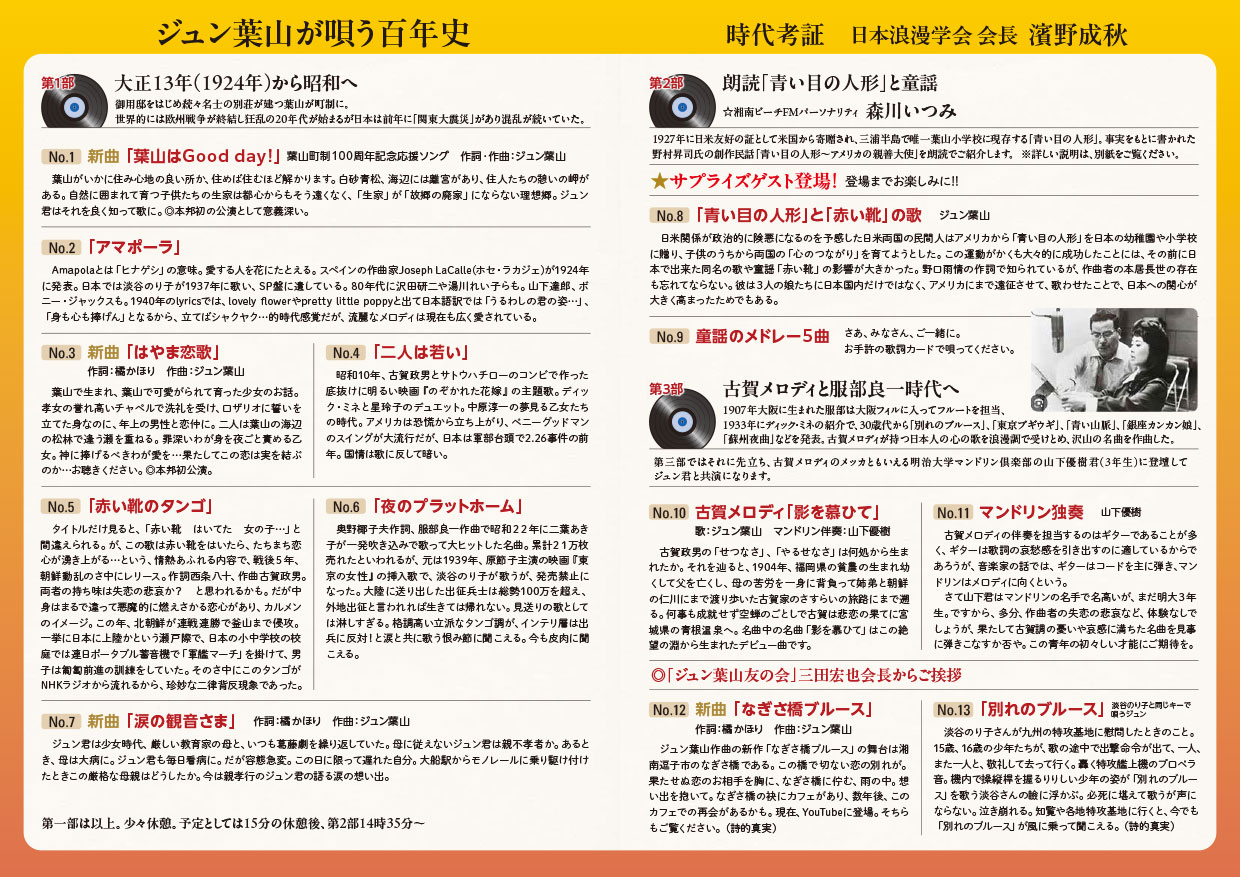
Historical commentary: Seishu Hamano, President, Japan Romanticism Academia.
Part 1: From Taisho 13 (1924) into Showa
Villas of distinguished people, including the imperial villa, were built one after another, and Hayama became a town. Around the world, the First World War had ended and the Roaring Twenties were beginning; Japan remained in turmoil from the Great Kanto Earthquake the previous year.
1. New Song: 葉山はGood day!
Song supporting the commemoration of Hayama town's centenary. Words and music: Jun Hayama.
The longer you live in Hayama, the more you understand how comfortable it is. White sand and green pines; the imperial villa beside the sea; a cape filled with the residents' memories. The birthplaces of children raised amid nature are not far from the city, either. It is an ideal hometown where one's family home does not become an abandoned house back home. Jun knows this well and put it into song. A meaningful first performance in Japan.
2. アマポーラ
Amapola means poppy. It likens one's beloved to a flower. Spanish composer Joseph LaCalle (ホセ・ラカジェ) published it in 1924. In Japan, 淡谷のり子 sang it in 1937, and it circulated on SP records. In the eighties, 沢田研二 and 湯川れい子 also took it up, as did 山下達郎 and the Bonny Jacks. The 1940 lyrics say la, lovely flower and pretty little poppy; the Japanese version has 「うるわしの君の姿…」 and 「身も心も捧げん」, giving it a sense of 立てばシャクヤク… suited to its age. Its flowing melody is still widely loved.
3. New Song: はやま恋歌
Lyrics: 橘かほり. Music: Jun Hayama.
The story of a girl born in Hayama, cherished there as she grew up. Esteemed as a devoted daughter, she received baptism in a chapel and made vows on a rosary; yet she falls in love with an older man. The two share meetings along Hayama's pine-fringed shore. Her sin is profound, and night after night she reproaches herself. The love that she should offer to God… Will this love bear fruit in the end? Please listen. First performance in Japan.
4. 二人は若い
The theme song of the utterly cheerful film 『のぞかれた花嫁』, made by the partnership of Masao Koga and サトウハチロー in Showa 10. A duet by Dick Mine and 星玲子: the age of 中原淳一's dreaming maidens. America had recovered from the Depression and Benny Goodman's swing was enormously popular, but in Japan the military was rising; it was the year before the February 26 Incident. In contrast to the song, the national mood was dark.
5. 赤い靴のタンゴ
The title alone may be mistaken for 「赤い靴 はいてた 女の子…」. But this song is full of passion: putting on red shoes makes love surge up at once. It was released five years after the war, in the midst of the Korean conflict. Lyrics by 西條八十, music by Masao Koga. One might think that their distinctive quality was the sorrow of lost love. Here, however, the content is entirely different: a demonic intensity of love, an image of Carmen. That year, North Korean forces won successive victories and advanced as far as Busan. On the brink of what people feared might become a landing in Japan, elementary and junior-high schools played 「軍艦マーチ」 on portable phonographs in their yards every day, and boys practiced prone advances. Amid that, this tango came from NHK radio: a strange contradiction.
6. 夜のプラットホーム
A major hit sung in one breath by 二葉あき子 in Showa 22, with words by 奥野椰子夫 and music by 服部良一. Total sales are said to have reached 210,000 copies. Originally, in 1939, it was an inserted song in 『東京の女性』, starring 原節子. 淡谷のり子 sang it, but its release was banned. Soldiers sent to the continent numbered more than a million in total. Being sent to a foreign posting meant not returning alive. As a song of farewell, it was too stylish. Its dignified, distinguished tango rhythm sounds as though the intellectual classes are tearfully singing against the dispatch of troops to remote places. It still sounds ironic today.
7. New Song: 涙の観音さま
Lyrics: 橘かほり. Music: Jun Hayama.
As a girl, Jun was repeatedly caught in conflicts with her strict, education-minded mother. Was Jun unfilial for refusing to obey her? Then her mother became gravely ill, and Jun nursed her every day. But her condition suddenly worsened. On that one day, Jun was late and took the monorail from Ofuna Station; how was her stern mother then? A tearful memory told by Jun, now a devoted daughter.
That ends Part 1. A short rest. A fifteen-minute interval is planned, with Part 2 from 14:35.
Part 2: Reading 「青い目の人形」 and Children's Songs
Shonan Beach FM presenter 森川いつみ.
The “blue-eyed doll” sent from America as a token of Japan–US friendship in 1927 is the only one on the Miura Peninsula preserved at Hayama Elementary School. We introduce it through recitation of 野村昇司's creative folk tale 「青い目の人形〜アメリカの親善大使」, written on a factual basis. Please see the separate sheet for the detailed explanation.
A surprise guest appears! Look forward to meeting them.
8. The Songs 青い目の人形 and 赤い靴 — Jun Hayama
Anticipating a political deterioration in Japan–US relations, private citizens of both countries sent “blue-eyed dolls” from America to Japanese kindergartens and elementary schools, seeking to nurture bonds between the two countries from childhood. The movement's great success owed much to the song of the same name and the children's song 「赤い靴」, both previously created in Japan. The lyrics by 野口雨情 are well known, but the composer 本居長世 must not be forgotten either. By having his three daughters travel and sing not only in Japan but even in America, he also greatly increased interest in Japan.
9. Children's Song Medley — Five Songs
Everyone, join in! Sing from the lyric cards in your hands.
Part 3: The Era of Masao Koga and Ryoichi Hattori
Born in Osaka in 1907, Hattori joined the Osaka Philharmonic as a flutist. Following an introduction by Dick Mine in 1933, from his thirties he released 「別れのブルース」, 「東京ブギウギ」, 「青い山脈」, 「銀座カンカン娘」 and 「蘇州夜曲」, among others. He took up in romantic popular song the songs of the Japanese heart embodied in Koga's melodies and composed numerous celebrated works.
Before that, Part 3 brings on 山下優樹, a third-year member of Meiji University's Mandolin Club, which could be called a mecca of Koga melodies, to perform together with Jun.
10. Masao Koga Melody: 影を慕ひて
Vocal: Jun Hayama. Mandolin accompaniment: 山下優樹.
Where did Masao Koga's poignancy and helpless sorrow come from? Tracing them takes us back to his birth into a poor farming family in Fukuoka in 1904. Losing his father young and bearing his mother's hardships, he wandered with his siblings as far as Incheon in Korea. Nothing succeeded, and on top of that came the loss of love; he went to Aone Onsen in Miyagi. The celebrated 「影を慕ひて」 was his debut song, born out of that abyss of despair.
11. Mandolin Solo — 山下優樹
Koga melodies are often accompanied by guitar, perhaps because the instrument is suited to drawing out the pathos of the words. Musicians say that the guitar mainly plays chords, while the mandolin is suited to melody. 山下 is renowned as a mandolin player, but he is still a third-year student at Meiji. He probably has no experience of emotions such as the composer's sorrow at losing love. Yet he plays famous melodies filled with the grief and sorrow of despair splendidly. Please look forward to this young man's first appearance.
A greeting from 三田宏也, President of 「ジュン葉山友の会」.
12. New Song: なぎさ橋ブルース
Lyrics: 橘かほり. Music: Jun Hayama.
Jun Hayama's new composition 「なぎさ橋ブルース」 is set at Nagisa Bridge in Zushi, Shonan. A sorrowful parting in love takes place on this bridge. Holding an unfulfilled love in the heart, standing on Nagisa Bridge in the rain, embracing memories. There is a café beside the bridge, and perhaps a reunion there several years later. The song is now on YouTube; please watch it there too. (Poetic truth.)
13. 別れのブルース
Jun sings in the same key as 淡谷のり子.
淡谷のり子 visited a special-attack base in Kyushu to entertain the troops. In the middle of the song, fifteen- and sixteen-year-old boys received orders to sortie, saluting and leaving one by one. The propellers of the special-attack aircraft roared. As she sang 「別れのブルース」, the gallant figures of boys gripping the controls appeared before her eyes. She tried desperately to hold back, but could no longer form the song. She broke down in tears. Visit 知覧 or another special-attack base today and you can still hear 「別れのブルース」 carried on the wind. (Poetic truth.)
Image 3: Circulation Flyer
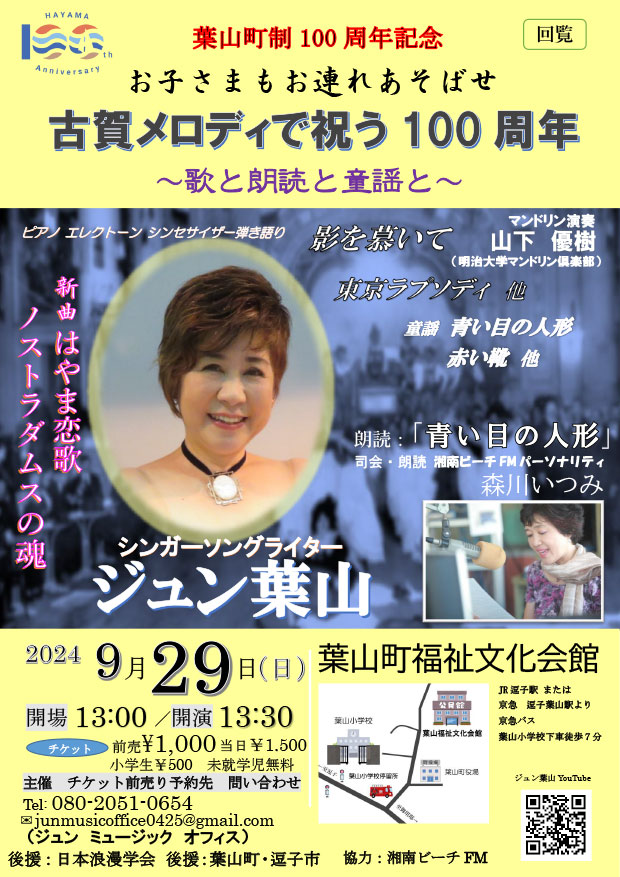
Hayama town's centenary. Please bring your children. Celebrate one hundred years with Koga melodies—songs, recitation and children's songs.
Singer-songwriter Jun Hayama: singing with piano, Electone and synthesizer. Mandolin: 山下優樹, Meiji University Mandolin Club. 「影を慕いて」, 「東京ラプソディ」 and other songs; children's songs 「青い目の人形」 and 「赤い靴」; new songs 「はやま恋歌」 and 「ノストラダムスの魂」.
Recitation: 「青い目の人形」. Host and reader: Shonan Beach FM presenter 森川いつみ.
Sunday, September 29, 2024. Hayama Town Welfare and Culture Hall. Doors 13:00; performance 13:30. Advance ¥1,000; on the day ¥1,500; elementary pupils ¥500; preschool children free. Take a Keikyu bus from JR Zushi Station or Keikyu Zushi-Hayama Station, get off at Hayama Elementary School and walk seven minutes. The map marks the station, bus stop, school, town hall, hall and intersections.
Organizer, advance tickets, reservations and inquiries: Jun Music Office, 080-2051-0654, [email protected]. Supported by the Japan Romanticism Academia, Hayama Town and Zushi City; cooperation by Shonan Beach FM. Jun Hayama YouTube.
Image 4: Flyer Reverse
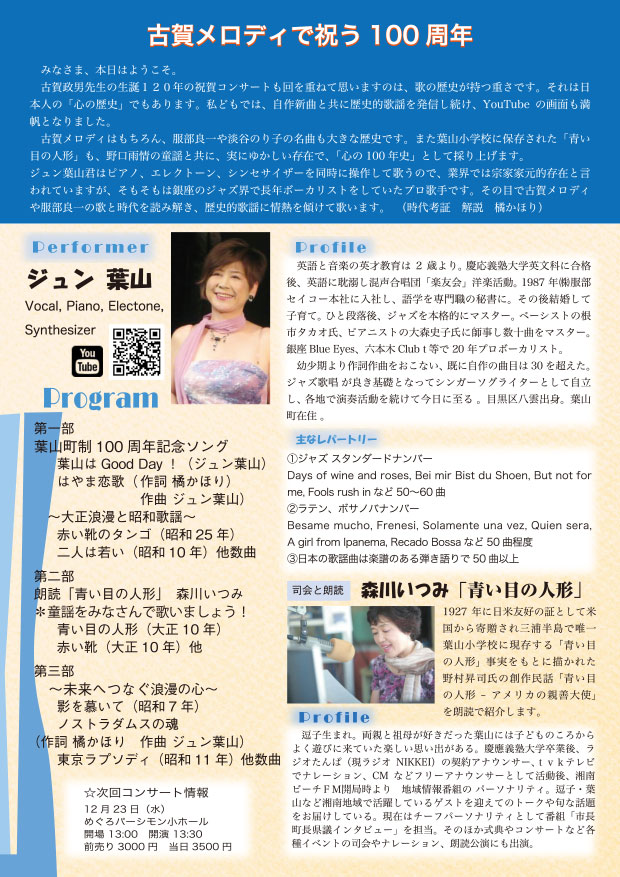
Celebrate One Hundred Years with Koga Melodies
Welcome, everyone. Today we place emphasis on song history in this concert celebrating the 120th anniversary of Masao Koga's birth. It is also the history of Japanese hearts. We continue to share historical popular songs alongside original new works, and our YouTube videos have become lively. Koga's melodies, of course, and famous songs by Hattori Ryoichi and Noriko Awaya are great history. Together with the children's song by 野口雨情 and the “blue-eyed doll” preserved at Hayama Elementary School, we explore them here as a century of the heart.
Jun operates piano, Electone and synthesizer simultaneously while singing: an unusual, multi-talented presence in the industry. With jazz as a foundation and a long career as a professional vocalist, she approaches famous Koga and Hattori melodies, and the poetry and songs that interpret their times, by bringing feeling to historical popular music.
Historical commentary and explanation: 橘かほり.
Performer — Jun Hayama
Vocal, Piano, Electone, Synthesizer
Her gifted education in English and music began at two. After entering the English Literature program at Keio's Faculty of Letters, she pursued Western music in the mixed chorus 「楽友会」. In 1987 she joined 服部セイコー and became a secretary specializing in languages. Marriage and child-rearing followed. Once those settled down, she studied jazz seriously with bassist 根市タカオ and pianist 大森史子, mastering several dozen pieces. She has performed as a professional vocalist for twenty years at venues including Blue Eyes in Ginza and Club t in Roppongi. She has written words and music from childhood, with more than thirty originals already. With jazz singing as a firm foundation, she became independent as a singer-songwriter and continues performing in many places. Born in Yakumo, Meguro; resident in Hayama.
Main repertoire: (1) Jazz standards: Days of wine and roses, Bei mir bist du Shoen, But not for me, Fools rush in and others, fifty to sixty songs. (2) Latin and bossa nova: Besame mucho, Frenesi, Solamente una vez, Quien sera, A girl from Ipanema, Recado Bossa and others, about fifty songs. (3) More than fifty Japanese popular songs, narrated with interesting anecdotes.
Program
Part 1 — Song commemorating Hayama town's centenary: 「葉山は Good Day!」 (Jun Hayama); 「はやま恋歌」 (lyrics 橘かほり; music Jun Hayama). Taisho romance and Showa songs: 「赤い靴のタンゴ」 (Showa 25), 「二人は若い」 (Showa 10), and others.
Part 2 — Recitation of 「青い目の人形」 by 森川いつみ. Let us all sing children's songs: 「青い目の人形」 (Taisho 10), 「赤い靴」 (Taisho 10), and others.
Part 3 — A romantic spirit connecting to the future: 「影を慕いて」 (Showa 7); 「ノストラダムスの魂」 (lyrics 橘かほり; music Jun Hayama); 「東京ラプソディ」 (Showa 11), and others.
Host and Reader: 森川いつみ — 青い目の人形
The “blue-eyed doll” sent from America in 1927 as a symbol of Japan–US friendship is the only one on the Miura Peninsula preserved at Hayama Elementary School. A recitation introduces 野村昇司's creative folk tale 「青い目の人形-アメリカの親善大使」, based on a true story.
Profile: Born in Zushi. She has fond memories of frequently visiting Hayama from childhood; her parents and grandmother loved the town. After graduating from Keio University, she was a contract announcer for Radio Tampa (now Radio NIKKEI) and worked as a freelance announcer on tvk television narration and commercials. From the opening of Shonan Beach FM, she presented local-information programs, inviting guests active in Zushi, Hayama and the wider Shonan area and bringing listeners conversations and timely topics. She currently serves as chief presenter of the program 「市長県議インタビュー」. She also hosts and narrates ceremonies, concerts and other events and appears in public readings.
Next Concert Information
December 23 (Wednesday), Meguro Persimmon Hall, Small Hall. Doors 13:00; performance 13:30. Advance ¥3,000; on the day ¥3,500.
Scope and source note: the historical notice and the program and flyer variants are retained as distinct sources. Song lyrics are not translated. The web walking-time text 「徒67分」, the six-minute and seven-minute directions, and the differing Monday/Wednesday labels for December 23 are kept as source differences. Organizational details, prices, career descriptions and announcements reflect the original documents. Names and historical assertions have not been independently corrected.
Original source images
Select an image to open its source. Text within images remains in its original language.
Original wording, author credits, notes and source materials are preserved there.