English translation of the prose
AI-assisted English translation of the prose; quoted poems remain in Japanese. The Japanese original remains authoritative.
Originally published: 12 November 2024. Historical announcement and four-page program for the concert on 23 December 2024.
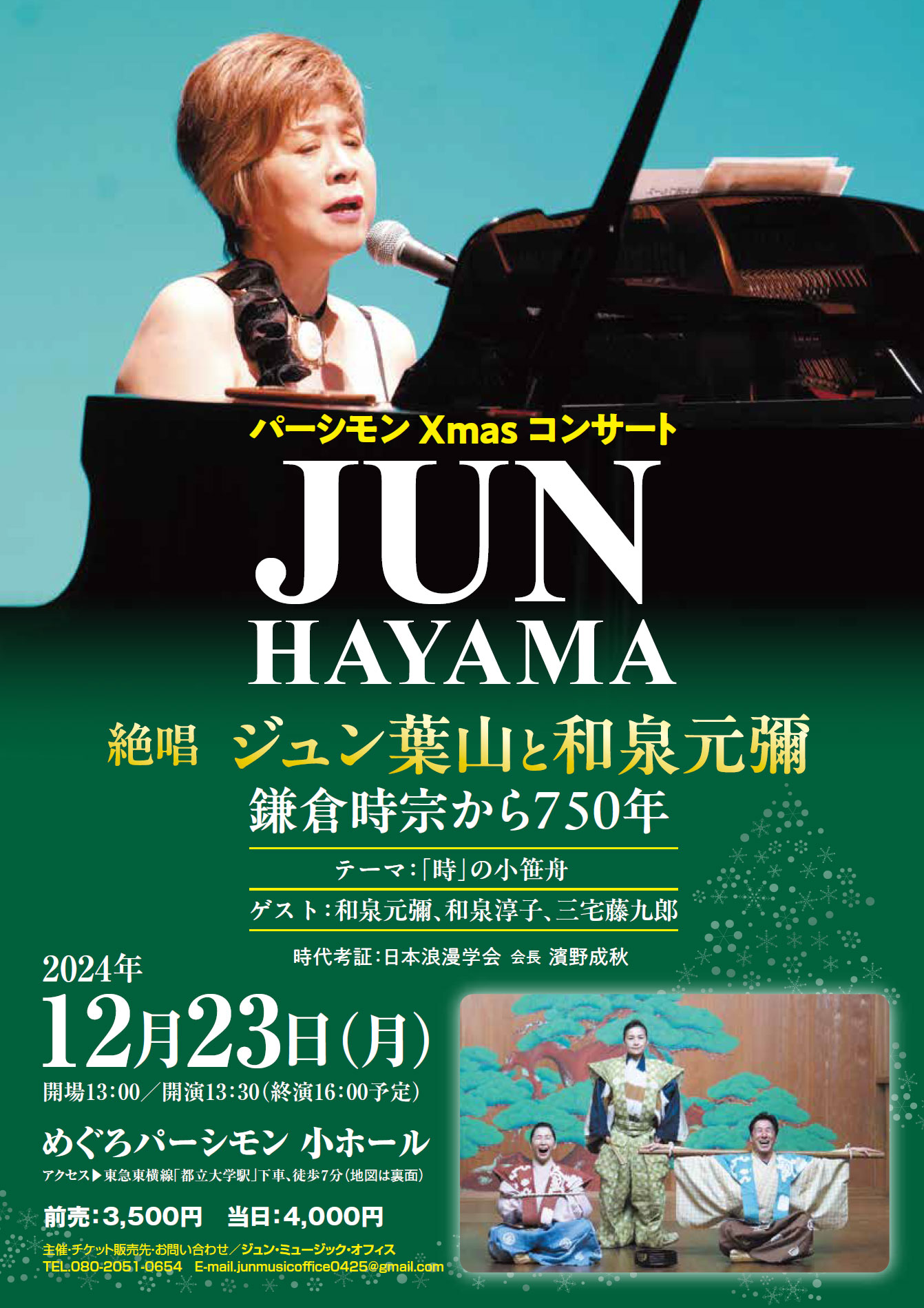
Persimmon Christmas Concert: Jun Hayama with Motoya Izumi
Passionate singing — 750 years since Tokimune’s Kamakura. Theme: “Time’s Little Bamboo-Leaf Boat.” Guests: Motoya Izumi, Junko Izumi, and Tokuro Miyake. Historical perspective and research: Seishu Hamano, President of Japan Romanticism Academia.
Monday, 23 December 2024. Doors 13:00; performance 13:30–16:00. Meguro Persimmon Hall, Small Hall, seven minutes on foot from Toritsu-Daigaku Station on the Tokyu Toyoko Line. Advance tickets ¥3,500; tickets on the day ¥4,000. Organizer, ticket sales, and inquiries: Jun Music Office, 080-2051-0654; [email protected].
This translation covers the announcement, biographies, program notes, access information, and following-concert notice. Dates, career stages, claims, and future plans follow the original program. Quoted Japanese poetry and lyrics remain untranslated.
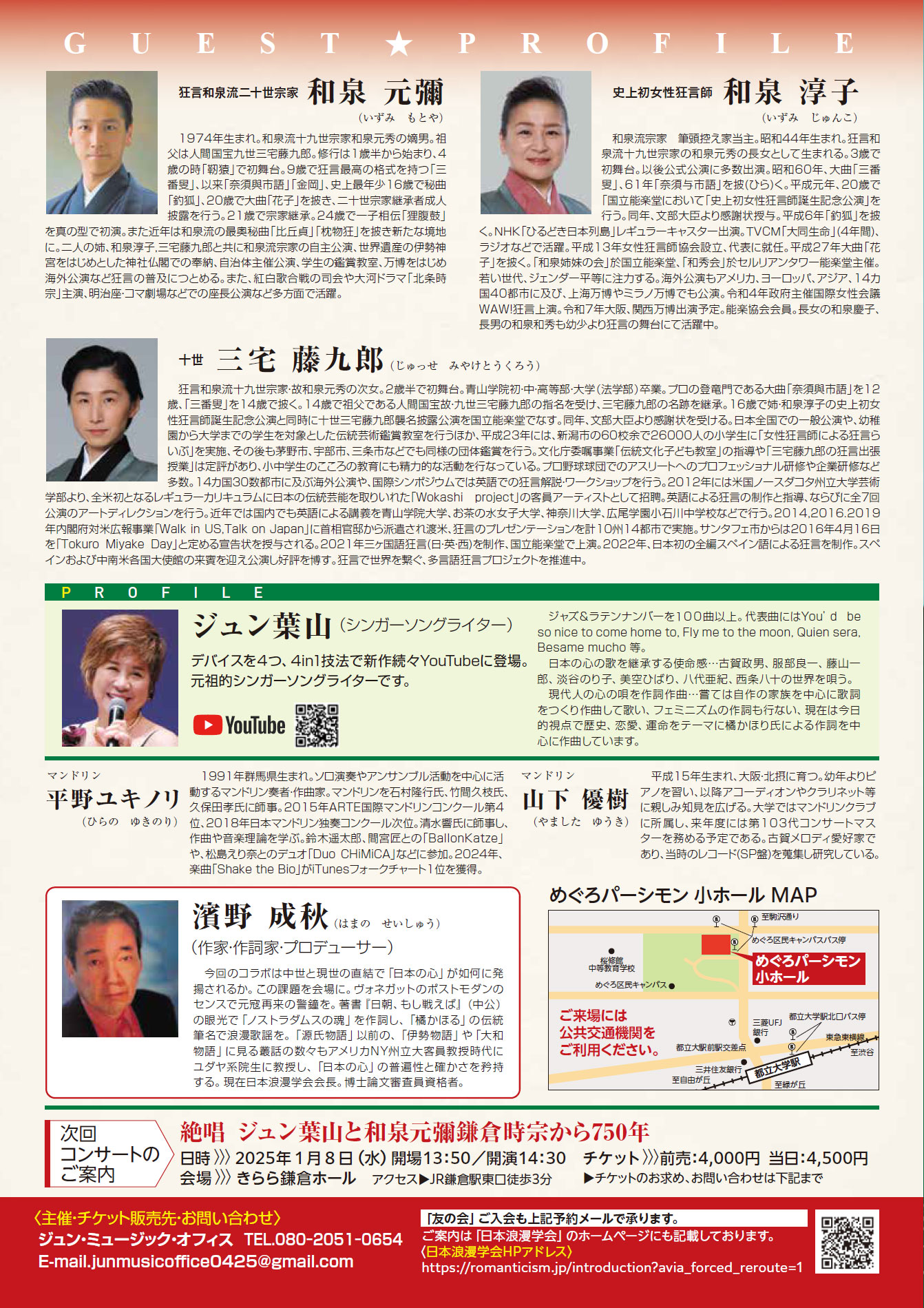
Guest profiles
Motoya Izumi — twentieth-generation head of the Izumi school of kyogen
Born in 1974, the legitimate son of Motohide Izumi, the nineteenth-generation head of the Izumi school. His grandfather was the Living National Treasure Tokuro Miyake IX. He began training at a year and a half and made his stage debut at four in Utsubozaru. At nine he performed Sanbaso, a work of the highest ceremonial standing in kyogen, followed by Nasunoyoichi and Kanaoka. At sixteen he became the youngest performer in history to undertake the secret piece Tsurigitsune. At twenty he performed the major work Hanago and held the presentation marking his coming of age as heir to the twentieth headship. He succeeded as head of the school at twenty-one. At twenty-four he first performed the shin form of 狸腹鼓, transmitted to a single heir.
In recent years he has opened new territory by performing 比丘貞 and 枕物狂, among the Izumi school’s most secret pieces. Together with his two elder sisters, Junko Izumi and Tokuro Miyake, he works to spread kyogen through the school’s own performances, votive performances at shrines and temples including the World Heritage site Ise Jingu, performances sponsored by local authorities, school appreciation programs, and overseas appearances including world expositions. He is also active in many other fields: hosting the Kohaku song contest, starring in the historical television drama Hojo Tokimune, and heading productions at the Meijiza and Koma theaters.
Junko Izumi — the first female kyogen performer in history
Head of the foremost supporting house of the Izumi school. Born in 1969, the eldest daughter of Motohide Izumi, the nineteenth-generation head of the kyogen school. She debuted at three and has appeared in numerous formal performances since. She performed the major work Sanbaso in 1985, followed by Nasunoyoichi in 1986. At twenty, in 1989, she gave a performance at the National Noh Theatre commemorating the emergence of the first female kyogen performer in history. That year she received a letter of appreciation from the Minister of Education. She undertook Tsurigitsune in 1994. She has also worked as a regular presenter on NHK’s Hirudoki Nihon Retto, appeared in Dai-ichi Life television commercials for four years, and been active in radio and other media.
In 2001 she founded the Association of Female Kyogen Performers and has remained its representative. She performed the major work Hanago in 2015. She organizes the “Izumi Sisters’ Association” performances at the National Noh Theatre and the “Washukai” at Cerulean Tower Noh Theatre, devoting particular effort to younger generations and gender equality. Her overseas performances have reached forty cities in fourteen countries across America, Europe, and Asia, including the Shanghai and Milan expositions. She appeared at WAW!, the government-sponsored international women’s conference, in 2022, and was scheduled to appear at Expo 2025 Osaka, Kansai. She is a member of the Nohgaku Performers’ Association. Her eldest daughter, 和泉慶子, and eldest son, 和泉和秀, have also been active on the kyogen stage since early childhood.
Tokuro Miyake X
The second daughter of the late Motohide Izumi, nineteenth-generation head of the Izumi school of kyogen. She debuted at two and a half and graduated from Aoyama Gakuin’s elementary, junior-high, and high schools and its university Faculty of Law. She performed Nasunoyoichi, the major piece regarded as a gateway to professional standing, at twelve, and Sanbaso at fourteen. At fourteen, on the recommendation of her grandfather, the late Living National Treasure Tokuro Miyake IX, she inherited the Tokuro Miyake name. At sixteen, alongside the commemorative performance marking her sister Junko’s emergence as the first female kyogen performer in history, she gave the performance announcing her succession as Tokuro Miyake X at the National Noh Theatre. In the same year she received a letter of appreciation from the Minister of Education.
In addition to general performances throughout Japan, she offers programs introducing traditional performing arts to students from kindergarten through university. In 2011 she conducted “Playing Kyogen with a Female Kyogen Performer” for 26,000 elementary-school pupils at sixty schools in Niigata City. Similar group experiences followed in Chino, Ube, Sanjo, and other cities. She has a reputation for teaching in the Agency for Cultural Affairs’ “Traditional Culture Classes for Children” program and for her traveling “Tokuro Miyake’s Kyogen Classes,” actively contributing to education during the elementary- and junior-high-school years. She also conducts numerous professional training sessions for athletes, including professional baseball teams, and for businesses.
Her overseas performances have reached more than thirty cities in fourteen countries, and she offers English-language explanations of kyogen and workshops at international symposia. In 2012 the Theatre Arts department of North Dakota State University invited her as a guest artist for the “Wokashi project,” the first regular US curriculum to incorporate Japanese traditional performing arts. She created and taught kyogen in English and provided artistic direction for all seven performances. In recent years she has also lectured in English in Japan at Aoyama Gakuin University, Ochanomizu University, Kanagawa University, and Hiroo Gakuen Koishikawa Junior High School, among other institutions.
In 2014, 2016, and 2019, she was sent to the United States by the Prime Minister’s Office for the Cabinet Office’s “Walk in US, Talk on Japan” public-relations program, presenting kyogen in fourteen cities across ten states. Santa Fe honored her with a declaration designating April 16, 2016, “Tokuro Miyake Day.” In 2021 she created trilingual kyogen in Japanese, English, and Spanish and performed it at the National Noh Theatre. In 2022 she created Japan’s first kyogen entirely in Spanish, earning acclaim in a performance attended by guests from the embassies of Spain and Central and South American countries. She continues promoting a multilingual kyogen project connecting the world through kyogen.
Performer profiles
Jun Hayama — singer-songwriter
Using four devices in a four-in-one technique, she brings new songs to YouTube: a pioneering singer-songwriter. Her repertoire includes over a hundred jazz and Latin standards, including “You’d be so nice to come home to,” “Fly me to the moon,” “Quien sera,” and “Besame mucho.”
With a mission to carry forward songs of the Japanese heart, she sings the worlds of Masao Koga, Ryoichi Hattori, Ichiro Fujiyama, Noriko Awaya, Hibari Misora, Aki Yashiro, and Yaso Saijo. She writes and composes songs of contemporary feeling. Her own lyrics formerly concerned her family and feminism; now she composes around Kahori’s words, approaching history, love, and destiny from the present.
Yukinori Hirano — mandolin
Born in Gunma Prefecture in 1991. A mandolin player and composer working primarily in solo performance and ensembles. He studied mandolin with 石村隆行, 竹間久枝, and 久保田孝. He placed fourth in the 2015 ARTE International Mandolin Competition and was a finalist in the 2018 Japan Mandolin Solo Competition. He studied composition and music theory with 清水響. He participates in BallonKatze with 鈴木遥太郎 and 間宮匠, and in Duo CHiMiCA with 松島えり奈. In 2024 his piece “Shake the Bio” reached number one on the iTunes Folk chart.
Yuki Yamashita — mandolin
Born in 2003 and raised in Kitahorie, Osaka. He began piano in childhood, later broadening his experience with accordion, clarinet, and other instruments. He belongs to his university’s mandolin club and is scheduled to become its 103rd concertmaster in the next academic year. A lover of Koga melodies, he collects and studies recordings from the period on 78-rpm discs.
Seishu Hamano — historical perspective and research
This collaboration directly connects medieval and modern Japan to ask how the “Japanese heart” can find expression. That is the question we bring to the venue. With Vonnegut’s postmodern sensibility, we sound an alarm about renewed Mongol invasions. With the foresight of my book 『日朝、もし戦えば』, published by Chuo Koron, I wrote the words to “Nostradamus no Tamashii.” Under the traditional pen name Kahori Tachibana, I undertake this performance of Japanese romantic popular song.
As a visiting professor at the State University of New York, I taught Jewish graduate students the range of literary discourse in The Tales of Ise and The Tales of Yamato, works preceding The Tale of Genji. I have confidence in the universality and solidity of the “Japanese heart.” I am currently president of Japan Romanticism Academia and qualified to examine doctoral dissertations.
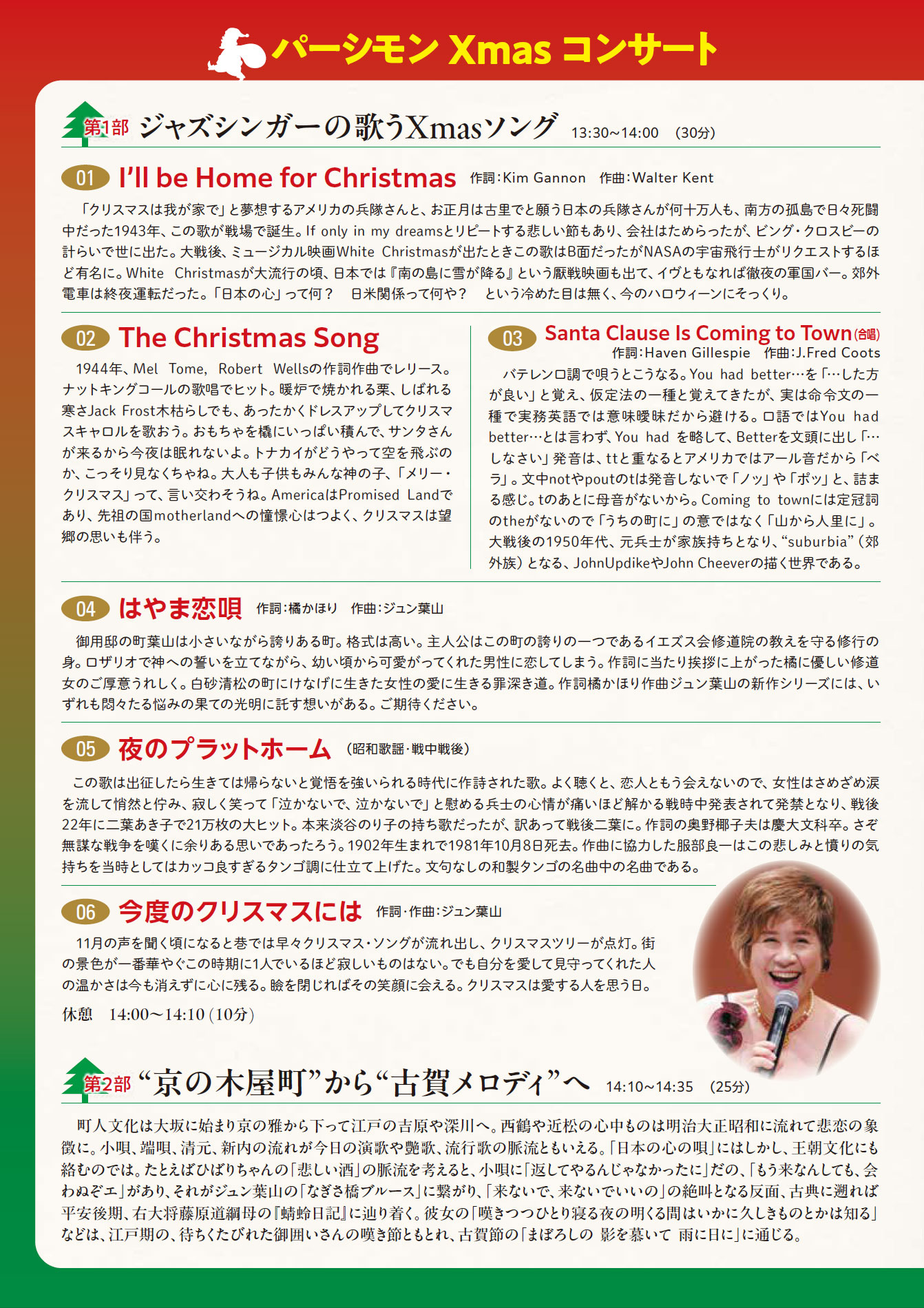
Part I: a jazz singer’s Christmas songs — 13:30–14:00
1. “I’ll Be Home for Christmas”
Words: Kim Gannon; music: Walter Kent.
American soldiers dreamed of Christmas at home, while Japanese soldiers wished to spend the New Year in their home villages. Hundreds of thousands of both were fighting for their lives day after day on isolated southern islands in 1943, when this song was born at the front. Its sad refrain repeats “If only in my dreams.” The company hesitated, but Bing Crosby’s arrangement made its release possible.
After the war, when the musical film White Christmas appeared, this song was on the B-side; NASA astronauts requested it, such was its fame. When “White Christmas” was enormously popular, Japan also had the antiwar film 『南の島に雪が降る』. On Christmas Eve, military bars stayed open late, while suburban trains ran all night. There were no cold looks asking “What about the Japanese heart?” or “What about Japan–US relations?” It was very like Halloween today.
2. “The Christmas Song”
Words and music: Mel Tome and Robert Wells, 1944. A hit for Nat King Cole.
Chestnuts roast by the hearth. Even with Jack Frost’s piercing cold, people dress warmly and sing Christmas carols. Santa is coming with his sleigh loaded with toys, so there will be no sleeping tonight: we must secretly watch how the reindeer fly. Adults and children are all God’s children. Let us say Merry Christmas to one another. America is the Promised Land, and the longing for the ancestors’ motherland is strong. Christmas brings homesickness with it.
3. “Santa Clause Is Coming to Town” — duet
Title as printed. Words: Haven Gillespie; music: J. Fred Coots.
This is a baritone’s song. We learn “You had better” as a subjunctive expression meaning “should,” but it has an imperative force; because of this ambiguity, it should be avoided in business. Americans omit “You had,” beginning with “Better” as a command. The double t becomes an American r-like sound, ベラ. The final t in “not” and “pout” is not voiced, ノッ and ポッ, with no added vowel.
“Town” has no article: it means coming from the mountains into a populated place, not specifically our town. This is the suburbia of veterans and their families in the 1950s, the world of Updike and Cheever.
4. “Hayama Koiuta”
Words: Kahori Tachibana; music: Jun Hayama.
Hayama, the town of the Imperial Villa, is small but proud and distinguished. The heroine lives in religious training, observing the teachings of the Jesuit convent of which this town is also proud. Despite making a vow to God with her rosary, she falls in love with the man who had shown her affection since she was little. Tachibana was pleased by the courtesy of the kind nun he greeted while preparing the lyrics. In this town of white sand and green pines, a woman boldly follows love’s deeply sinful path. Every new song in the series with words by Kahori Tachibana and music by Jun Hayama entrusts a hope to the light beyond continuing anguish. Please look forward to them.
5. “Yoru no Platform”
Words: Yashio Okuno; music: Ryoichi Hattori.
This song was written in an age when going to the front meant being forced to accept that one would not return alive. Listening closely, we hear a woman breaking into tears because she will never see her lover again. She stands forlornly, then smiles with loneliness. We painfully understand the soldier who comforts her with 泣かないで、泣かないで. Presented during the war, it was banned, then became a huge postwar hit for Akiko Futaba in Showa 22, 1947, selling 210,000 records. Originally Noriko Awaya’s song, it passed to Futaba after the war for particular reasons. Lyricist Yashio Okuno graduated from Keio’s Faculty of Letters. Surely he had every reason to lament the senseless war. Born in 1902, he died on 8 October 1981. Working with him, Ryoichi Hattori shaped those feelings of sorrow and anger into what was then a stylish tango. It is unquestionably one of the finest Japanese tangos.
6. “Kondo no Christmas ni”
Words and music: Jun Hayama.
Around November the city fills with Christmas songs and lights. It is the brightest season, but for someone alone it can be lonely. The warmth of loved ones watching over us remains close to the heart. Close your eyes and you can still see their smiles. Christmas is a time to think of those we love.
Intermission: 14:00–14:10, ten minutes.
Part II: from Kyoto’s Kiyamachi to Masao Koga — 14:10–14:35
The elegance of merchant culture in Osaka and Kyoto joins the worlds of Edo’s Yoshiwara and Fukagawa. From Saikaku and Chikamatsu onward, the tragic love of a double suicide became an enduring pattern through Meiji, Taisho, and Showa. Kouta, hauta, kiyomoto, and shinnai led toward enka and popular song: the Japanese heart together with courtly culture.
Hibari’s “Kanashii Sake” belongs to the lineage of kouta expressed in 返してやるんじゃなかったに and もう来なんしても、会わぬぞエ. Jun’s “Nagisabashi Blues,” with 来ないで、来ないでいいの, has a connection to it. In the late-Heian classic The Kagero Diary, the mother of Fujiwara no Michitsuna wrote:
嘆きつつひとり寝る夜の明くる間はいかに久しきものとかは知る
From this comes the lament of an Edo-period kept mistress waiting for her visitor, and onward to Koga’s まぼろしの 影を慕いて 雨に日に.
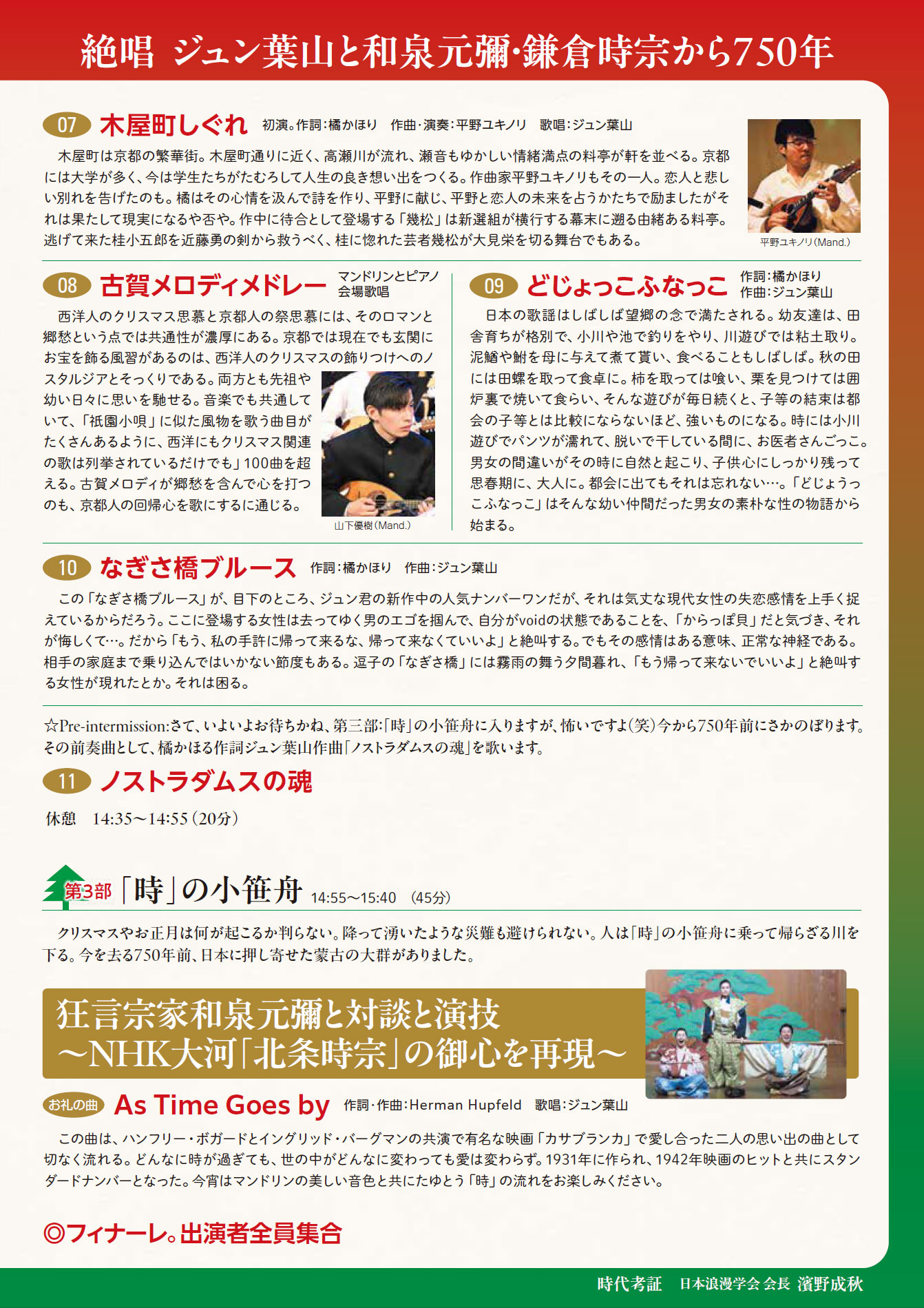
7. “Kiyamachi Shigure” — premiere
Words: Kahori Tachibana; composition and performance: Yukinori Hirano; singing: Jun Hayama.
Kiyamachi is Kyoto’s entertainment district. The Takase River flows near Kiyamachi-dori, where refined restaurants stand side by side in an elegant, atmospheric setting. Kyoto has many universities, and students today make happy memories there. Composer Yukinori Hirano is one of them: it is a place where he sadly parted from his beloved. Tachibana understood his feelings and dedicated these lyrics to him. He tried to encourage Hirano by predicting a future with his beloved, but perhaps it will indeed come true. The restaurant Ikumatsu, which appears as a meeting place in the song, retains the atmosphere of the late shogunate when the Shinsengumi roamed freely. It is also the setting for the dramatic scene in which the geisha Ikumatsu, in love with Katsura Kogoro, strikes a grand pose to save him from Kondo Isami’s sword after he flees to her.
8. Masao Koga medley
Mandolin and piano, with audience singing: Yukinori Hirano and Yuki Yamashita.
Western people’s feelings about Christmas and Kyoto people’s feelings about their festivals have much in common in romance and nostalgia. Even now, Kyoto people decorate their entrances with treasures, a custom very like Western nostalgia for Christmas decorations. Both bring ancestors and childhood to mind. Their music too has something in common: like the many songs of scenery and customs resembling “Gion Kouta,” the Western world has more than a hundred published Christmas songs alone. Koga melodies strike the heart with homesickness, much as Kyoto people put their longing to return into song.
9. “Dojokko Funakko”
Words: Kahori Tachibana; music: Jun Hayama.
Japanese song has often been filled with homesickness. Childhood friends, especially those brought up in the countryside, play at fishing in small streams and ponds, and gather clay during river play. They bring loaches and crucian carp to their mothers to cook and eat. In autumn they collect freshwater snails from the rice fields for the table, eat persimmons they have picked, and roast chestnuts by the hearth. When such play continues daily, the ties between children become incomparably stronger than those of city children. Sometimes their underpants get wet playing in a stream, and while they take them off and dry them they play at being doctors. Differences between boys and girls arise naturally then and stay firmly with the children into adolescence and adulthood. Even after moving to the city, they do not forget. “Dojokko Funakko” begins with that simple story of sexuality between a boy and girl who were childhood friends.
10. “Nagisabashi Blues”
Words: Kahori Tachibana; music: Jun Hayama.
“Nagisabashi Blues” is currently the most popular of Jun’s new songs, probably because it captures the feelings of a courageous modern woman whose love has ended. The woman seizes the departing man’s collar and becomes aware of her own void, her empty shell of a state. She resents it. That is why she cries out もう、私の手許に帰って来るな、帰って来なくていいよ. This is a normal human feeling. Yet there is restraint: she must not invade the other person’s family home. Imagine a woman in the misty twilight rain at Zushi’s Nagisabashi, crying that he need never return. That would be troublesome.
Before the intermission: Part III’s little boat of time, both frightening and amusing, carries us back 750 years. Its prelude is “Nostradamus no Tamashii,” with words by Kahori Tachibana and music by Jun Hayama.
11. “Nostradamus no Tamashii”
Intermission: 14:35–14:55, twenty minutes.
Part III: “Time’s Little Bamboo-Leaf Boat” — 14:55–15:40
Christmas and the New Year: we do not know what catastrophes await. Time’s little boat inevitably floats down a river from which there is no return, taking us back 750 years to the Mongol army.
Motoya Izumi presents kyogen talk and performance, recreating the heart of the world he portrayed in NHK’s Hojo Tokimune.
A song of thanks: “As Time Goes By,” words and music by Herman Hupfeld, sung by Jun Hayama. It flows poignantly as the lovers’ song of remembrance in Casablanca, famous for Humphrey Bogart and Ingrid Bergman. No matter how much time passes or the world changes, love does not change. Written in 1931, it became a standard with the success of the film in 1942. Tonight, please enjoy the flow of time with the beautiful sound of the mandolin.
Finale: all performers. Historical perspective and research: Seishu Hamano.
Access and the following concert, as advertised
Meguro Persimmon Hall, Small Hall: seven minutes on foot from Toritsu-Daigaku Station on the Tokyu Toyoko Line. Please use public transportation. The map marks Meguro Citizens’ Campus and its bus stop, Sakurashukan Secondary School, Mitsubishi UFJ Bank, Sumitomo Mitsui Banking Corporation, the station bus stop and intersections, and the directions toward Komazawa-dori, Shibuya, and Jiyugaoka.
Next concert: Wednesday, 8 January 2025, at Kirara Kamakura Hall, three minutes from JR Kamakura Station’s east exit. Doors 13:50; performance 14:30. Advance ¥4,000; on the day ¥4,500.
Friends’ Association members may reserve by email. Organizer, ticket sales, and inquiries: Jun Music Office, 080-2051-0654; [email protected]. Further information: Japan Romanticism Academia’s Japanese website.
Original source images
Select an image to open its source. Text within images remains in its original language.
Original wording, author credits, notes and source materials are preserved there.