English translation of the prose
AI-assisted English translation of the prose; quoted poems remain in Japanese. The Japanese original remains authoritative.
Originally published:
This is material published on the Japanese website. Dates and notices describe circumstances at the time of its original publication.
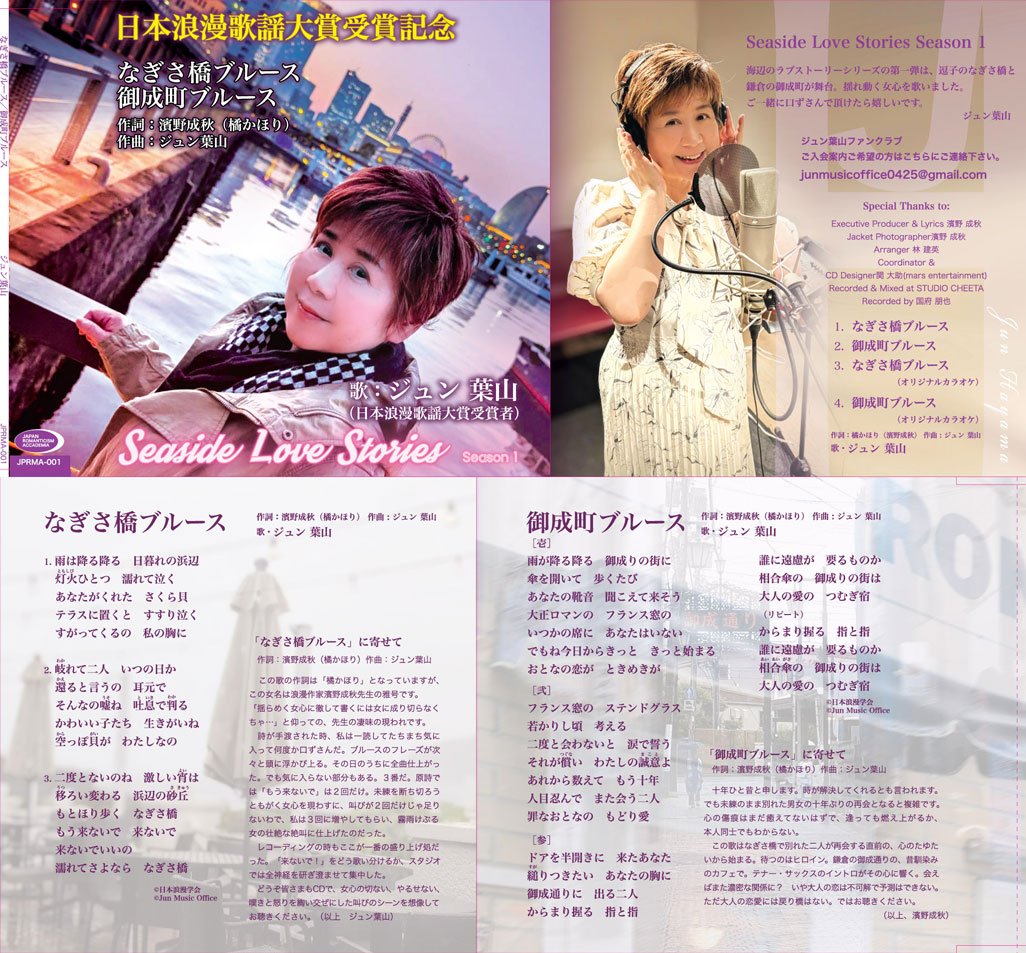
Commemorating the Japan Romanticism Popular Song Grand Prize
“Nagisabashi Blues” (なぎさ橋ブルース)
“Onarimachi Blues” (御成町ブルース)
Lyrics: Seishu Hamano (橘かおり, as written in the page text)
Music: Jun Hayama
Seaside Love Stories — Season 1
Vocals: Jun Hayama, recipient of the Japan Romanticism Popular Song Grand Prize.
JAPAN ROMANTICISM ACADEMIA
JPRMA-001
The first installment in this seaside love-story series is set at Nagisa Bridge in Zushi and in Kamakura's Onarimachi. I have sung the changing emotions of a woman's heart. I would be happy if you would hum along with me.
Jun Hayama
Jun Hayama Fan Club
If you would like information about joining, please contact:
[email protected]
Special Thanks to:
- Executive Producer & Lyrics: 濱野 成秋
- Jacket Photographer: 濱野 成秋
- Arranger: 林 建英
- Coordinator & CD Designer: 関 大助 (mars entertainment)
- Recorded & Mixed at STUDIO CHEETA
- Recorded by: the name is preserved in the original jacket image; its small lettering has not been confidently transcribed.
- “Nagisabashi Blues” (なぎさ橋ブルース)
- “Onarimachi Blues” (御成町ブルース)
- “Nagisabashi Blues” (なぎさ橋ブルース) — original karaoke backing track
- “Onarimachi Blues” (御成町ブルース) — original karaoke backing track
Lyrics: 橘かほり (Seishu Hamano)
Music and vocals: Jun Hayama
On “Nagisabashi Blues”
Lyrics: Seishu Hamano (橘かほり)
Music: Jun Hayama
The lyricist of this song is given as “橘かほり,” but this woman's name is the pen name of the Romantic writer Seishu Hamano. It expresses his humor: “To write devotedly about a woman's wavering heart, you've got to become a woman…”
When he handed me the poem, I loved it at first reading and found myself humming. Blues phrases rose one after another in my mind. The music was finished that same day. But there was a part I did not like: the third verse. In the original poem, “もう来ないで” appeared only twice. I felt that two cries were not enough to express the struggle of a woman trying to cut off her lingering attachment, and had it increased to three. We made it into a fierce cry from a woman fleeing the pain of love.
This was also the greatest climactic moment during recording. In the studio I sharpened every nerve and concentrated on how to distinguish the repetitions of “来ないで!”
As you listen to the CD, please imagine this scene of crying out, weaving together the aching sorrow and anger of a woman's heart.
Jun Hayama
On “Onarimachi Blues”
Lyrics: Seishu Hamano (橘かほり)
Music: Jun Hayama
They say ten years makes an age, and that time will resolve things. But a reunion after ten years between a man and a woman who parted with feelings unresolved is complicated. The embers in their hearts cannot yet have died away. Whether they will flare up when they meet is something even the two people concerned cannot know.
This song begins with the wavering of the heart just before the two people who parted at Nagisa Bridge meet again. It is the heroine who waits, in a familiar cafe on Kamakura's Onari-dori. The tenor saxophone's introduction echoes through her heart. When they meet, will they fall into an intimate relationship again? No one can predict the inscrutability of adult love. Yet there is no return ticket in an adult romance. Now, please listen.
Seishu Hamano
© 日本浪漫学会
© Jun Music Office
The two sets of song lyrics remain in Japanese in the original CD jacket. This English version covers the prose notes, track information and readable credits. One small-print recording credit remains untranscribed rather than guessed. The page text uses 橘かおり, while the jacket uses 橘かほり; both original spellings are retained in their respective credits. The fan-club contact is reproduced from the historical jacket.
Original source images
Select an image to open its source. Text within images remains in its original language.
Original wording, author credits, notes and source materials are preserved there.