English translation
AI-assisted English translation. The Japanese original remains authoritative.
Originally published: 9 December 2025.
How to make Ito shine more brightly than anywhere in the world
“Politics with Romanticism” with Councilor Sugimoto
Final symposium manuscript
Seishu Hamano, Japan Romanticism Society
Translation of the introductory web text and all nine pages of the symposium PDF. Statements, proposals, biographical assertions, and numerical comparisons are those of the original speakers at publication; they have not been rewritten as current factual guidance.
I chose this title from a single-minded wish to increase the appeal of Izu, which I love. It comes from the idea I have often voiced in university classrooms: scholarship must be useful to human society.
Mr. Sugimoto’s hometown is Ito, and he attended Ritsumeikan University in Kyoto. I was a graduate-school professor at Kyoto University of Foreign Studies, which also gives us common ground.
I would be very pleased if readers understood this as a discussion of international romanticism firmly rooted in Japanese society. Together with you, I will work for Ito, at the entrance to the Izu Peninsula.
Seishu Hamano
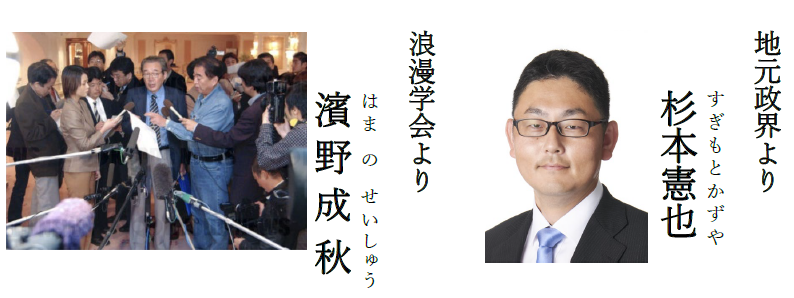
Participants: Kazuya Sugimoto (杉本憲也), from local politics; Seishu Hamano (濱野成秋), from the Japan Romanticism Society.
Japan and America are exceptionally compatible
Hamano: President Trump is stirring up the world now, almost as though insisting that what is acceptable everywhere depends entirely on him.
Sugimoto: One wants to ask when democratic America became a monarchy.
Hamano: He is impatient. Recognizing that his political life is limited makes him obsessive.
Sugimoto: He is too forceful, like Hitler. Japan was made to contribute ¥80 trillion too.
Hamano: He is intense because he is of German ancestry and comes from Fordham, which is something like a preparatory school for the law.
Sugimoto: You mean a Harvard-educated WASP would not move toward such extreme arguments?
Hamano: Yes. The intensity of the Germanic people is completely exposed.
Sugimoto: With things like that, some say inviting Americans to Japan would be dangerous.
Hamano: That is far too hasty a conclusion. From my experience living in America, there is no need to worry that ordinary people will also become overbearing. Since its founding, America has had Jeffersonian democracy in opposition to the imperial rule found in European countries, so there is no such concern. That is America’s strength.
America is a multiethnic country and the oldest democracy, and therefore deeply values freedom
Sugimoto: I think individual interests, or the expression of curiosity, matter in America. Outside politics, many people must be interested in Japanese history, architecture, gardens, hot springs, and so on.
Hamano: [Nodding.] Exactly. Japanese performing arts would do, as would dance or popular songs. They would probably like to see kabuki female-role performers like those in the film Kokuho, and enjoy the atmosphere of kouta or shinnai singing with shamisen. We could invite unpretentious professional singers to Ito and hold ballroom dancing at hotels.
Photograph caption, page 2: Tokaikan, a historic building in Ito.
Sugimoto: Ito’s conspicuous feature is its district of luxurious hot-spring hotels…
Hamano: And its human warmth. With Japanese attentiveness, we could offer Japanese dance and song performances after dinner, translate the lyrics into English, and leave explanatory English flyers in every room…
Sugimoto: Ah, yes. If visitors read those flyers before leaving their own country, they would watch with anticipation.
Hamano: Their appreciation would be all the greater. They would feel deeply glad they came. Back home, they would share those impressions and return with friends. Ito Onsen would become a place of exceptionally fine hospitality.
Begin with Japanese Americans: there are many descendants of Japanese immigrants
Sugimoto: I think we should first invite descendants of Japanese immigrants among American tourists.
Hamano: An excellent starting point. What should we do first?
Sugimoto: Visit the American embassy and consulates…
Hamano: That might help with publicity. In practice, however, prefectural associations and a 442nd RCT memorial institution would be good.
Sugimoto: The 442nd RCT?
Hamano: The Japanese American combat unit that received more decorations than any other American unit in World War II. Its remarkable record is still celebrated.
Sugimoto: The Nisei unit. They must be quite elderly now…
Hamano: But the director I know well is a veteran’s son, and the members are all close to their children and grandchildren.
Sugimoto: Come to think of it, hundreds of thousands of Japanese Americans in Hawaii have never visited Japan despite Japanese ancestry, and there are twice as many on the mainland.
Photograph caption, page 3: Ito’s coastline, full of a southern, tropical atmosphere.
Hamano: Even if they visit their ancestral hometowns on their own, those places have changed completely. So they tend to go only to Kyoto and Nara.
Build “Rest your legs at Ito’s hot springs” into tour packages
Sugimoto: After climbing Mount Fuji, they could rest at Ito Onsen…
Hamano: I think such visitors should also see the Toro archaeological site.
Sugimoto: Toro? In Shizuoka?
Hamano: Yes. It is particularly famous as a place where people lived in Japan’s Stone Age [the period named in the source]. It is in Shizuoka Prefecture, and Toro also has the offices of the Shizuoka Shimbun, which looked after the Japanese-language Hawaii Hochi. We need a strategy that includes it in packages before people leave their home country.
Sugimoto: The outline is becoming clearer.
Hamano: Outline? Oh yes, the outline of a strategy to make Ito the best in Japan.
Sugimoto: Yes. If I can contribute proposals for Ito’s prosperity as a citizen, I want the tourists now overflowing throughout Japan to come here and enjoy the finest hot-spring experience. This is a warm-hearted place, famous for high-quality waters where they can rest legs tired from climbing Fuji.
Hamano: Songs, dancing, and Japanese dance are also available; have these included in the itinerary before departure. I can advise on making Ito known as a delightful, high-quality resort filled with romanticism.
Sugimoto: Please do help us.
Next installment: education. End of the first discussion.
Photograph caption, page 4: Visit Mount Fuji and Toro, then Ito Onsen.
Second symposium: make Ito shine as a special education district too
Ito has a concentration of large hot-spring hotels near Tokyo, but its citizens are enthusiastic about education. With international competition in technology today, talent must be developed from early childhood or our children will lose at the forefront. Without firm teaching of care for parents, there will be nobody who loves and serves the hometown, and the city will depopulate.
Sugimoto comes from Ito and studied at Ritsumeikan in Kyoto, yet has splendidly flourished in his hometown. At that time, a Kyoto Seminar for scholars was held every summer, and I was invited to Kyoto to speak vigorously about American studies. In some respects, this symposium may be considered a result of those activities.
Participants again: Kazuya Sugimoto, from local politics; Seishu Hamano, from the Society.
The age of rigidly insisting on perfect scores is already out of date
Hamano: On the bus here, I saw a high-school student studying intensely while standing. He held an Eiken Grade Pre-1 practice book and was completely absorbed. I could not help telling him: “You are me in earlier days, studying hard and wasting no spare moment. I later became a professor at the State University of New York and lectured in English. Keep going like that.”
Sugimoto: Your generation was in the midst of fierce entrance-examination competition: the age of studying by firefly light and snowlight, as the saying goes. Perfect scores in everything.
Hamano: We said “four hours brings success, five brings failure”: sleep four hours a day and pass; five and fail. We studied ferociously through the remaining hours, begrudging even time to eat or bathe.
Sugimoto: Did you study ten hours a day?
Hamano: No, fifteen.
Sugimoto: Were you aiming for the University of Tokyo?
Hamano: No, Keio. But after entering its Faculty of Letters, there was another proficiency test for English literature. Ultimately, unless you placed within the top sixty-five of all 8,500 applicants, you were pushed into settling for another department.
Sugimoto: That is a terrible system.
Hamano: Terrible indeed. Long after we graduated, it was improved, and now they take everyone who wishes to study English literature.
Sugimoto: Yet that intense examination competition helped bring Japan to the point of being called “Japan as Number One.”
Hamano: At first, yes. But neighboring countries gradually began high-tech-centered technical education from early childhood. Sony’s diodes and Sharp’s organic displays now feel like brief fireworks of a transition. Sadly, this relates to Japanese early-childhood education…
Sugimoto: Population decline?
Hamano: Not only that. What I learned teaching in America was that Japan lost because its textbooks for young children contained too little knowledge.
If early education is too easy, the world will leave us behind
Sugimoto: Do American elementary and middle schools cover about twice as much as Japanese schools?
Hamano: About fifty times as much. The quantity of knowledge forming the foundation is vastly greater.
Sugimoto: The quantity of knowledge. In Japan we reduced it out of sympathy for children and kept recommending relaxed education. Was that the mistake?
Hamano: The problem was rigid perfectionism over a narrow range: on a hundred-point scale, 98 gets you Tokyo, 95 Kyoto, 90 Tohoku, and so forth.
Sugimoto: Limiting the scope to a little knowledge, praising a perfect score, or saying the top student averages 95…
Hamano: America expands learning to something like 5,000 points. Without a perfect score, 3,500 or 4,000 can take you to Harvard or Princeton. Japan should also move to a system where children who want more knowledge early in life may learn far more.
Sugimoto: I see. In a field where a child develops strongly, even a ten-year-old could learn the amount expected of a seventeen-year-old final-year high-school student. Learning what they like does not feel burdensome.
Photograph caption, page 7: Ito, ideally suited to cultivating the emotions and sensibilities.
Hamano: Do not impose it on children who feel it as a burden. For those who enjoy it, teach advanced technology from the early elementary years and let them become absorbed. Even generative AI, impossible for adults’ rigid minds, can be readily taken up by kindergarten children. In accordance with brain physiology, offer advanced learning as interesting stimulation, without strain, and develop many talents capable of competing worldwide.
Sugimoto: Such an approach is treated as discrimination, so everyone is adjusted to the lower level. In Japan this is called fairness, although it is reverse discrimination.
Hamano: Work according to aptitude, rather than discrimination. A child who likes food more than IT could receive an introduction to nutrition, learn delicious haute cuisine, and become a first-class chef.
Sugimoto: What happens to Japanese-language study?
Hamano: Naturally, children who love waka, haiku, or Soseki could read the Hyakunin Isshu, Narihira, Chikamatsu, or Shakespeare from elementary school. Assuming elementary pupils cannot understand them is uniform education. Starting songwriting and composition early can bring great development.
Introducing seminars is ideal
Sugimoto: If elementary schools adopted seminars, they would certainly produce many people who make distinctive leaps forward.
Hamano: Seminars twice or three times a week, all enjoyable. For example:
- IT programming: discover talent to lead Japan’s future industries. Even at third-grade level, children could develop things together with adults.
- Agricultural engineering: learn grain cultivation, factory growing of vegetables and fruit, and use of associated equipment.
- Hotel management: gain practical experience of hotel operation and management for the future.
- Media: learn reporting practice centered on television and make programs themselves.
- Power course: specialized entrance-examination preparation, an “early-maturation education” comparable to Kaisei junior and senior high school. By the first year of high school, roughly the knowledge needed to pass Tokyo or Kyoto University entrance examinations.
- Gourmet course: the specialty of Japan Women’s University’s home-economics faculty: practical Japanese cooking, training as a Japanese chef, French, Chinese, and Italian cuisine, and cake-making. Probably the most popular course.
- Performing arts and song: everything from lyrics and composition to a producer’s work, including the essentials of putting on a concert.
Sugimoto: With staff shortages, this would place unreasonable demands on elementary and middle-school teachers.
Hamano: [Nodding.] You are right. Every course would also need professional instructors. Cooking involves fire and hot oil, so a principal who prefers avoiding risks might hesitate to introduce some courses.
Sugimoto: I would also like English speech and competitive Hyakunin Isshu clubs, and many sports: baseball, soccer, volleyball, swimming…
Hamano: Mr. Sugimoto, you really have a balanced outlook. Intellectual, moral, and physical education are the three fundamentals of Japan’s educational ideals. Without that balance, excellent early education cannot be achieved. [Laughter; end.]
Read the original nine-page Japanese symposium manuscript, including photographs.
Original documents
The documents retain the language and wording of their original publication.
Original source images
Select an image to open its source. Text within images remains in its original language.
Original wording, author credits, notes and source materials are preserved there.