English translation of the prose
AI-assisted English translation of the prose; quoted poems remain in Japanese. The Japanese original remains authoritative.
AI-assisted English translation. The Japanese original remains authoritative.
Originally published:
This material was published on the Japanese website. Dates and notices in the text reflect the original publication.
New Year Popular Song and Pops Concert — January 22, 2026
This is a past announcement for the concert of January 22, 2026, preserved as a separate source about the same event. Differences from other articles in wording, song order and performers remain differences between versions.
Select the original four-page program for details. The following translation covers its prose, with lyric quotations retained in Japanese.
PDF Page 1 — Cover and Welcome
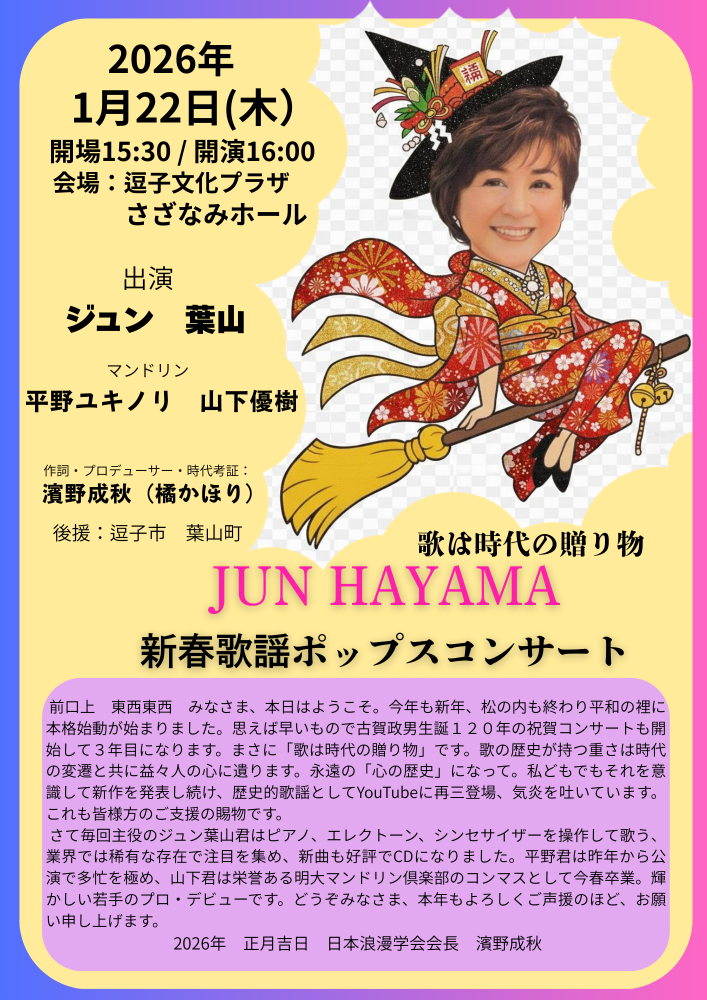
JUN HAYAMA — Songs Are Gifts from Their Times
New Year Popular Song and Pops Concert
- Thursday, January 22, 2026
- Doors 15:30; performance 16:00
- Venue: Sazanami Hall, Zushi Cultural Plaza
- Performer: Jun Hayama
- Mandolin: 平野ユキノリ and 山下優樹
- Lyrics, production and historical commentary: Seishu Hamano (橘かほり)
- Supported by Zushi City and Hayama Town
Opening Address
Attention, everyone, and welcome. The New Year festive season has ended, and ordinary activity is beginning in earnest under the peace we enjoy. How quickly time passes: this is already the third year since we began the concerts celebrating the 120th anniversary of Masao Koga's birth. Truly, songs are gifts from their times. The weight of song history remains ever more deeply in people's hearts as times change, becoming an eternal history of the heart. Conscious of this, we continue presenting new works, returning to YouTube as historical popular song with renewed spirit. This too is thanks to all your support.
Our regular leading performer, Jun Hayama, attracts attention as a rare presence in the industry, singing while operating piano, Electone and synthesizer. The new songs have also been well received and made into CDs. 平野 has been extraordinarily busy with performances since last year. 山下 will graduate this spring as concertmaster of Meiji's distinguished Mandolin Club: a brilliant young professional debut. We ask you all for your generous encouragement again this year.
An auspicious day of the New Year, 2026
Seishu Hamano, President, Japan Romanticism Academia
PDF Page 2 — Part 1: From the Present to a Century Ago
Historical commentary: Seishu Hamano
Exactly one hundred years ago, Hemingway's 『日はまた昇る』 appeared: the opening of hard-boiled fiction. Amid the Charleston dances of flappers excited by Fitzgerald's 『偉大なるギャッツビー』, published the year before, Japan, still suffering the aftereffects of the Great Kanto Earthquake, sought a way forward in building Manchukuo. Before slipping back into that age, let us begin with present-day Shibuya.
No. 1 — どじょっこふなっこ
Lyrics: Seishu Hamano. Music: Jun Hayama.
The children's song of the same name comes from Akita. It is a children's song told by becoming the creatures of a stream, setting the human world against the natural world. In this song, childhood friends, a boy and a girl who were mischievous children, come to Tokyo. Asked to sing at a friend's wedding reception, they awaken not to a “silver romance,” but to homesickness. What will become of Akita's loaches and crucian carp living in Shibuya's bustle? This new song, unfolding in the urban Japan of rapid economic growth, is a gift from its time.
No. 2 — 別れのブルース (1937)
Lyrics: 藤浦洸. Music: 服部良一.
Exquisite when sung by 淡谷のり子. It became enormously popular in the overseas territories; the military frowned. Several years later, during official entertainment for special-attack personnel, 淡谷 sang in tears as she watched young men salute, board Zero fighters and leave, even in the middle of a song. Their superior officers were crying too. The female students seeing them off shed tears upon tears. The author could not ignore the moist eyes of an innkeeper at Chiran airfield who had witnessed this scene every day.
No. 3 — なぎさ橋ブルース
Lyrics: Seishu Hamano. Music: Jun Hayama. CD available.
The time shifts to the present. Parting is painful. The place is Nagisa Bridge in Zushi. The man returns to the home where his wife and children wait. The heroine cries 「もう帰って来ないでいいの」, lamenting that she is already like 「からっぽの貝」. One can more than sympathize with her feelings. I wrote under a female-role pen name, but after release there was such a chorus of pity for the heroine that I ultimately wrote a sequel. It became No. 4, 「御成町ブルース」.
No. 4 — 御成町ブルース
Lyrics: Seishu Hamano. Music: Jun Hayama. CD available.
Ten years after the parting at Nagisa Bridge, the scene moves from Zushi to Onari-dori on the Enoden side of Kamakura Station. As an aside, this sort of reunion also appears in Edo kouta: 「近くへ来たときゃ寄りゃしゃんせ、誰に気兼ねがエ、あらうかいな」. Adult love is probably rather brazen. So it is in 「御成町ブルース」. After ten years, the pure feelings of one's twenties become worldly. A middle-aged woman waits in the café where they once met. What is her state of mind? This too is a gift of a generation to the age called the present.
With Mandolin
No. 5 — 蘇州夜曲 (1940)
Lyrics: 西条八十. Music: 服部良一. Vocal: Jun Hayama. Mandolin: 平野ユキノリ.
The year before the surprise attack on Pearl Harbor. A love story between a Japanese man and a Chinese woman amid increasingly complicated relations with a neighboring country. Suzhou is a city of waterways easily reached from Shanghai. Even now, many people float boats and enjoy an evening of spring. Enchanting scenes are 西条八十's specialty. Hanshan Temple is nearby. If you go, surely take your lover. Be aware, however, that the political situation is still unstable, and some may not welcome you.
No. 6 — 春が来た変奏曲
Mandolin: 平野ユキノリ.
Today we present 「春が来た」, a song announcing spring a little early, in an arrangement by 中野二郎. 中野 made 岡野貞一's original of the same name into an unaccompanied solo mandolin piece. Keeping the outline of the melody, he changes tone color, rhythm and layers of sound to broaden its expression. The further the variations progress, the more we glimpse the fascination of the same song transformed. Glittering harmonies and lingering resonance toward the end suggest the presence of spring, fitting for early spring, and give the work an independent character. (From the performer, 平野ユキノリ.)
PDF Page 3 — Program Continued
No. 7 — 魔法かけてみよう! — Premiere
Words and music: Jun Hayama.
『ひみつのアッコちゃん』—original work by 赤塚不二夫, animated from 1969—allowed its heroine to transform into anything by chanting 「テクマクマヤコン」. A great hit with girls then, it was the forerunner of the magical-girl series that continue today. I too was one of the girls who begged her parents to buy her a magic compact. But once grown up, one forgets those dreams and hopes, and every day becomes messy… No, wait: there must have been more I really wanted to do. Isn't it I who can change myself? We live only once. Recalling that childhood excitement and putting a little magic on myself produced this song. (Jun.)
Intermission
Fifteen-minute break. Part 2 begins at 16:55.
Part 2 — Youth in the Showa Thirties and Today
This was also when 「プティフルー」 was immensely popular. Pops from shopping-street loudspeakers every day put a spring in the steps of passersby. There were no CDs yet. LPs were flourishing and tape recorders becoming commonplace, moving from reels to cassettes that could be slipped into a pocket. Transistor radios also became a craze at this time. Car stereos used cassettes too. LP records were dubbed onto cassette tape. What a joyous, joyous age.
No. 8 — 学生時代
Words and music: 平岡精二. Everyone, join in!
As Peggy Hayama's signature number, it is sometimes called Aoyama Gakuin's song. It is widely sung, but not so much at Aoyama Gakuin. I taught American studies in its evening division for fifteen years. Peggy was in good spirits; we consulted about reviving Fiddler on the Roof, and English Literature students invited me to attend Mass in the chapel… Looking back, those days were just like the song's words. Yet returning to the campus now, I see only unfamiliar faces. My days as a teacher are a dream, a dream…
From Producer Seishu Hamano — The Professional Debut of 山下優樹 in the Lineage of Masao Koga
Today we introduce another accomplished player in Japan's mandolin world: 山下優樹. He is due to graduate from Meiji University this spring, making his professional debut from the position of concertmaster of the distinguished Mandolin Club founded by Masao Koga. When he plays a Koga melody, its feeling sinks poignantly into everyone's heart. Jun and I have thought about him together: he seems like a young man from a 竹久夢二 painting. Please welcome him with applause.
No. 9 — A Selection of Mandolin Masterpieces
We will perform three carefully selected pieces whose originals used mandolin. The first is 『つぐない』, poignantly sung by Teresa Teng and a hit in Showa 59. Next comes the theme from 『太陽がいっぱい』, the Franco-Italian film that became a great success starring the celebrated actor Alain Delon. Finally, there is 「丘を越えて」, a representative work of Masao Koga, who founded the Meiji University Mandolin Club where I serve as concertmaster. Please listen while immersing yourselves in fond memories of those days and times. (山下.)
No. 10 — 春の海
Performed by 平野ユキノリ and 山下優樹.
This piece, surely the first that comes to anyone's mind as New Year music, was composed in Showa 4 by 宮城検校, known as 宮城道雄. Even now, nearly a hundred years after its composition, it is highly regarded in Japan and abroad. A masterpiece that brought fresh air into the traditional-music world of its time, it continues to be performed without falling out of favor. Playing the entire original takes around seven minutes, so today we will excerpt the section everyone knows. (山下.)
PDF Page 4 — Final Songs, Profiles and Information
No. 11 — 尽くして拒んで泣きぬれて — Premiere
Lyrics: Seishu Hamano. Music: Jun Hayama.
A new song for early spring. It sings of the final reaches of a couple's love, following 「御成町ブルース」, set ten years after 「なぎさ橋ブルース」. There was an upheaval before this new work appeared: an entire song was shelved. See the Japan Romanticism Academia website for details. Search for 「みそぎ橋ブルース」.
No. 12 — ノストラダムスの魂
Lyrics: Seishu Hamano. Music: Jun Hayama.
橘かほり's lyric tells a chilling tale of a fortune teller: a chant of a soul flying through space and time to carry you into a world of fantasy. To break a dark destiny, one must become a monk who breaks the precepts. Both Koga and Hattori had a deity dwelling in their souls. As the song's words say, 「暗い運命にうらぶれ果てし身を」, they set themselves free and built brilliant lives. Jun and 成秋 dedicate this song to those two great predecessors and their distinguished achievements.
No. 13 — もう一度直球勝負!
Words and music: Jun Hayama. For the finale, everyone meets it head-on!
This is a woman's song of rousing herself. Men of the world, do not underestimate women. Oh, frightening! Did you know that feminism is not a fashionable word that began only now? It was also the central concern of 平塚らいてう and the members of 『青鞜』 in the Meiji thirties.
Profile
Jun Hayama — Singer-Songwriter
Born in Meguro in 1965. Her gifts for English and music emerged at two, and she awakened to Western music in elementary school. Graduated from the English and American Literature major at Keio University's Faculty of Letters. While a student she belonged to the mixed chorus 「楽友会」. Joined 服部セイコー Co., Ltd. in 1987 and became secretary to an executive managing director. Once marriage and child-rearing settled down, her love of music returned. She studied jazz with bassist 根市タカオ and pianist 大森史子, performing as a jazz and Latin vocalist in Ginza and Roppongi. Began writing words and music in 2018 and became independent as a singer-songwriter in 2020. Appeared on tvk's 「あっぱれKANAGAWA大行進」 in 2023, TV Tokyo's 「モヤモヤさまぁ〜ず2」 in 2024 and BS Nippon TV's 「歌謡プレミアム」 in 2025, receiving favorable responses.
YouTube channel; SNS: Instagram, Facebook and X.
Seishu Hamano — Producer, Writer and Lyricist
Wrote 「ノストラダムスの魂」 from the perspective of the author of 『日朝、もし戦えば』 (中央公論社). His pen name 「橘かほり」 comes from his family crest. As a visiting professor at the State University of New York, he spoke of the ghostly world of medieval Japanese literature. He contributed serial articles on American postmodern literature to Japanese literary magazines. He has lectured at Meiji, Hitotsubashi, Waseda and Aoyama Gakuin universities, among others. Former Professor in the Department of Literature, Japan Women's University; currently President of the Japan Romanticism Academia. Qualified to examine doctoral dissertations. Author and editor of many books. Japan Romanticism Academia website.
平野ユキノリ — Mandolin, Composer
Born in Takasaki, Gunma. Began mandolin at Takasaki High School and trained with the Doshisha University Mandolin Club. Active from bases in Tokyo, Gunma and Shizuoka. Third prize in the international “Jazz Conpe” in 2025; fourth in the Japanese solo competition in 2018; fourth internationally at ARTE in 2015. 『Shake the Bio』 reached No. 1 in iTunes Folk; 『Raga Soma』 reached Apple Music Top30. Studied with 石村隆行, 久保田孝 and 竹間久枝, and composition with 清水響.
山下優樹 — Mandolin, Composer
Grew up in Hokusetsu, Osaka, familiar from early childhood with instruments such as piano and clarinet. Upon entering university, joined the Meiji University Mandolin Club founded by Masao Koga and others. Served as its 102nd concertmaster in Reiwa 5. Onstage he plays not only mandolin but also balalaika, taishogoto, requinto guitar, mandola, accordion and various other instruments, approaching a reassessment of popular music.
More Information
Next concert: Saturday, May 30, 2026. Doors 13:00; performance 13:30. Kamakura Lifelong Learning Center, Kirara Kamakura.
Organizer, reservations and inquiries: Jun Music Office. TEL: 090-4822-0935. [email protected].
Translation note: all four PDF pages were read visually and their prose translated; the linked PNG repeats the cover. Japanese lyric quotations remain untranslated. Names, dates, performer profiles and historical claims follow this particular program and have not been independently verified or reconciled with other versions. “An auspicious day of the New Year” is not assigned an exact date. The later concert notice and sales references belong to the original program.
Original documents
The documents retain the language and wording of their original publication.
Original source images
Select an image to open its source. Text within images remains in its original language.
Original wording, author credits, notes and source materials are preserved there.