English translation of the prose
AI-assisted English translation of the prose; quoted poems remain in Japanese. The Japanese original remains authoritative.
Originally published: 28 May 2026. Historical concert program for Saturday, 30 May 2026.
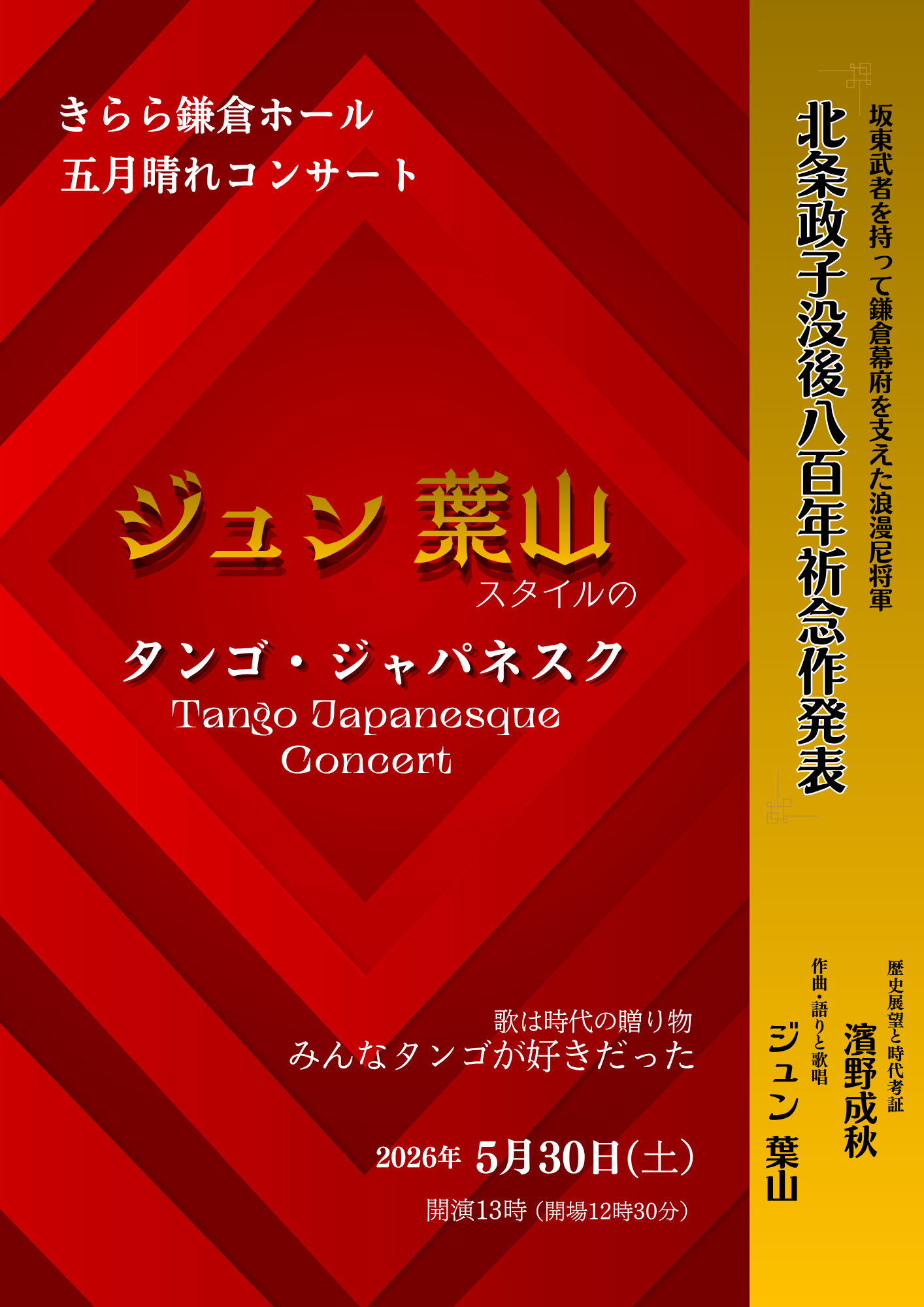
Clear May Skies Concert: Jun Hayama’s Tango Japanesque
Kirara Kamakura Hall. Performance at 13:00; doors at 12:30, as printed on this program.
“Songs Are Gifts from Their Times — Everyone Loved Tango.” Presentation of a commemorative work marking 800 years since Hojo Masako’s death: the romantic nun-shogun who led the warriors of eastern Japan in supporting the Kamakura government. Historical perspective and research: Seishu Hamano. Composition, narration, and singing: Jun Hayama.
English translation of the prose on all four program pages, including handwritten additions. Historical interpretations and biographical descriptions follow this source; quoted lyrics remain in Japanese.
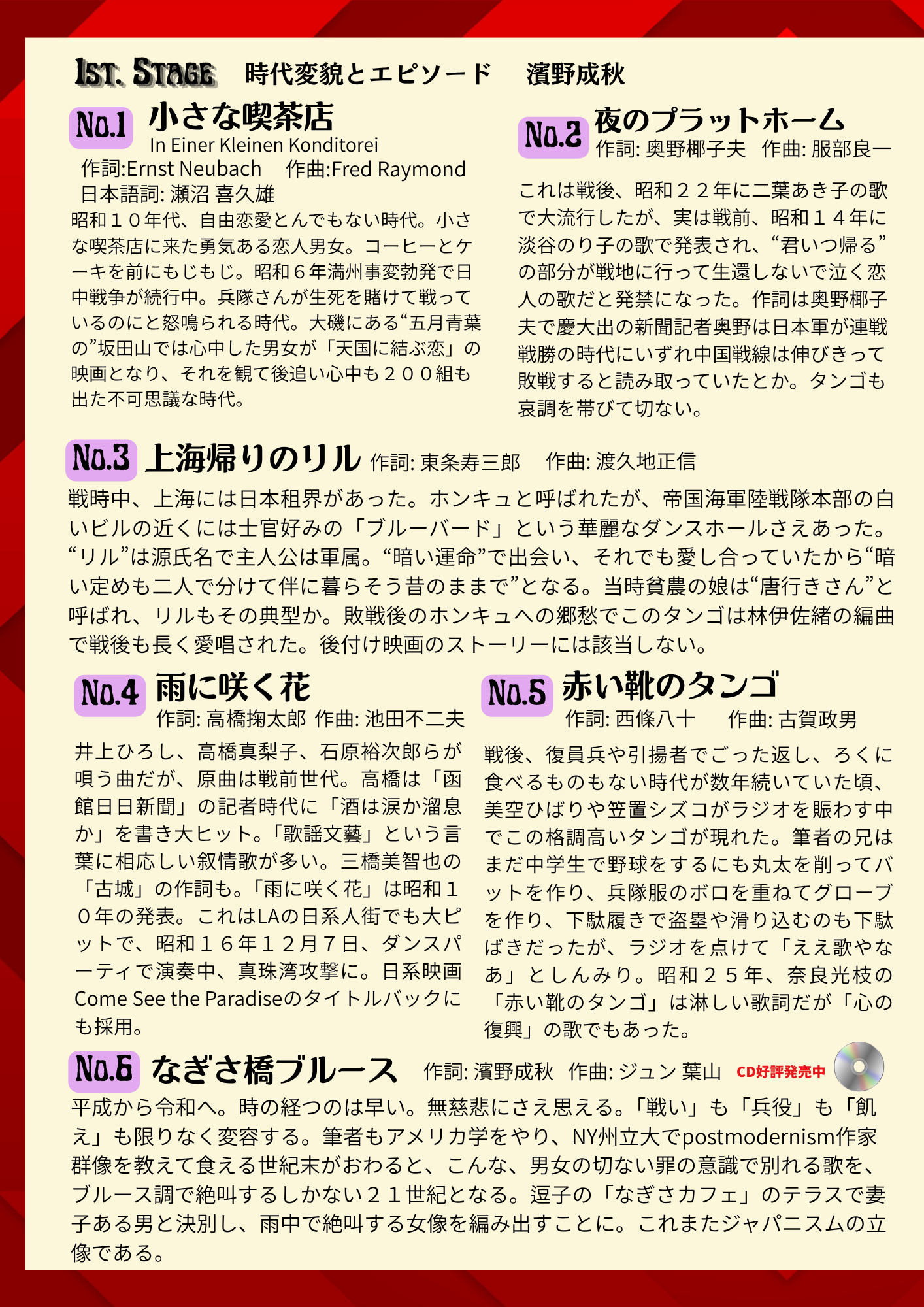
First stage: changing times and episodes — Seishu Hamano
1. “Chiisana Kissaten” — “In Einer Kleinen Konditorei”
Words: Ernst Neubach; music: Fred Raymond; Japanese words: 瀬沼喜久雄.
The decade beginning in Showa 10, 1935, was an age when freely chosen love was considered outrageous. A courageous couple in a little café sits fidgeting before coffee and cake. Since the Manchurian Incident in Showa 6, 1931, war with China was continuing. This was an age when people were scolded because soldiers were risking their lives while others indulged themselves. At Sakata Mountain in Oiso, associated with 五月青葉の, a couple’s double suicide became the film Tengoku ni Musubu Koi. It was a strange era in which as many as two hundred couples followed their example after seeing it.
2. “Yoru no Platform”
Words: Yashio Okuno; music: Ryoichi Hattori.
It became a great postwar hit sung by Akiko Futaba in Showa 22, 1947, but was first presented by Noriko Awaya in Showa 14, 1939. The phrase 君いつ帰る was taken as a lover’s tears for someone who would not return alive from the front, and the song was banned. Lyricist Okuno, a Keio-educated newspaper reporter, is said to have foreseen that even amid repeated Japanese victories, the Chinese front would eventually become overstretched and Japan would lose. The tango too carries a poignant lament.
3. “Shanghai Gaeri no Lil”
Words: 東条寿三郎; music: 渡久地政信.
During the war Shanghai had a Japanese concession called Hongkou. Near the Imperial Navy landing-force headquarters’ white building stood an elegant dance hall, the Bluebird, favored by officers. “Lil” is a professional alias, and the protagonist is a civilian attached to the military. They met under 暗い運命 but still loved each other, giving rise to 暗い定めも二人で分けて伴に暮らそう昔のままで. Daughters of poor farmers were then called karayuki-san; perhaps Lil was another example. After defeat, this tango’s nostalgia for Hongkou, in Isao Hayashi’s arrangement, remained beloved for many years. It does not fit the story of the film made afterward.
4. “Ame ni Saku Hana”
Words: 高橋掬太郎; music: 池田不二男.
Sung by Hiroshi Inoue, Mariko Takahashi, Yujiro Ishihara, and others, the original belongs to the prewar generation. While a reporter for the Hakodate Nichinichi Shimbun, Takahashi wrote the huge hit “Sake wa Namida ka Tameiki ka.” Many of his lyrical songs deserve the term “song literature”; he also wrote the words to Michiya Mihashi’s “Kojo.” “Ame ni Saku Hana” appeared in Showa 10, 1935. It was a major hit in Los Angeles’ Japanese district too, and on 7 December 1941 it was being played at a dance party when Pearl Harbor was attacked. It also appears in the opening titles of the Japanese American film Come See the Paradise.
5. “Akai Kutsu no Tango”
Words: Yaso Saijo; music: Masao Koga.
After the war, the country was crowded with demobilized soldiers and repatriates, and years passed with scarcely enough to eat. While Hibari Misora and Shizuko Kasagi filled the radio, this dignified tango appeared. My elder brother, then still in middle school, carved a log into a baseball bat and layered scraps of military uniform to make a glove. He even stole bases and slid while wearing wooden clogs. Turning on the radio, he would quietly say, “What a good song.” Released in Showa 25, 1950, Mitsue Nara’s “Akai Kutsu no Tango” had lonely lyrics but was also a song of the heart’s recovery.
6. “Nagisabashi Blues”
Words: Seishu Hamano; music: Jun Hayama. CD advertised as on sale.
From Heisei to Reiwa, time passes quickly, almost mercilessly. War, military service, and hunger endlessly change their forms. At the century’s end I earned my living in American studies, teaching portraits of postmodernist writers at the State University of New York. When that ended, the twenty-first century brought songs in which a man and woman must cry out their painful parting and guilt in blues style. Creating the figure of a woman who parts from a married man with children on the terrace of Zushi’s Nagisa Café and cries out in the rain: this too gives form to Japanism.
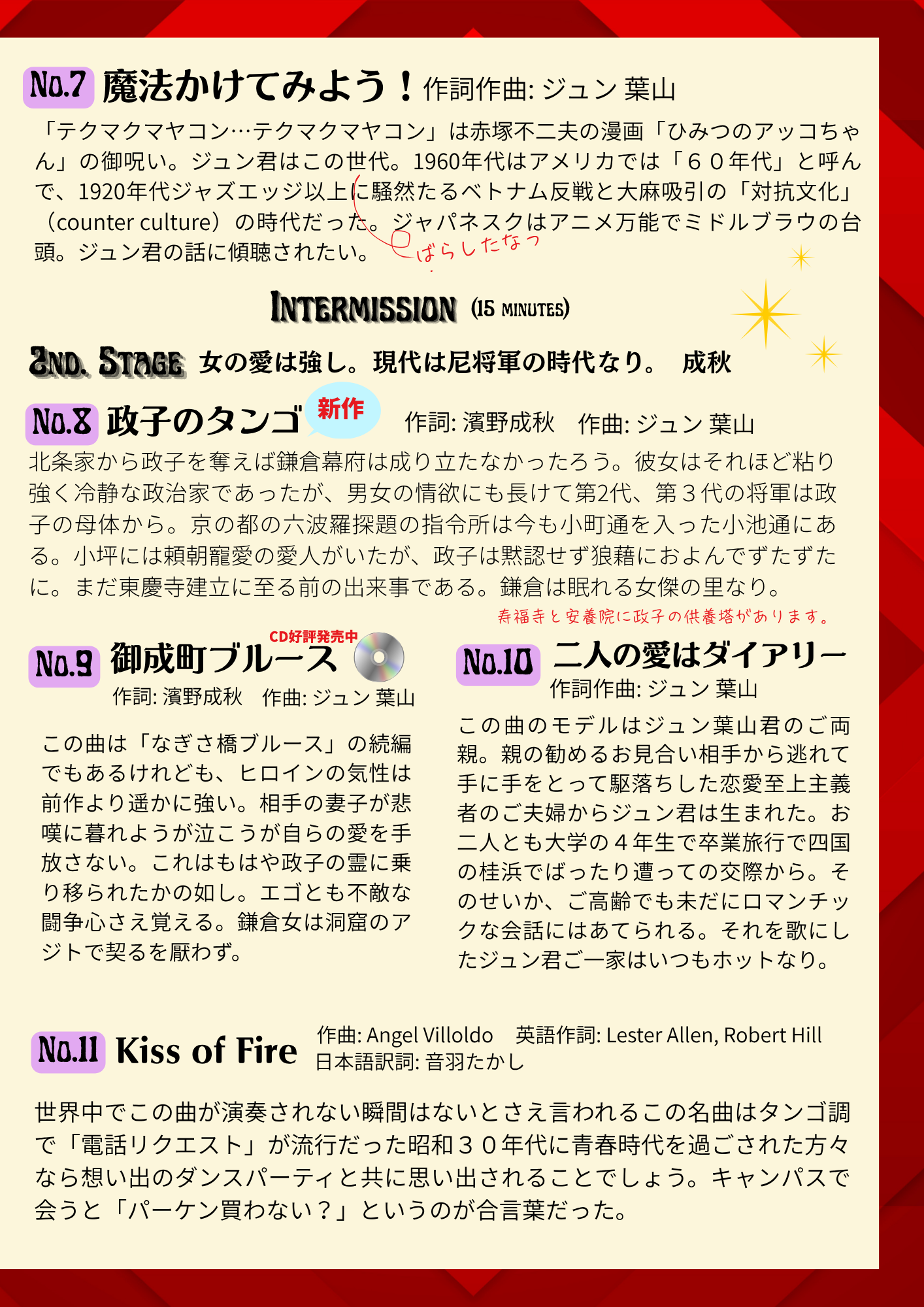
7. “Maho Kakete Miyo!”
Words and music: Jun Hayama.
“Tekumaku Mayakon…Tekumaku Mayakon” is the spell from Fujio Akatsuka’s manga Himitsu no Akko-chan. Jun belongs to that generation. In America, the 1960s were called “the Sixties,” an age of counterculture, with opposition to the Vietnam War and marijuana smoking creating greater tumult than the 1920s Jazz Age. In Japanesque culture, anime was everywhere and the middlebrow rose. Please listen closely to Jun’s account. A handwritten aside responds: “You gave that away!”
Intermission: 15 minutes.
Second stage: a woman’s love is strong; ours is the age of the nun-shogun — Seishu
8. “Masako no Tango” — new work
Words: Seishu Hamano; music: Jun Hayama.
Take Masako from the Hojo family and the Kamakura government would probably never have come into being. She was that persistent and cool-headed a politician, yet also versed in passion between men and women: the second and third shoguns came from her own body. The Rokuhara Tandai’s headquarters in Kyoto remains on Koike Street, entered from Komachi Street, as the program describes it. In Kotsubo lived a lover whom Yoritomo adored, but Masako would not tolerate it and had the place violently destroyed. This happened before Tokeiji’s founding. Kamakura is a land of sleeping heroines.
Handwritten addition: Masako has memorial towers at Jufukuji and An’yoin.
9. “Onarimachi Blues”
Words: Seishu Hamano; music: Jun Hayama. CD advertised as on sale.
A sequel to “Nagisabashi Blues,” but its heroine is far stronger-willed. Whatever misery her lover’s wife and children suffer, she refuses to relinquish her love. It is as though Masako’s spirit has possessed her. One senses egoism and even a fearless fighting spirit. A Kamakura woman would not shrink from making a lovers’ pact in a cave hideout.
10. “Futari no Ai wa Diary”
Words and music: Jun Hayama.
The models for this song are Jun Hayama’s parents. They escaped the arranged matches recommended by their parents and eloped hand in hand, believing above all in love; Jun was born to this couple. Both were fourth-year university students when they met by chance at Katsurahama in Shikoku on graduation trips and began their relationship. Perhaps for that reason, even in old age their romantic conversation still overwhelms us. Jun made it into a song; her family is always full of warmth.
11. “Kiss of Fire”
Music: Angel Villoldo; English words: Lester Allen, Robert Hill; Japanese words: 音羽たかし.
It is even said that there is no moment when this famous tango is not being played somewhere in the world. Those whose youth fell in the decade beginning in Showa 30, 1955, when telephone request programs were popular, will recall it with their dance parties. On campus, “Want to buy a party ticket?” was the familiar greeting.
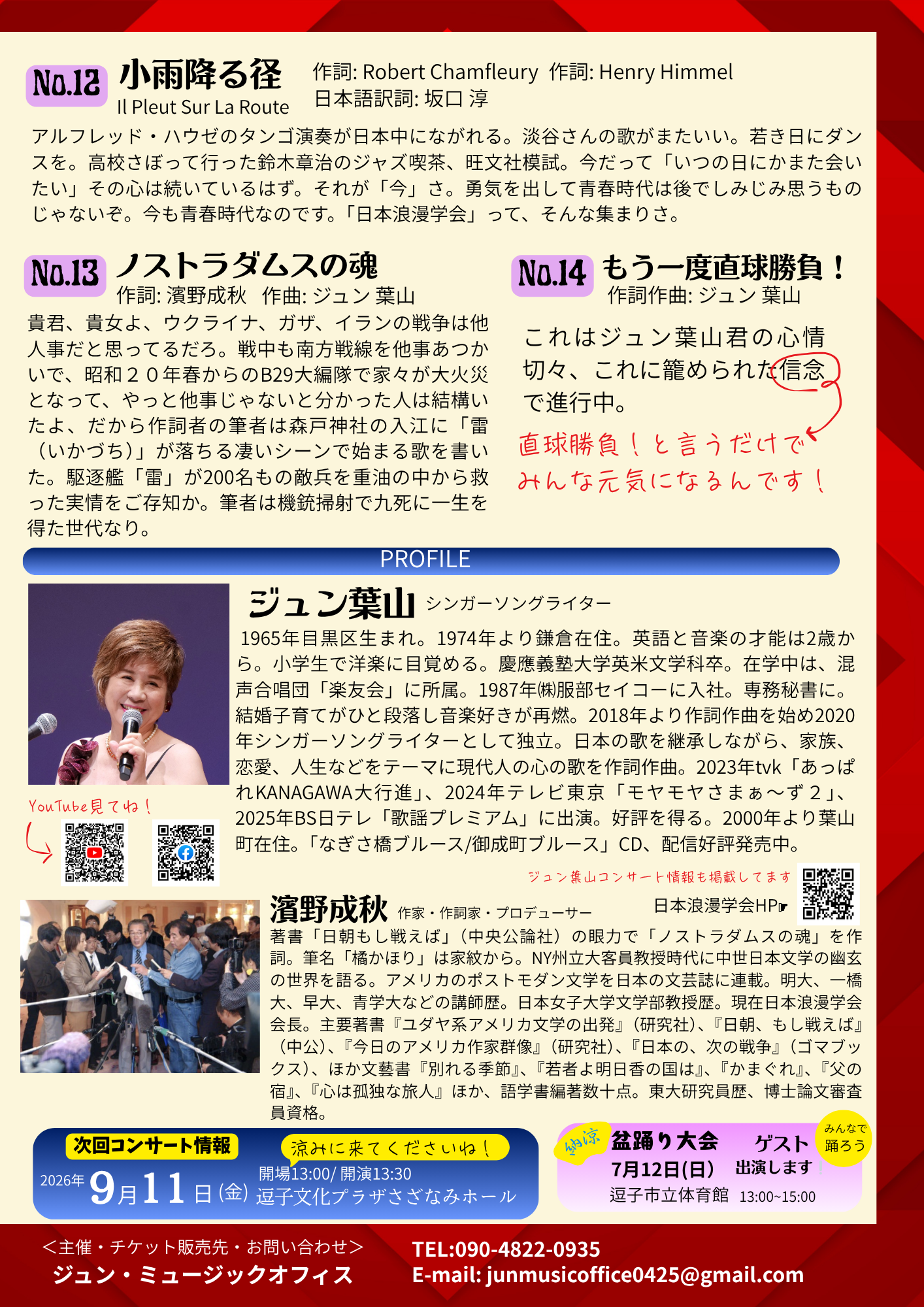
12. “Kosame Furu Michi” — “Il Pleut Sur La Route”
Robert Chamfleury and Henry Himmel are both labeled as lyricists in the original program; Japanese words: 坂口淳. The duplicated credit label is retained here.
Alfred Hause’s tango performances played throughout Japan, and Awaya’s singing was wonderful too. Dancing in youth; skipping high school to visit Shoji Suzuki’s jazz café; preparing for the Obunsha mock examinations. Even now, the wish expressed by いつの日にかまた会いたい must continue. That moment is now. Be brave: youth is not merely something to look back on wistfully. We are still young today. The Japan Romanticism Society is that kind of gathering.
13. “Nostradamus no Tamashii”
Words: Seishu Hamano; music: Jun Hayama.
You probably think the wars in Ukraine, Gaza, and Iran concern other people. During the war too, many treated the southern front as someone else’s business until massed B-29 raids burned their homes from spring 1945 onward. Only then did they understand. That is why I, as lyricist, wrote a song opening with a tremendous scene of lightning—ikazuchi—striking the inlet at Morito Shrine. Do you know the true story of the destroyer Ikazuchi, which saved as many as two hundred enemy sailors from heavy oil? I belong to the generation that narrowly survived machine-gun strafing.
14. “Mo Ichido Chokkyu Shobu!”
Words and music: Jun Hayama.
Jun Hayama’s feelings are expressed earnestly here, proceeding with the conviction contained in the song. Handwritten addition: “Just saying ‘Chokkyu shobu!’ gives everyone energy!”
Profiles as printed in this program
Jun Hayama — singer-songwriter
Born in Meguro in 1965; lived in Kamakura from 1974. Talent for English and music emerged at two; she discovered Western popular music in elementary school. She graduated from Keio University’s English and American literature department and belonged to its mixed chorus, Gakuyukai. In 1987 she joined Hattori Seiko and became secretary to a senior managing director. Once marriage and child-rearing settled down, her love of music revived. She began writing lyrics and music in 2018 and became an independent singer-songwriter in 2020. Carrying forward Japanese songs, she writes music of the contemporary heart on family, love, and life. She appeared on tvk’s Appare! KANAGAWA Daikoshin in 2023, TV Tokyo’s Moyamoya Summers 2 in 2024, and BS Nippon TV’s Kayo Premium in 2025, receiving favorable responses. She has lived in Hayama since 2000. “Nagisabashi Blues / Onarimachi Blues” is advertised as available on CD and streaming. The image supplies YouTube and Facebook QR codes, with the handwritten invitation “Watch on YouTube!”
Seishu Hamano — writer, lyricist, producer
Author of Nitchō Moshi Tatakaeba (『日朝もし戦えば』, Chuo Koronsha); with that prescience, he wrote “Nostradamus no Tamashii.” His pen name 橘かほり comes from the family crest. As a visiting professor at the State University of New York, he discussed the subtle world of medieval Japanese literature. He serialized writing on American postmodern literature in Japan’s literary magazines. He has taught as a lecturer at Meiji, Hitotsubashi, Waseda, and Aoyama Gakuin universities, among others, and served as a professor in Japan Women’s University’s Faculty of Letters. The program names him as current President of the Japan Romanticism Society.
Major publications include 『ユダヤ系アメリカ文学の出発』, the beginnings of Jewish American literature (Kenkyusha); 『日朝、もし戦えば』 (Chuko); 『今日のアメリカ作家群像』, portraits of contemporary American writers (Kenkyusha); and 『日本の、次の戦争』, Japan’s next war (Goma Books). Literary works include 『別れる季節』, 『若者よ明日は君の国は』, 『かまぐれ』, 『父の宿』, and 『心は孤独な旅人』. He has also edited dozens of language-study books. The profile records experience as a University of Tokyo researcher and qualification to examine doctoral dissertations. A Society website QR code is accompanied by the handwritten note that Jun Hayama concert information is also posted there.
Further event notices printed in May 2026
Next concert: Friday, 11 September 2026, Sazanami Hall, Zushi Cultural Plaza. Doors 13:00; performance 13:30. Handwritten invitation: “Come and cool off!”
Guest appearance at a cool summer Bon dance event: Sunday, 12 July, Zushi Municipal Gymnasium, 13:00–15:00. “Let us all dance!”
Organizer, ticket sales, and inquiries: Jun Music Office. Telephone 090-4822-0935; email [email protected].
Original source images
Select an image to open its source. Text within images remains in its original language.
Original wording, author credits, notes and source materials are preserved there.