English translation
AI-assisted English translation. The Japanese original remains authoritative.
Originally published: 26 February 2021.
These are the historical regulations in nine sections published in 2021. They are preserved as a separate version from the regulations in twenty-two articles. The current applicability of the fees and arrangements, and whether these provisions amend or supersede other rules, have not been confirmed.
Regulations
These regulations set out arrangements concerning the following nine subjects:
- Overview of activities
- Membership
- Membership fees
- Submission rules
- Overseas membership
- The time capsule
- Awarding qualifications
- Headquarters
- Other matters
For the presentation of these rules, we have dispensed with the austere convention of numbering them as “Articles.”
1. Overview of Activities
- The concepts in the Academia's “Purpose of Establishment,” stated above, provide the philosophy underlying its activities.
- Its principal activities are: (1) contributing to the Online Manyo-shu; (2) undertaking activities that spread Japan's spirit of harmony; (3) maintaining the scholarly standards of an academic society; (4) pooling funds towards the construction of a five-hundred-year time capsule; and (5) producing research papers or comparable achievements for those aspiring to research positions.
- Plan and carry out visits for exchanges with other academic societies, research groups, and creative organisations.
- Increase membership through poetry gatherings, joint reviews, critiques, social exchanges, and poetry outings among members.
- Proceed with the organisation of officers established at the Academia's founding. This arrangement may be revised.
- Propose other activities appropriate to the Academia and carry them out with the president's approval.
2. Membership and Submission Format
- Those wishing to join should email their application, on the condition that they accept the Academia's concepts and comply with its regulations.
- After joining, members should actively contribute manuscripts to enrich the Online Manyo-shu.
- Take part in the Academia's events, including readings, talks, and gatherings, and continue in a spirit of harmony.
- For academic papers, refer to the format used by the English Literary Society of Japan; for literary work, refer to the format used by Bungakukai.
- Pay the prescribed membership fee at the beginning of the year. In principle, payment through the following year is desirable.
- Those wishing to learn from the fundamentals should consult us about a separately arranged training period.
3. Membership Fees
- The annual membership fee is ¥3,000, with a maintenance contribution of ¥2,000: a total of ¥5,000. Payment confers eligibility to participate in the Academia's activities.
- On joining, pay the following year's fee as well, and be prepared to contribute work. For the payment destination, see the headquarters information in section 8 below.
- Manuscripts by general members are published in the Online Manyo-shu following review, and membership fees apply.
- Invited writers and authors commissioned to contribute are not obliged to pay membership fees.
- Until membership reaches two hundred, the construction costs of the five-hundred-year time capsule must be treated separately from membership and maintenance fees.
4. Rules for Online Submissions
- As with submissions for print publication, manuscripts must be original, must not be under simultaneous consideration by another organisation, and must not offend public order or morality.
- There is no limit on the number of submissions in a year, but an excessive volume of manuscripts will incur an additional charge.
- When a submitted manuscript is substantial in length, publication costs will also be borne by the beneficiary.
- Membership will be forfeited in the event of submitting plagiarised work, destroying another person's data, reselling it, engaging in defamation, or seriously falling behind in payment of membership fees.
- Consult us in advance about publishing a master's or doctoral dissertation. Contributions by invited writers or scholars fall outside these provisions.
5. Overseas Membership
Kindly consider this academy is worldwide and always wants to keep peace, mutual understanding and warm-hearted individual relationships. And here is hoping you will send us poems, tanka, haiku with hearty sincerity and benevolent consideration. We do believe human passion should be superior to AI mentality and international negotiation should be done with thoughtful compassion rather than inconsiderate win-win relationships and/or political negotiation. Devotion with each other is much more precious than monetary give-and-takes.
6. The Time Capsule
The Academia aspires to create a time capsule that will preserve poems reflecting their age for five hundred years. Candidate sites for preservation have already been proposed. Along with outstanding poems, fine criticism and both short and long creative works will be opened five hundred years from now and presented to the people of the future. Securing land and constructing the capsule will, however, require funds. If we seek a fully satisfactory scale and waterproofing system, we must work together to overcome the difficulties while funds remain insufficient.
7. Qualifications, Advancement, and a Graduate-Study System
Given its specialised nature, an academic society with people comparable in calibre to those of a university graduate school is capable, at the level of research, of awarding doctorates, researcher qualifications, or professorial qualifications, and may accept requests from other universities to provide principal or supporting examiners. For the Academia to award qualifications independently, however, it would need an appropriate organisation and continuity. For the present, we will not establish an independent system, but will limit ourselves to accepting requests for examination from elsewhere. Other academic societies and arts organisations have systems of advancement or graduate study. We will take these as reference points as part of our outlook towards the future.
8. Headquarters
The headquarters is established at the following address:
Japan Romanticism Academia
1337-11 Isshiki, Hayama-machi, Miura-gun, Kanagawa 240-0111, Japan
[email protected]
Bank: Sumitomo Mitsui Banking Corporation, Zushi Branch
Ordinary deposit account: 6896995
Account name: 日本浪漫学会 (Japan Romanticism Academia)
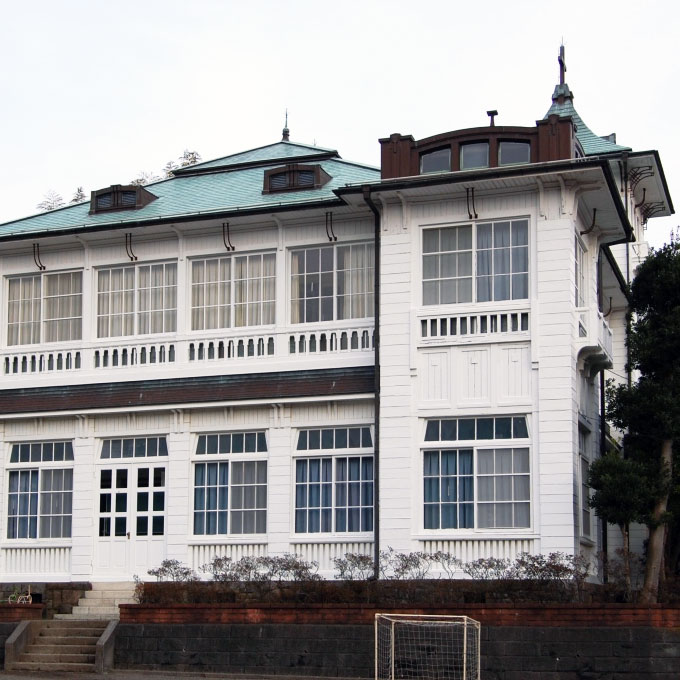
The Academia has established its headquarters in Hayama, the town of the Imperial Villa of the Emperor, a symbolic presence in peaceful Japan. One reason is that the area was a birthplace of modern Romantic literature, associated with writers including Roka Tokutomi. Along its coastline of white sand and green pines, the Imperial Villa stands among many villas of political and cultural figures of the Meiji and Taisho periods. It is a setting in which one can learn from the past to discover the new. Hayama today offers distinctively Japanese scenes, including the Museum of Modern Art, Kanagawa, the memorial museum of the Japanese-style painter Hoshun Yamaguchi, and Ikkei-an and the Shiomi residence on the former grounds of the Imperial Villa. It is also possible for the Academia to hold regular meetings by renting the Western-style building of the Higashifushimi princely residence. The ancient capital of Kamakura is nearby, too, and the landscapes of Yasujiro Ozu's films still live on. We could therefore invite members from other regions to a tea gathering at Ikkei-an and dine together at a hotel looking towards Mount Fuji at sunset. A “Myojo House” in the spirit of Tekkan and Akiko would cease to be only a dream. A place from which Romanticism is shared is also a place where members gather.
9. Other Matters
Cases not covered by these regulations shall be decided by the board of officers or by the president (chair of the board).
All the articles mentioned in the above are only to keep this academia safe and sound based on the Japan’s national laws. This home page is the main field to show your work, and the rules show what is appropriate and what is not.
The total annual fee is only $50 a year. Your romantic poems will welcome, and your kind consideration to be paid herewith would be highly appreciated.
Original source images
Select an image to open its source. Text within images remains in its original language.
Original wording, author credits, notes and source materials are preserved there.