English translation
AI-assisted English translation. The Japanese original remains authoritative.
Originally published: 11 January 2020.
This historical page combines a September 2024 update and Friends of the Society invitation with membership and meeting information from 2020. Differences in the stated fees have been preserved. Current fees, benefits, and admission conditions have not been confirmed. The meeting scheduled for 1 November 2020 was announced as cancelled in the separate “Meeting Information” document.
The Japan Romanticism Society website has made great strides!
An invitation to join the Friends of the Society
5 September 2024 — President and lyricist Seishu Hamano (Kahori Tachibana)
The fierce summer heat has finally eased. I trust that all of you who have supported and assisted us are in good health, and extend my heartfelt good wishes.
Thanks to you, our Japan Romanticism Society has made remarkable progress in poetry since its foundation. Poems, lyrics, compositions, and appearances on YouTube have multiplied: it feels as though everything is in bloom. In recent years, Jun Hayama, who joined us as a professor of composition and singing, has been particularly active. His “4-in-1” skills in lyrics and composition, piano, Electone, synthesizer, and singing, together with his outstanding feeling for the romantic idiom, have brought great success to the series of concerts celebrating the 120th anniversary of Masao Koga’s birth. He has also brought Ryoichi Hattori’s musical world splendidly back to life. Audiences have grown markedly. He works without a pause, moving from venues in Hayama and Kamakura to stages in Tokyo.
1. Looking back through history
In the Meiji and Taisho periods, the world of romantic literature concentrated largely on print. Yet the world of song also extended from Tekkan Yosano and Shihoko Kitami to Hakushu Kitahara, Toson Shimazaki, and Ujo Noguchi. Following that legacy, we too have made considerable advances into music: from Ujo and Nagayo Motoori to Yaso Saijo, Masao Koga, and Ryoichi Hattori. Cherishing the Japanese heart, we continue to present new works today. Preserving historical repertoire through performance has come to feel like our mission.
2. Romantic singing in the electronic world
Among those who worked splendidly to pass Japan’s “songs of the heart” on to later generations were Hibari Misora, Aki Yashiro, my dear friend Tetsuro Hoshino, Hideko Takamine, and Dick Mine. They have now departed to a world where we cannot meet them, however much we wish to. I hope that the romantic quality of their singing, lyrics, and compositions will continue to flow vibrantly throughout Japan in this electronic age. Alongside that work, we are creating one new song after another and carrying them forward in performances on major stages.
3. Thanks to everyone who helped produce the website
We have also worked to improve the website. Although our budget remains inadequate, the cooperation of Takeuchi Design and Satake Kobo has given it a colorful, impressive form. We have now reached the point where we can release work on YouTube one item after another. This is the fruit of your support. For “Nihon no Kokoro,” too, I am deeply grateful to Satake Studio and Takeuchi Design for their efforts.
4. What distinguished the Society at its foundation
At first I feared that our aim—to move away from print, combining images and sound to present new works and preserve and disseminate historical ones—might be reckless. That aim has gradually gained understanding, however, and our activities have now acquired real substance and scale. We have established a form in which everyone’s insight can develop, step by step, toward greater universality. Of course, there is still much room to improve its substance.
5. Though still without a parallel among Japanese societies, our Friends group is a great pleasure
We hope to continue moving forward, benefiting from our directors’ judgment and repeatedly reflecting on our work. We gratefully receive your warm support and ask for your continued encouragement as we seek to improve. With an annual fee of ¥5,000, we also feel something of the financial desperation experienced by the Yosanos as they kept publishing the literary magazine Myojo. We therefore appeal for the friendly cooperation of all who deeply love this romantic world.
That is our recent news. We are also considering crowdfunding. As we already have a Friends group, we are considering membership benefits for those who support us financially, including discounted tickets, informal tea gatherings, and enjoyable group trips. Please join this circle.
4 September 2024 — Seishu Hamano, President, Japan Romanticism Society (pen name for lyrics: Kahori Tachibana)
Please feel free to contact [email protected] or 090-2735-7495.
How to join
As an academic society, we would ordinarily ask applicants to submit a résumé with a list of research achievements, much as in university faculty recruitment. In present circumstances, however, disclosure of personal histories and incautious money transfers increasingly appear risky. To take the applicant’s perspective and remove anxiety, we have adopted the following three methods. If you wish to join, please choose A, B, or C.
Method A: Begin with an interview
Telephone President Seishu Hamano directly. We will listen to your creative history and explain our aims. Whether you are a beginner or an experienced practitioner, we will hear your aspirations and answer your questions, allowing you to join with a clear understanding of our activities. This method suits those living in Tokyo and nearby prefectures. Meetings are usually held in the salon at Yomiuri Culture, on the ninth floor of the Sogo department store outside the east exit of JR Yokohama Station. You do not need to belong to that cultural center. Contact Hamano on 090-2735-7495.
Method B: Attend a cultural-center seminar directly
Yomiuri Culture is on the ninth floor of the Sogo department store at the east exit of JR Yokohama Station. We meet in its lobby and you attend a trial lesson. In this case, you must pay Yomiuri the tuition fee for one lesson. This method suits beginners as well as accomplished people who have the determination to work patiently toward completing a long work or biography. It is, in effect, a course for developing your abilities.
Method C: Apply in advance—suited to those living farther away
First send a brief email expressing your wish to join to [email protected]. After several exchanges by email or telephone to get to know one another, you attend our first meeting in November and join there. You introduce yourself and describe your aspirations, becoming a formal member with a warm welcome from everyone.
As times and people’s attitudes change, admission methods naturally change too. Online society has become normal, and information can conveniently be retrieved in an instant. Yet the internet has also made it increasingly clear that caution is necessary.
We therefore consider choosing one of these three methods the most appropriate approach available at present. Although it is frustrating that we cannot use exactly the same method as university faculty recruitment, we can still establish an applicant’s character and commitment.
Required documents and membership fee
Having described these methods with applicants’ circumstances in mind, we recognize that you may now be concerned about which documents are required. Please prepare at least the following. We will receive them after the interview, once both sides have reached an understanding. Needless to say, the information will neither be distributed online nor shown to third parties.
All documents should be word-processed horizontally on A4 paper in portrait orientation. Since everyone’s life differs, we do not require a uniform format. If you have many publications, your principal books will suffice. Present the information chronologically, using the president’s biography in the officers section of this website as a model.
- An A4 document with horizontal text giving your name, address, mobile number, and email address, and briefly explaining why you wish to join and your future aims or aspirations.
- Copies of the issues containing your published works, books, or similar material.
- Annual membership fee: ¥10,000.
Information headquarters will provide to members, but not to third parties
- The Society’s full address, needed for postal correspondence.
- The name and number of the Society’s dedicated bank account.
- Your membership number.
First meeting
- Date and time
- Sunday, 1 November 2020, 13:30–17:00.
- Venue
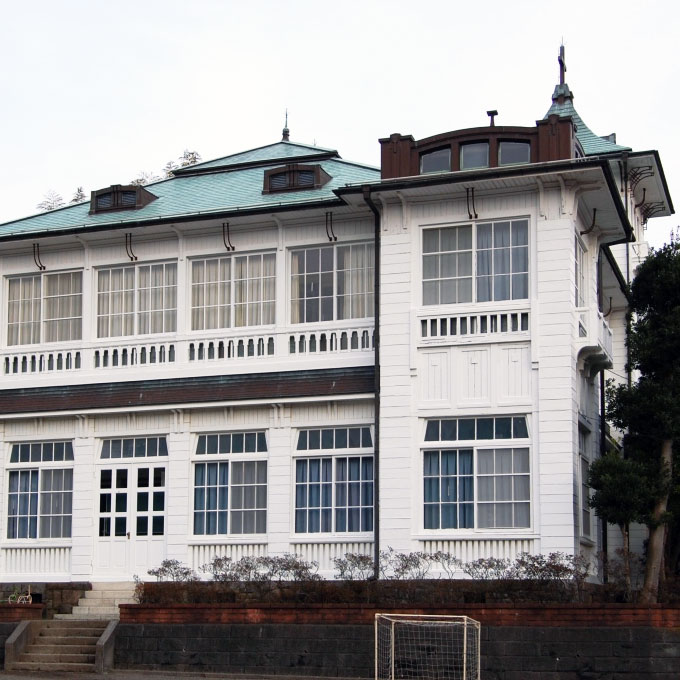
- The former Higashifushimi imperial residence in Hayama, Kanagawa Prefecture. Directions: 090-2735-7495.
- Transport
- From Tokyo, take the Yokosuka Line for approximately one hour and get off at Zushi Station. Leave through the central ticket gate and use the bus stop on the left, confirming that the bus goes to Mukaihara (向原). The journey takes about 15 minutes and costs ¥200. From the stop, walk back along the same road for about two minutes. The gate of Akenohoshi Kindergarten is on the right. Enter the gate and follow the passage to the right of the kindergarten buildings. The residence is the white Western-style house among the trees beyond.
- Meeting fee
- ¥7,000.
Acknowledgment: use of the Higashifushimi residence
The Higashifushimi residence is a place full of memories. On a previous occasion we invited Professor Tomotada Iwakura, a direct descendant of Tomomi Iwakura and a schoolmate of the present Emperor Emeritus, for an evening of chamber music. President Seishu Hamano hosted that event, and Motoya Izumi, head of the Izumi school of kyogen, together with the Izumi family, also performed short dances. We are deeply grateful to the administrators that this first meeting can take place with exclusive use of the Western-style house at this very residence.
There will also be a tour of the residence and a meal. It will be a peaceful, friendly occasion for conversation. We look forward to seeing you at the first meeting. With best wishes.
Original source images
Select an image to open its source. Text within images remains in its original language.
Original wording, author credits, notes and source materials are preserved there.