English translation
AI-assisted English translation. The Japanese original remains authoritative.
Originally published: 13 January 2020.
This is the officers' list, headquarters information, and president's biography published on the Japanese website. The current status of positions, affiliations, classes, and contact details has not been confirmed. Differences from the officers' list on the “Membership” page are preserved as they appear in the source.
Headquarters and Officers
Organisation and Headquarters Officers
I. Officers
Personal names whose romanised readings have not been confirmed are retained in Japanese.
- Honorary president
- Tadatoshi Saito — Professor Emeritus of Hitotsubashi University. “Prof. Emeritus at Hitotsubashi University”
- Chief adviser
- Takao Suzuki — Professor Emeritus of Keio University. “Prof. Emeritus at Keio University”
- Adviser
- Kimie Imura — Professor Emeritus of Meisei University. “Prof. Emeritus at Meisei University”
- President, master, and chair of the board
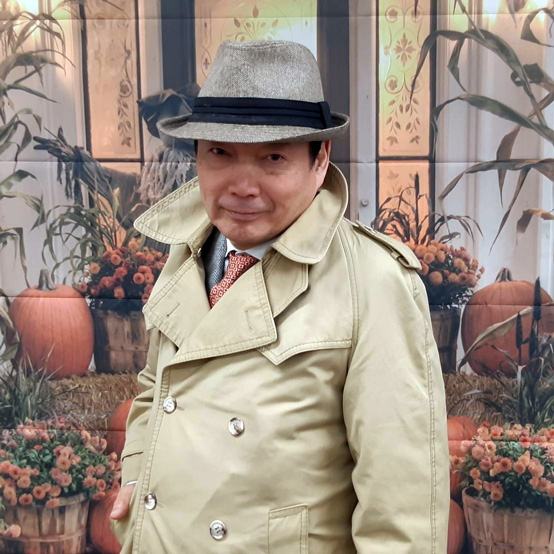
- Seishu Hamano, legal name Shigeo Hamano — previously a professor at Japan Women's University and in the graduate school of Kyoto University of Foreign Studies. “Post-graduate Prof. at Japan Women’s University, Kyoto University of Foreign Studies”
- Standing director for the Kansai region
- Kyoichi Fukuda — Professor Emeritus of Doshisha Women's College. “Prof. Emeritus at Doshisha Women’s University”
- Vice-president and head of the San Diego branch, United States
- Margot Gonzalez (Photographer & Painter)
- Standing director for the Tokyo region
- Motoya Izumi — head of the Izumi school of kyogen. “Kyogen Master at Izumi School”
- Standing director for the Kinan region
- 岩倉哲夫 — researcher into the history of the Sanada in the Warring States period. “Samurai Period Historian”
- Standing director for the Kyushu region
- 市川邦康 — Professor Emeritus of Kurume University. “Prof. Emeritus at Kurume University”
- Standing director for the Tohoku region
- 伊達雅彦 — Professor at Shobi University. “Prof. at Shobi University”
- Vice-president and standing director responsible for accounts
- 河内裕二 — Associate Professor at Shobi University. “Associate Prof. at Shobi University”
- Specially appointed professor
- 若松宗雄, president of S-Pro and former president of Sony Music. “Ex-President, Sony Music Co., Ltd.”
- Specially appointed professor
- Motoya Izumi — performing arts.
- Specially appointed professor
- Jun Hayama — guidance in composition and performance.
- Specially appointed professor
- 鈴木敬三 — director of the Ome Kimono Museum.
- Specially appointed professor
- Seishu Hamano — writer, with marugo (丸合) professorial qualification for the later-stage doctoral programme in literary studies.
- Specially appointed professor
- 三井茂子 — master of the way of poetry. “Poetry Master”
II. Headquarters
Headquarters Secretariat
Hayama-machi, Miura-gun, Kanagawa 240-0111, Japan
Japan Romanticism Academia — romanticism.jp
Telephone: 090-2735-7495
Email: [email protected]
(Minute address can be given when requested by phone or e-mail.)
Direct Instruction by the President
Yomiuri Nippon Television Culture Centre, ninth floor of Sogo department store, by the east exit of JR Yokohama Station.
Yomiuri Culture School, Yomiuri Newspaper Co., Ltd.
Telephone: 045-465-2010 (Sano)
Enquiries About Attending Classes
[email protected] — 090-2735-7495
A Brief Biography of Seishu Hamano
Born in Joroku, Sakai, he enjoyed life in the countryside. On the day of the air raid on central Sakai, fragments from machine-gun fire wounded his head in two places. After the war, he learned English from the occupation forces. American studies became his lifelong subject.
He entered the Faculty of Letters at Keio University. Fascinated by the ideas of young Americans, he wrote his undergraduate dissertation comparing the Lost Generation and the Beat Generation. During his years as a high-school teacher, he became familiar with tanka and English poetry. He was a member of the literary circles of Mita Bungaku and the New Japanese Literature Society. His research concerned postmodern literary criticism and Jewish American literature.
He served as a full-time lecturer in the Faculty of Literature at Tsurumi University and as an associate professor at Tohoku University. As a visiting professor in the English Department at the State University of New York at Buffalo, he taught Japanese poetry to graduate students. After returning to Japan, he became a graduate-school professor at Meisei University. He was a professor in the English Department of the Faculty of Humanities at Japan Women's University, with concurrent graduate-school duties; a lecturer at Waseda University, Aoyama Gakuin University, and Hitotsubashi University; and a researcher at the University of Tokyo. He obtained the Ministry of Education's marugo (丸合) professorial qualification for later-stage doctoral programmes, as well as eligibility to serve as a doctoral dissertation examiner.
His short stories, studies of American writers, interviews, and other pieces appeared in series in Bungeishunju's Bungakukai, the literary magazine Umi of Chuokoron-Shinsha, Kenkyusha's Eigo Seinen, and Shin Nihon Bungaku.
His books include 『今日のアメリカ作家群像』 (Portraits of Today's American Writers) and 『ユダヤ系アメリカ文学の出発』 (The Beginnings of Jewish American Literature), both published by Kenkyusha. He also published five literary selections: 『別れる季節』 (The Season of Parting), 『若者よ明日香の国は』 (Young People, the Land of Asuka…), 『かまぐれ』 (Kamagure), 『父の宿』 (Father's Lodging), and 『心は孤独な旅人』 (The Heart Is a Lonely Traveller). The English titles here are explanatory renderings of the Japanese titles.
Concerned about relations between Japan and North Korea, he published 『日朝、もし戦えば』 (If Japan and North Korea Went to War, Chuokoron-Shinsha). The recommendation on the book's wraparound band was written by Yozo Ishikawa, a member of the House of Representatives who had served as Director-General of the Defense Agency. Concern about the international situation following constitutional revision led to 『日本の、次の戦争』 (Japan's Next War, Goma Books). Concern about the inadequacies of the Juvenile Act led to the novel 『愚劣少年法』 (The Foolish Juvenile Act, Chuokoron), and concern about bureaucrats taking posts at universities after retirement led to the novel 『ビーライフ!白亜館物語』 (Be Life! A Tale of Hakuakan, Chuokoron).
He has written or edited more than a dozen other research books, including 『日米映像文学は戦争をどう見たか』 (How Japanese and American Screen Literature Viewed War, Kinseido). He has also published 『日本語朗読の楽しみ』 (The Pleasures of Reading Japanese Aloud), concerning Japanese poetry, along with many language-learning and general-interest books.
Newspapers, television, and magazines have described him as a writer who sounds warnings. A collection of his criticism has appeared online through the business magazine Diamond. Certificates of periods of employment are available for all the university appointments mentioned above. Searches must, however, be made under his legal name, 濱野成生 (Shigeo Hamano), rather than his pen name. He has also continued to serve as president of the Nationwide University Mita-kai (全国大学三田会), an officially registered Mita-kai of Keio University.
Original source images
Select an image to open its source. Text within images remains in its original language.
Original wording, author credits, notes and source materials are preserved there.