English translation of the prose
AI-assisted English translation of the prose; quoted poems remain in Japanese. The Japanese original remains authoritative.
New Year concert, 8 January 2025: Jun Hayama and Motoya Izumi
Japan Romanticism Society
750 years since Hojo Tokimune’s Kamakura era
This is a historical concert record. It states a 13:30 start at Kirara Kamakura Hall. Timings, credits, and historical interpretations follow the record; existing English passages are preserved as written. Quoted song lyrics remain in Japanese. The related promotional flyer and the six-page record PDF are distinct versions.
Performers: Jun Hayama, Yukinori Hirano, Yuki Yamashita. Guest performers: Motoya Izumi, head of the Izumi school of kyogen; Junko Izumi; Tokuro Miyake; Setsuko Izumi; and 和泉采明. Producer and program creator: Seishu Hamano, President of the Japan Romanticism Society.
English passage already present in the source:
We held Shogatu-koen or New Year Concert at Kirara
Kamakura Hall in the memory of the 750th anniversary
of Genko or the Sudden Attack of Fubirai Hern from
the mainland Asia.
Motoya Izumi of Traditional Kyogen Artist was very
kind enough to collaborate our program, to which we
would like to sincerely show our gratitude.
Part One: love, past and present
1. Long ago, there was a wonderful song called “Soshu Yakyoku”…
This song appeared in the 128-minute feature film Shina no Yoru, released in 1940. Its words are by Yaso Saijo and music by Ryoichi Hattori. Li Xianglan, then immensely popular as a beautiful actress, captivated men with her dreamy expression while boating in the water city of Suzhou. Many assumed she was Chinese, but she was Japanese, the daughter of a strict Japanese-language teacher. Her real name was Yoshiko Yamaguchi; after the war she was tried and expelled from the country. I too have boated on that river. Although I understand the authorities’ unease about international romance, her fans paid no heed. When she came to the Nichigeki theater, they surrounded its circular building three deep. Both words and music are excellent, and many singers still perform it. Within it lies love’s sigh, delicate and fleeting, vanishing like a heat shimmer.
2. “Hayama Koiuta” — words: Kahori Tachibana; music: Jun Hayama
The love in “Soshu Yakyoku” belonged to an unfortunate era. Even a romantic relationship itself could contain reasons for being told to exercise restraint. Today, though, is love between two Japanese people free of problems? Times may change, but family lineage, standing, and succession can still forbid freely chosen love. In “Hayama Koiuta,” God’s teaching weighs on the heroine. All the more if she is a nun: she is tormented by guilt.
This is the story of an innocent young woman who relies on the convent’s kindness to pursue her love. When Tachibana visited while preparing the lyrics, the sisters’ gentle generosity was deeply appreciated. The song follows the sinful path of a woman bravely living for love in a town of white sand and green pines. All the new works in the Tachibana–Hayama series place their hopes in a light beyond prolonged anguish. Please look forward to them.
3. “Nagisabashi Blues” — words: Kahori Tachibana; music: Jun Hayama
Today there are countless loves that cry out as in Teresa Teng’s song:
奪えるものなら 奪いたいあなた、そのために誰かを泣かしてもいい
…
Even if one wants to take a lover for oneself, one may choose to give up, recognizing that it must not be done and that the lover’s family would suffer.
Yet one’s own heart is empty, like this shell. Feeling this keenly, the heroine cries out at Nagisa Bridge. Do not offer empty comfort about returning someday; she cries:
もう、還ってこな
くていいの! 還らないで!
Thus even in an age when love is relatively free, those involved have a sense of restraint, and because of it they cry out while enduring loneliness.
4. “Onarimachi Blues” — words: Kahori Tachibana; music: Jun Hayama
A new song, but also a sequel to “Nagisabashi Blues.” That song did so well that people began humming it, saying the heroine was too pitiful to leave things as they were. Eventually I wrote the continuation. However loudly one declares one will never meet again, longing remains; that is what I focused on. A kouta says:
返してやるんじゃ、なかったに。 ふくむ未練の夜の盃
Even when separated, lovers retain feelings. They understand without words: each feels as the other does. Another kouta goes:
近くへ来たときゃ、寄りゃしゃんせ 誰に気がねが
え、あろうかいひな
The fussy, fault-finding relatives who pointed fingers have grown old and are no longer in this world…that is the idea.
5. “Dojokko Funakko” — words: Kahori Tachibana; music: Jun Hayama; premiere
Japanese popular songs are often filled with homesickness. Rural childhood friendships are particularly special: fishing in streams and ponds, gathering clay while playing in the river, and often taking loaches or crucian carp home for mother to cook and eat. Children gathered paddy snails for the table in autumn, picked persimmons to eat, and roasted chestnuts over the hearth. With such play every day, their bonds became incomparably stronger than those of city children. Sometimes, when their underwear got wet in the stream, they took it off to dry and played doctors. Early encounters between boys and girls happened naturally and stayed vividly in memory through adolescence and adulthood, even after they moved to the city. “Dojokko Funakko” begins with this simple story of the early sexual awareness of a man and woman who were childhood companions.
6. “Yoru no Platform” — Showa popular song, during and after the war
This song’s words were written when soldiers were compelled to accept that going to war meant never returning alive. Listen closely: because the lovers will never meet again, the woman stands despondently, weeping bitterly, while the soldier smiles sadly and comforts her with 泣かないで、泣かないで. His feelings are painfully clear. Released during the war and banned, it became a major 210,000-copy hit for Akiko Futaba in Showa 22, 1947. Originally Noriko Awaya’s song, it passed to Futaba after the war for particular reasons. Lyricist Yashio Okuno graduated from Keio’s literature faculty. He must have felt overwhelming grief at such reckless warfare. Born in 1902, he died on 8 October 1981. He was alive until so recently, yet I deeply regret never having the chance to meet him. Thank you for these fine lyrics; through tears, I take off my hat. Ryoichi Hattori, who collaborated as composer, shaped the sorrow and anger into a tango almost too stylish for its time. It is unquestionably among the greatest Japanese tangos. I also salute Awaya, who sang it through tears and saw it banned by the authorities.
English passage already present in the source:
Jun Hayama, Singer-song writer, sang some of
her own new songs as were mentioned above but
with some exceptions. No.2“Hayama Love
Song”on religious offensive, No.3 “Nagisa
Bridge Elegy”on lost‐love repentance, No.4
“Onaricho Blues”on regaining lost₋love, but
No.1 “Soshu Nocturne” actually very popular
prewar days in China, and No.6 “On the Evening
Railway Station”meant saying forever Sayonara
to the lover going to the battle field with
little hope of coming back alive.
Part Two: fate, past and present — seeking Koga melodies
Last year we presented a varied series of concerts marking 120 years since Masao Koga’s birth, welcoming Jun Hayama, Yuki Yamashita, the Meiji University Mandolin Club concertmaster who deeply loves Koga melodies, and professional player Yukinori Hirano from Doshisha University’s mandolin club.
Koga melodies are ideally suited to convey the “heart of Japan” to future generations. I believe Koga’s presence was essential to raising Hibari Misora’s singing to such heights.
Masao Koga was an exceptionally warm-hearted person, particularly devoted to his parents. We have been honored that people connected with him appreciate our Koga performances and attend our concerts. Our wholehearted efforts have borne fruit in the 120th-anniversary project.
In this second part, we consider his achievements, examine what remains insufficient, and intend to continue working to honor Koga melodies.
1. “Konayuki no Requiem”
A signature song written and composed by Jun Hayama to pray for the repose of those who died in the Noto Peninsula earthquake on New Year’s Day 2024 and for the earliest possible recovery. Memories fade with time, but preserving events in song allows us to reflect again on what happened and what it means to live strongly while carrying profound grief. Dedicated to Koga and his descendants.
English passage already present in the source:
Jun Hayama wrote and composed this song entitled “A
Requiem of Powder Snow” with the deep agony for the
people in the Noto Peninsula, who suffered disastrous
damage from the earthquake occurred at the New Year’s
day of 2024.
2. “Kiyamachi Shigure” — composed and performed on mandolin by Yukinori Hirano
Normally the work has lyrics by Kahori Tachibana, music and instrumental performance by Yukinori Hirano, and singing by Jun Hayama. This time, however, you will hear Hirano’s mandolin rendition. Kiyamachi is a lively district of Kyoto. The Takase River flows near Kiyamachi Street, lined with atmospheric restaurants where the sound of the shallows is charming. Kyoto has many universities, and students gather there to make happy memories. Composer Hirano was one of them; it was also where he said a sad farewell to a lover. Understanding those feelings, Tachibana wrote a poem, dedicated it to him, and offered encouragement by foretelling a future for him and his beloved. Whether it becomes reality remains to be seen. Please listen.
3. “Shake the Bio”
Mandolin solo by Yukinori Hirano.
4. “Haru no Umi”
Michio Miyagi’s masterpiece, performed as a duet by Doshisha alumnus Yukinori Hirano and Meiji University Mandolin Club concertmaster Yuki Yamashita.
English passage already present in the source:
「春の海」or “Spring Sea”is now very popular in Japan,
but originally it was composed by Mr.Michio Miyagi, who
with no eye sight,is a gifted player of Japanese
traditional harp, depicted calm and gentle spring sea
waves so elegant in his tune.
Koga melody medley — mandolins: Hirano and Yamashita
Western people’s fondness for Christmas and Kyoto people’s fondness for festivals share a strong romantic and nostalgic quality. Kyoto’s continuing custom of displaying treasures at the entrance closely resembles Western nostalgia for Christmas decorations. Both bring thoughts of ancestors and childhood. There is a musical parallel too: just as many songs describe seasonal scenes like “Gion Kouta,” more than a hundred Western Christmas-related songs can be listed.
The nostalgia with which Koga melodies touch the heart likewise resembles turning Kyoto people’s longing to return into song.
English passage already present in the source:
What we call“Koga melody”now used to be here in Japan
so much well-known tunes that many Japanese people did not
forget to hum even after the war when we were no longer
obliged to go to fight battles. Enforced or not, Japanese
natives had to endure everyday hard work, otherwise we could
not have survived with scarce foods and opportunities to
live long.
Masao Koga himself had hardships even when young.
Masao loved his mother so much, but no matter how hard he
tried to work, he could not make his mother happy and
affluent at all. In later years, however, so many of his
songs were sold that he became very well-known.
5. “Nostradamus no Tamashii” — “Soul of Nostradamus”
Lyrics by Kahori Tachibana Music by Jun Hayama
The pen name is Kahori Tachibana, but the true author is Seishu Hamano. This is a work of dark spirits roaming at night, even imagining Japan unexpectedly becoming another Ukraine. It might be called “darker than black” romanticism.
Intermission: 14:00–14:15, 15 minutes, as printed.
Part Three: 750 years since the Mongol invasions — a little bamboo-leaf boat of time
14:55–15:40, 45 minutes.
As the recorded “Nostradamus…” plays, the curtain rises and Jun appears. Her introduction: “At Christmas and New Year, we never know what may happen. Nor can we escape calamities that seem to fall from nowhere. People ride a little bamboo-leaf boat of time down a river of no return. Seven hundred and fifty years ago, a great Mongol army descended on Japan.” Motoya enters; Jun introduces him, and the audience applauds.
Jun Hayama: “Today we welcome Motoya Izumi, who recreated the anguish of the regent Hojo Tokimune in the leading role of NHK’s historical drama.” A brief conversation asks what feelings he brought to portraying Tokimune as he confronted the task of averting a great disaster such as the Mongol invasions, followed by performance.
Conversation and performance with kyogen head Motoya Izumi: recreating Hojo Tokimune’s inner life from the NHK drama.
English passage already present in the source:
Motoya Izumi, Kyogen Master of Izumi Clan, played
the role of Shogun Tokimune of the Kamakura
Government in the NHK Taiga Drama. And now he was
kind enough to collaborate with us successfully
showing the importance of peaceful relationship with
any country in any time.
Song of thanks: “As Time Goes By”
Words and music: Herman Hupfeld; singer: Jun Hayama. In Casablanca, famous for Humphrey Bogart and Ingrid Bergman, it plays poignantly as the remembered song of two people who loved each other. However time passes or the world changes, love remains. Written in 1931, it became a standard with the film’s success in 1942. Tonight, enjoy the drifting flow of time with the mandolin’s beautiful sound.
Grand finale: all performers gather, with recorded music playing.
Encore: 15:40–15:45, five minutes
“Mo Ichido Chokkyu Shobu” — words, music, and singing: Jun Hayama.
The late 1980s through 1991, buoyed by the bubble economy, are often viewed negatively as a frivolous age. Yet they were also years when Japanese people were full of energy and hope. Afterward Japan fell into the stagnation of the “lost thirty years”; repeated natural disasters and the unprecedented coronavirus crisis also hampered recovery. In an age of hundred-year lives, this song expresses a wish that people find renewed spirit and create a future of energy and hope. At the concert’s close, the Izumi head family and all performers joined together onstage with the audience in singing, bringing a warm conclusion.
English passage already present in the source:
“Brave yourself!” Music and lyrics by Jun Hayama
The period of the Japanese bubble economy in the late 1980s
and early 1990s, often tends to be viewed negatively as a time
of “an extravagant and frivolous era”, but also represented
a period of great, energetic optimism, when people held strong
hopes for the future. After that, Japan has fallen into
declining years. Jun Hayama composed this song to encourage
people again in future filled with positive energy and hope.
The concert concluded with a joyful atmosphere as all the
performers gathered on the stage and sang together with the
audience. We were very pleased and grateful to have favorable
support by so many people all over the world.
Seishu Hamano, Hayama, Japan
Record PDF: an earlier version and its additional passage
Original six-page New Year concert record. This records the 8 January 2025 performance at Kirara Kamakura Hall. Its English introduction and guest list differ from the web article. The PDF lists Motoya Izumi, Junko Izumi, and Tokuro Miyake as guests, and Seishu Hamano for historical research, production, program creation, and authorship. Its common Japanese commentary is translated above; its shorter “Konayuki no Requiem” note simply dedicates Hayama’s song to Koga and his descendants. “Nostradamus” is numbered 4 in the PDF, compared with 5 in the web article.
The PDF also contains this additional pre-intermission introduction: “Now at last we come to the long-awaited Part Three, ‘A Little Bamboo-Leaf Boat of Time.’ It is frightening! [Laughter.] We go back 750 years. As its prelude, I will sing ‘Nostradamus no Tamashii,’ with words by 橘かほる [spelling in this PDF] and music by Jun Hayama.” The existing English wording remains available unchanged in the PDF.
Accompanying promotional flyer
The two flyer images embedded with this article have the following English text. They advertise a 14:30 start, whereas the program text above gives 13:30. Guest lists and biographical details are preserved separately as printed.
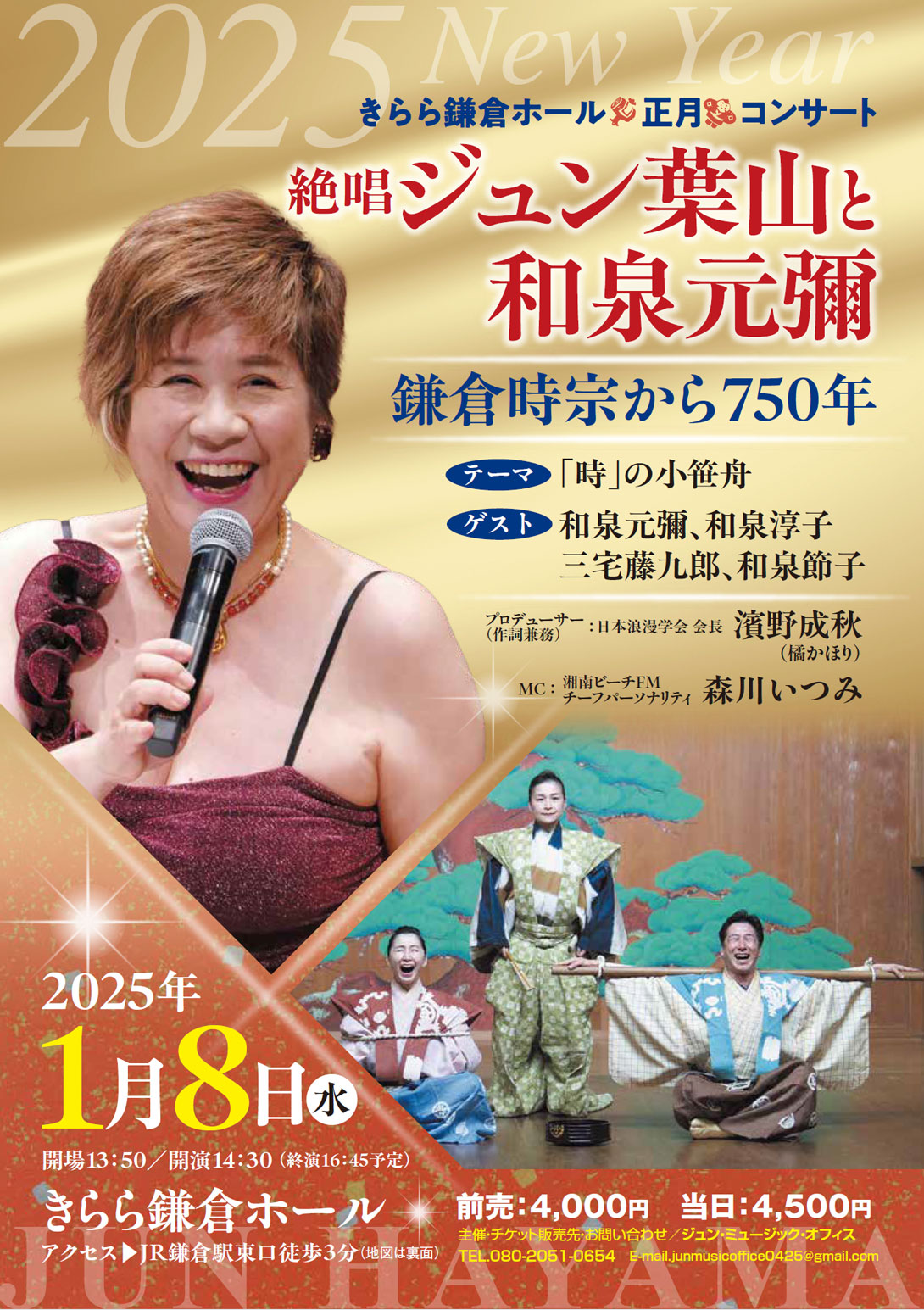
Passionate singing by Jun Hayama, with Motoya Izumi
750 years since Tokimune’s Kamakura
- Theme: “Time’s Little Bamboo-Leaf Boat.”
- Guests: Motoya Izumi, Junko Izumi, Tokuro Miyake, and Setsuko Izumi.
- Producer, also serving as lyricist: Seishu Hamano (Kahori Tachibana), President of Japan Romanticism Academia.
- Master of ceremonies: Itsumi Morikawa, chief radio personality at Shonan Beach FM.
- Date: Wednesday, January 8, 2025.
- Doors open at 13:50; performance begins at 14:30; scheduled to end at 16:45.
- Venue: Kirara Kamakura Hall.
- Tickets: ¥4,000 in advance; ¥4,500 on the day.
- Organizer, ticket sales, and inquiries: Jun Music Office. Telephone: 080-2051-0654. Email: [email protected].
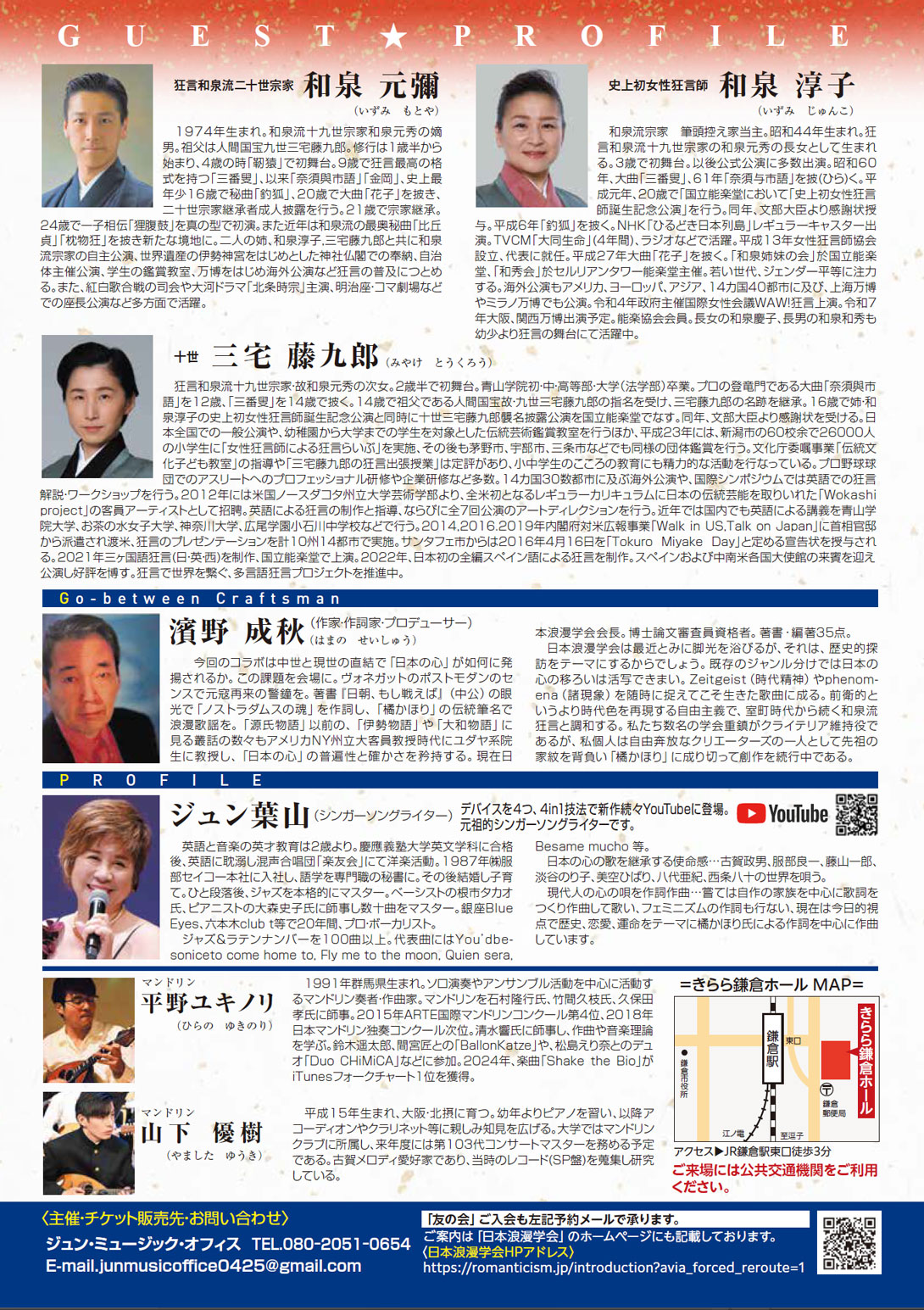
Guest profiles
Motoya Izumi — twentieth-generation head of the Izumi school of kyogen
Born in 1974, the legitimate son of Motohide Izumi, the nineteenth-generation head of the Izumi school. His grandfather was the Living National Treasure Tokuro Miyake IX. He began training at a year and a half and made his stage debut at four in Utsubozaru. At nine he performed Sanbaso, a work of the highest ceremonial standing in kyogen, followed by Nasunoyoichi and Kanaoka. At sixteen he became the youngest performer in history to undertake the secret piece Tsurigitsune. At twenty he performed the major work Hanago and held the presentation marking his coming of age as heir to the twentieth headship. He succeeded as head of the school at twenty-one. At twenty-four he first performed the shin form of 狸腹鼓, transmitted to a single heir.
In recent years he has opened new territory by performing 比丘貞 and 枕物狂, among the Izumi school’s most secret pieces. Together with his two elder sisters, Junko Izumi and Tokuro Miyake, he works to spread kyogen through the school’s own performances, votive performances at shrines and temples including the World Heritage site Ise Jingu, performances sponsored by local authorities, school appreciation programs, and overseas appearances including world expositions. He is also active in many other fields: hosting the Kohaku song contest, starring in the historical television drama Hojo Tokimune, and heading productions at the Meijiza and Koma theaters.
Junko Izumi — the first female kyogen performer in history
Head of the foremost supporting house of the Izumi school. Born in 1969, the eldest daughter of Motohide Izumi, the nineteenth-generation head of the kyogen school. She debuted at three and has appeared in numerous formal performances since. She performed the major work Sanbaso in 1985, followed by Nasunoyoichi in 1986. At twenty, in 1989, she gave a performance at the National Noh Theatre commemorating the emergence of the first female kyogen performer in history. That year she received a letter of appreciation from the Minister of Education. She undertook Tsurigitsune in 1994. She has also worked as a regular presenter on NHK’s Hirudoki Nihon Retto, appeared in Dai-ichi Life television commercials for four years, and been active in radio and other media.
In 2001 she founded the Association of Female Kyogen Performers and has remained its representative. She performed the major work Hanago in 2015. She organizes the “Izumi Sisters’ Association” performances at the National Noh Theatre and the “Washukai” at Cerulean Tower Noh Theatre, devoting particular effort to younger generations and gender equality. Her overseas performances have reached forty cities in fourteen countries across America, Europe, and Asia, including the Shanghai and Milan expositions. She appeared at WAW!, the government-sponsored international women’s conference, in 2022, and was scheduled to appear at Expo 2025 Osaka, Kansai. She is a member of the Nohgaku Performers’ Association. Her eldest daughter, 和泉慶子, and eldest son, 和泉和秀, have also been active on the kyogen stage since early childhood.
Tokuro Miyake X
The second daughter of the late Motohide Izumi, nineteenth-generation head of the Izumi school of kyogen. She debuted at two and a half and graduated from Aoyama Gakuin’s elementary, junior-high, and high schools and its university Faculty of Law. She performed Nasunoyoichi, the major piece regarded as a gateway to professional standing, at twelve, and Sanbaso at fourteen. At fourteen, on the recommendation of her grandfather, the late Living National Treasure Tokuro Miyake IX, she inherited the Tokuro Miyake name. At sixteen, alongside the commemorative performance marking her sister Junko’s emergence as the first female kyogen performer in history, she gave the performance announcing her succession as Tokuro Miyake X at the National Noh Theatre. In the same year she received a letter of appreciation from the Minister of Education.
In addition to general performances throughout Japan, she offers programs introducing traditional performing arts to students from kindergarten through university. In 2011 she conducted “Playing Kyogen with a Female Kyogen Performer” for 26,000 elementary-school pupils at sixty schools in Niigata City. Similar group experiences followed in Chino, Ube, Sanjo, and other cities. She has a reputation for teaching in the Agency for Cultural Affairs’ “Traditional Culture Classes for Children” program and for her traveling “Tokuro Miyake’s Kyogen Classes,” actively contributing to education during the elementary- and junior-high-school years. She also conducts numerous professional training sessions for athletes, including professional baseball teams, and for businesses.
Her overseas performances have reached more than thirty cities in fourteen countries, and she offers English-language explanations of kyogen and workshops at international symposia. In 2012 the Theatre Arts department of North Dakota State University invited her as a guest artist for the “Wokashi project,” the first regular US curriculum to incorporate Japanese traditional performing arts. She created and taught kyogen in English and provided artistic direction for all seven performances. In recent years she has also lectured in English in Japan at Aoyama Gakuin University, Ochanomizu University, Kanagawa University, and Hiroo Gakuen Koishikawa Junior High School, among other institutions.
In 2014, 2016, and 2019, she was sent to the United States by the Prime Minister’s Office for the Cabinet Office’s “Walk in US, Talk on Japan” public-relations program, presenting kyogen in fourteen cities across ten states. Santa Fe honored her with a declaration designating April 16, 2016, “Tokuro Miyake Day.” In 2021 she created trilingual kyogen in Japanese, English, and Spanish and performed it at the National Noh Theatre. In 2022 she created Japan’s first kyogen entirely in Spanish, earning acclaim in a performance attended by guests from the embassies of Spain and Central and South American countries. She continues promoting a multilingual kyogen project connecting the world through kyogen.
Go-between Craftsman
Seishu Hamano — writer, lyricist, and producer
This collaboration directly connects the medieval and modern worlds to ask how the “Japanese heart” can find expression. That is the question we bring to the venue. With Vonnegut’s postmodern sensibility, we sound an alarm about renewed Mongol invasions. From the perspective of my book 『日朝、もし戦えば』, published by Chuo Koron, I wrote the lyrics for “Nostradamus no Tamashii,” undertaking a romantic performance under the traditional stage name Kahori Tachibana. While a visiting professor at the State University of New York, I also taught Jewish graduate students the range of literary discourse found in The Tales of Ise and The Tales of Yamato, works preceding The Tale of Genji. I have confidence in the universality and solidity of the “Japanese heart.”
I am currently president of Japan Romanticism Academia, qualified to examine doctoral dissertations, and the author or editor of thirty-five books. The Academia has recently drawn considerable attention, perhaps because its subject is historical inquiry. Existing divisions into genres cannot capture the changing Japanese heart. Our songs emerge from a ready sensitivity to Zeitgeist, the spirit of the age, and phenomena, the surrounding linguistic landscape. Rather than call it avant-garde, we might speak of a freedom that re-presents an earlier age, harmonizing with Izumi-school kyogen handed down from the Muromachi period. A number of us serve as members of academic award committees and maintain criteria, but as an individual I am one of the freely expressive creators. Bearing an ancestral family crest and becoming “Kahori,” I continue to create.
Performer profiles
Jun Hayama — singer-songwriter
Specialized education in English and music began at the age of two. After gaining admission to Keio University’s English literature department, Jun immersed herself in English and performed Western music with the mixed chorus “Gakuyukai.” In 1987 she joined Hattori Seiko and became a secretary specializing in languages. After marriage and child-rearing had settled down, she seriously mastered jazz, studying with bassist 根市タカオ and pianist 大森史子 and learning dozens of pieces. She has spent twenty years as a professional vocalist at Ginza’s Blue Eyes, Roppongi’s club t, and other venues.
Her repertoire includes more than a hundred jazz and Latin standards, among them “You’d be so nice to come home to,” “Fly me to the moon,” “Quien sera,” and “Besame mucho.” Using four devices in a four-in-one technique, she continues bringing new works to YouTube: an exceptionally gifted singer-songwriter.
With a mission to carry forward songs of the Japanese heart, she sings the worlds of Masao Koga, Ryoichi Hattori, Ichiro Fujiyama, Noriko Awaya, Hibari Misora, Aki Yashiro, and Yaso Saijo. She writes and composes songs of contemporary feelings, previously focusing on her own family and also writing feminist lyrics. Now, from today’s perspective, she composes around Kahori’s words on themes of history, love, and destiny.
Yukinori Hirano — mandolin
Born in Gunma Prefecture in 1991. A mandolin player and composer working primarily in solo performance and ensembles. He studied mandolin with 石村隆行, 竹間久枝, and 久保田孝. He placed fourth in the 2015 ARTE International Mandolin Competition and was a finalist in the 2018 Japan Mandolin Solo Competition. He studied composition and music theory with 清水響. He participates in BallonKatze with 鈴木遥太郎 and 間宮匠, and in Duo CHiMiCA with 松島えり奈. In 2024 his piece “Shake the Bio” reached number one on the iTunes Folk chart.
Yuki Yamashita — mandolin
Born in 2003 and raised in Kitahorie, Osaka. He began piano in childhood, later broadening his experience with accordion, clarinet, and other instruments. He belongs to his university’s mandolin club and is scheduled to become its 103rd concertmaster in the next academic year. A lover of Koga melodies, he collects and studies recordings from the period on 78-rpm discs.
Kirara Kamakura Hall: access
A three-minute walk from the east exit of JR Kamakura Station. The original map marks the station, east exit, hall, Kamakura Post Office, Kamakura City Hall, the Enoden line, and the direction toward Zushi. Please use public transportation when attending.
Reservations and further information as originally published
Organizer, ticket sales, and inquiries: Jun Music Office
Telephone: 080-2051-0654
Email: [email protected]
Members of the Friends’ Association may also reserve by email at the address above. Information is also provided on the Japan Romanticism Academia website: the original Japanese website information link.
Original flyer
Event details
· Japan Standard Time
Kirara Kamakura Hall
This event has taken place. This page is kept as an activity record.
Programme record
Read the original PDF (6 pages)The PDF and the web article preserve different versions of the introduction and guest list.
Original wording, author credits, notes and source materials are preserved there.