English translation
AI-assisted English translation. The Japanese original remains authoritative.
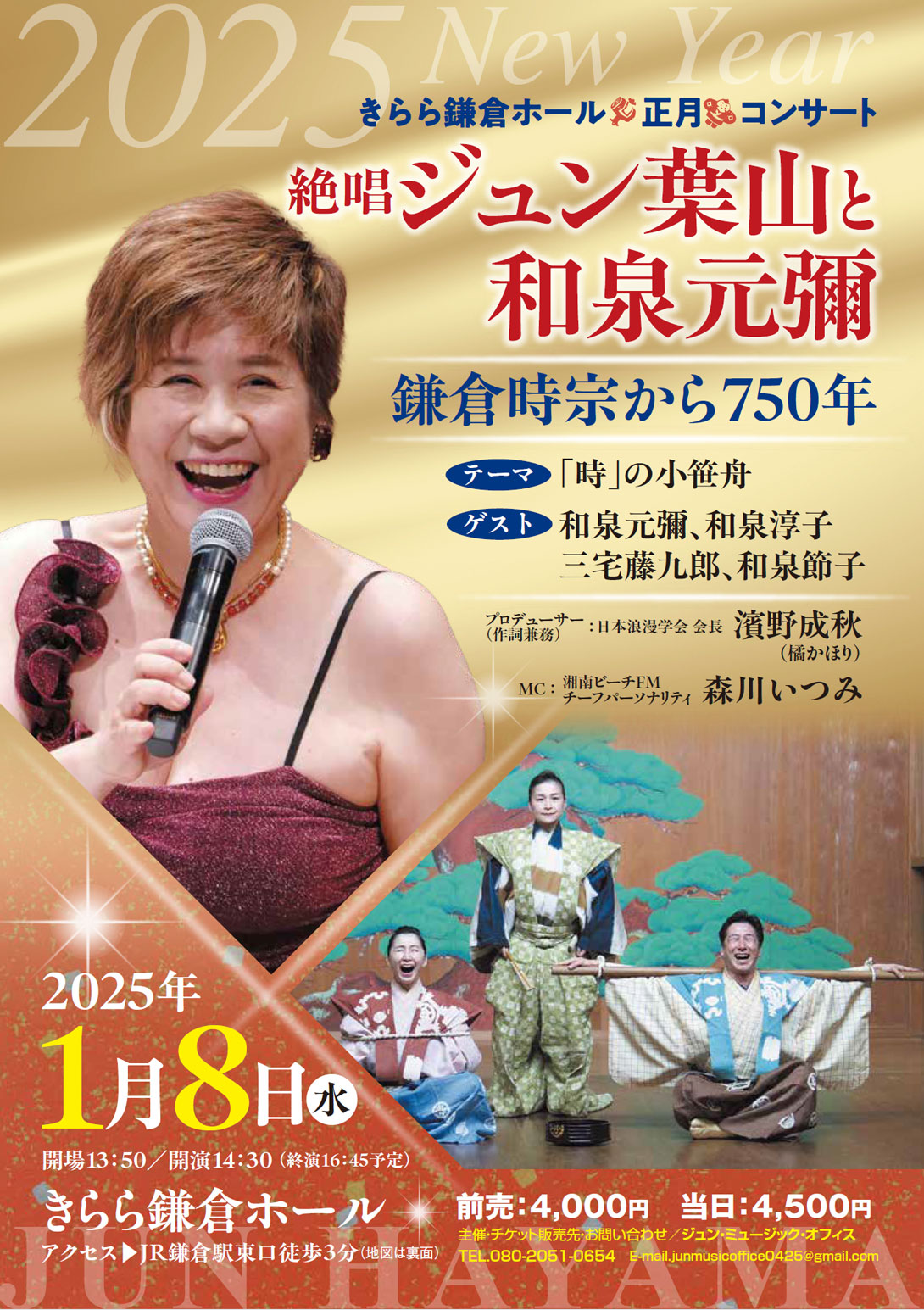
2025 New Year Concert at Kirara Kamakura Hall
Passionate singing by Jun Hayama, with Motoya Izumi
750 years since Tokimune’s Kamakura
This is a translation of the announcement and both sides of its original flyer. Dates, career stages, prices, contact details, and future plans are those printed in that historical notice.
- Theme: “Time’s Little Bamboo-Leaf Boat.”
- Guests: Motoya Izumi, Junko Izumi, Tokuro Miyake, and Setsuko Izumi.
- Producer, also serving as lyricist: Seishu Hamano (Kahori Tachibana), President of Japan Romanticism Academia.
- Master of ceremonies: Itsumi Morikawa, chief radio personality at Shonan Beach FM.
- Date: Wednesday, January 8, 2025.
- Doors open at 13:50; performance begins at 14:30; scheduled to end at 16:45.
- Venue: Kirara Kamakura Hall.
- Tickets: ¥4,000 in advance; ¥4,500 on the day.
- Organizer, ticket sales, and inquiries: Jun Music Office. Telephone: 080-2051-0654. Email: [email protected].
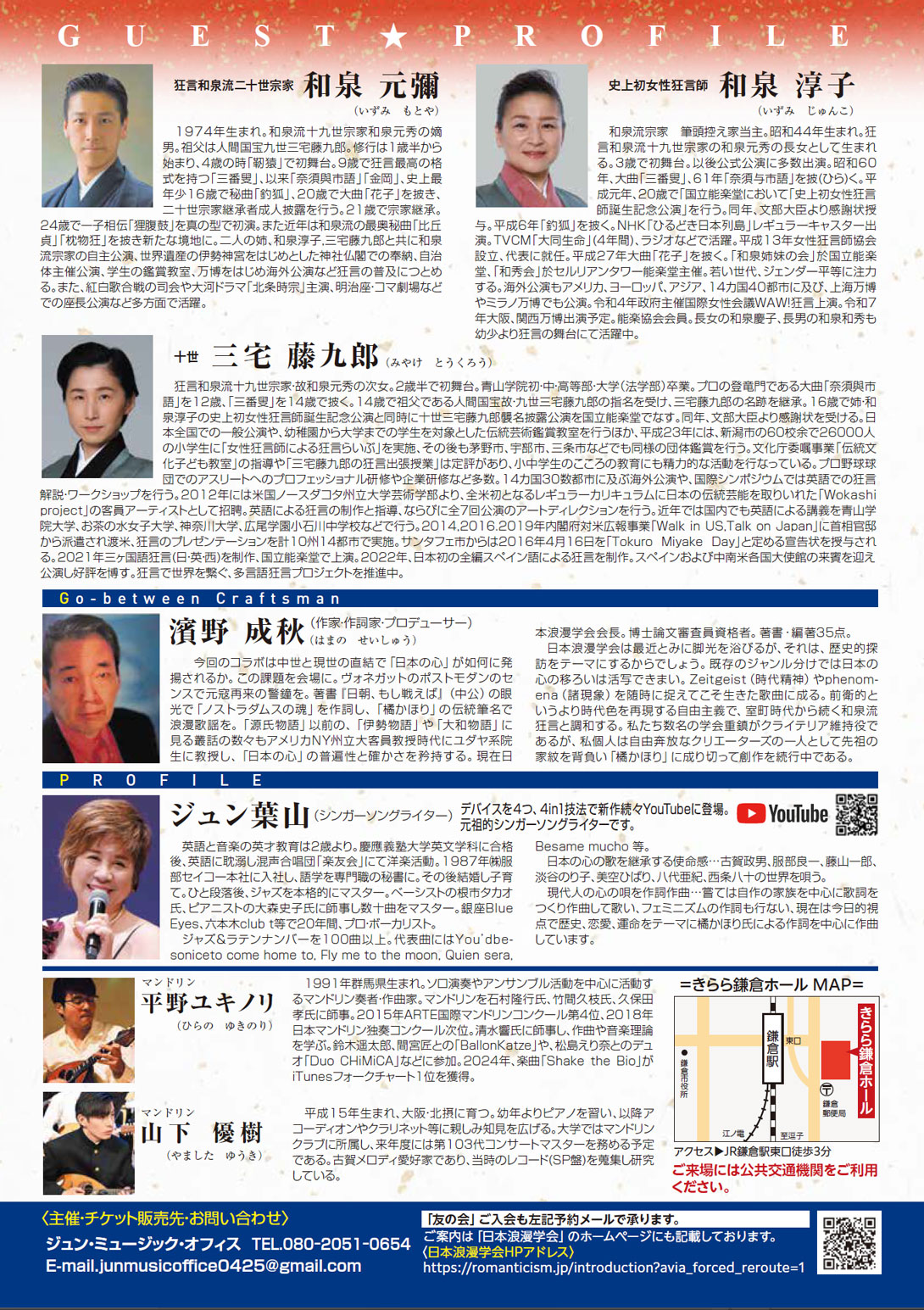
Guest profiles
Motoya Izumi — twentieth-generation head of the Izumi school of kyogen
Born in 1974, the legitimate son of Motohide Izumi, the nineteenth-generation head of the Izumi school. His grandfather was the Living National Treasure Tokuro Miyake IX. He began training at a year and a half and made his stage debut at four in Utsubozaru. At nine he performed Sanbaso, a work of the highest ceremonial standing in kyogen, followed by Nasunoyoichi and Kanaoka. At sixteen he became the youngest performer in history to undertake the secret piece Tsurigitsune. At twenty he performed the major work Hanago and held the presentation marking his coming of age as heir to the twentieth headship. He succeeded as head of the school at twenty-one. At twenty-four he first performed the shin form of 狸腹鼓, transmitted to a single heir.
In recent years he has opened new territory by performing 比丘貞 and 枕物狂, among the Izumi school’s most secret pieces. Together with his two elder sisters, Junko Izumi and Tokuro Miyake, he works to spread kyogen through the school’s own performances, votive performances at shrines and temples including the World Heritage site Ise Jingu, performances sponsored by local authorities, school appreciation programs, and overseas appearances including world expositions. He is also active in many other fields: hosting the Kohaku song contest, starring in the historical television drama Hojo Tokimune, and heading productions at the Meijiza and Koma theaters.
Junko Izumi — the first female kyogen performer in history
Head of the foremost supporting house of the Izumi school. Born in 1969, the eldest daughter of Motohide Izumi, the nineteenth-generation head of the kyogen school. She debuted at three and has appeared in numerous formal performances since. She performed the major work Sanbaso in 1985, followed by Nasunoyoichi in 1986. At twenty, in 1989, she gave a performance at the National Noh Theatre commemorating the emergence of the first female kyogen performer in history. That year she received a letter of appreciation from the Minister of Education. She undertook Tsurigitsune in 1994. She has also worked as a regular presenter on NHK’s Hirudoki Nihon Retto, appeared in Dai-ichi Life television commercials for four years, and been active in radio and other media.
In 2001 she founded the Association of Female Kyogen Performers and has remained its representative. She performed the major work Hanago in 2015. She organizes the “Izumi Sisters’ Association” performances at the National Noh Theatre and the “Washukai” at Cerulean Tower Noh Theatre, devoting particular effort to younger generations and gender equality. Her overseas performances have reached forty cities in fourteen countries across America, Europe, and Asia, including the Shanghai and Milan expositions. She appeared at WAW!, the government-sponsored international women’s conference, in 2022, and was scheduled to appear at Expo 2025 Osaka, Kansai. She is a member of the Nohgaku Performers’ Association. Her eldest daughter, 和泉慶子, and eldest son, 和泉和秀, have also been active on the kyogen stage since early childhood.
Tokuro Miyake X
The second daughter of the late Motohide Izumi, nineteenth-generation head of the Izumi school of kyogen. She debuted at two and a half and graduated from Aoyama Gakuin’s elementary, junior-high, and high schools and its university Faculty of Law. She performed Nasunoyoichi, the major piece regarded as a gateway to professional standing, at twelve, and Sanbaso at fourteen. At fourteen, on the recommendation of her grandfather, the late Living National Treasure Tokuro Miyake IX, she inherited the Tokuro Miyake name. At sixteen, alongside the commemorative performance marking her sister Junko’s emergence as the first female kyogen performer in history, she gave the performance announcing her succession as Tokuro Miyake X at the National Noh Theatre. In the same year she received a letter of appreciation from the Minister of Education.
In addition to general performances throughout Japan, she offers programs introducing traditional performing arts to students from kindergarten through university. In 2011 she conducted “Playing Kyogen with a Female Kyogen Performer” for 26,000 elementary-school pupils at sixty schools in Niigata City. Similar group experiences followed in Chino, Ube, Sanjo, and other cities. She has a reputation for teaching in the Agency for Cultural Affairs’ “Traditional Culture Classes for Children” program and for her traveling “Tokuro Miyake’s Kyogen Classes,” actively contributing to education during the elementary- and junior-high-school years. She also conducts numerous professional training sessions for athletes, including professional baseball teams, and for businesses.
Her overseas performances have reached more than thirty cities in fourteen countries, and she offers English-language explanations of kyogen and workshops at international symposia. In 2012 the Theatre Arts department of North Dakota State University invited her as a guest artist for the “Wokashi project,” the first regular US curriculum to incorporate Japanese traditional performing arts. She created and taught kyogen in English and provided artistic direction for all seven performances. In recent years she has also lectured in English in Japan at Aoyama Gakuin University, Ochanomizu University, Kanagawa University, and Hiroo Gakuen Koishikawa Junior High School, among other institutions.
In 2014, 2016, and 2019, she was sent to the United States by the Prime Minister’s Office for the Cabinet Office’s “Walk in US, Talk on Japan” public-relations program, presenting kyogen in fourteen cities across ten states. Santa Fe honored her with a declaration designating April 16, 2016, “Tokuro Miyake Day.” In 2021 she created trilingual kyogen in Japanese, English, and Spanish and performed it at the National Noh Theatre. In 2022 she created Japan’s first kyogen entirely in Spanish, earning acclaim in a performance attended by guests from the embassies of Spain and Central and South American countries. She continues promoting a multilingual kyogen project connecting the world through kyogen.
Go-between Craftsman
Seishu Hamano — writer, lyricist, and producer
This collaboration directly connects the medieval and modern worlds to ask how the “Japanese heart” can find expression. That is the question we bring to the venue. With Vonnegut’s postmodern sensibility, we sound an alarm about renewed Mongol invasions. From the perspective of my book 『日朝、もし戦えば』, published by Chuo Koron, I wrote the lyrics for “Nostradamus no Tamashii,” undertaking a romantic performance under the traditional stage name Kahori Tachibana. While a visiting professor at the State University of New York, I also taught Jewish graduate students the range of literary discourse found in The Tales of Ise and The Tales of Yamato, works preceding The Tale of Genji. I have confidence in the universality and solidity of the “Japanese heart.”
I am currently president of Japan Romanticism Academia, qualified to examine doctoral dissertations, and the author or editor of thirty-five books. The Academia has recently drawn considerable attention, perhaps because its subject is historical inquiry. Existing divisions into genres cannot capture the changing Japanese heart. Our songs emerge from a ready sensitivity to Zeitgeist, the spirit of the age, and phenomena, the surrounding linguistic landscape. Rather than call it avant-garde, we might speak of a freedom that re-presents an earlier age, harmonizing with Izumi-school kyogen handed down from the Muromachi period. A number of us serve as members of academic award committees and maintain criteria, but as an individual I am one of the freely expressive creators. Bearing an ancestral family crest and becoming “Kahori,” I continue to create.
Performer profiles
Jun Hayama — singer-songwriter
Specialized education in English and music began at the age of two. After gaining admission to Keio University’s English literature department, Jun immersed herself in English and performed Western music with the mixed chorus “Gakuyukai.” In 1987 she joined Hattori Seiko and became a secretary specializing in languages. After marriage and child-rearing had settled down, she seriously mastered jazz, studying with bassist 根市タカオ and pianist 大森史子 and learning dozens of pieces. She has spent twenty years as a professional vocalist at Ginza’s Blue Eyes, Roppongi’s club t, and other venues.
Her repertoire includes more than a hundred jazz and Latin standards, among them “You’d be so nice to come home to,” “Fly me to the moon,” “Quien sera,” and “Besame mucho.” Using four devices in a four-in-one technique, she continues bringing new works to YouTube: an exceptionally gifted singer-songwriter.
With a mission to carry forward songs of the Japanese heart, she sings the worlds of Masao Koga, Ryoichi Hattori, Ichiro Fujiyama, Noriko Awaya, Hibari Misora, Aki Yashiro, and Yaso Saijo. She writes and composes songs of contemporary feelings, previously focusing on her own family and also writing feminist lyrics. Now, from today’s perspective, she composes around Kahori’s words on themes of history, love, and destiny.
Yukinori Hirano — mandolin
Born in Gunma Prefecture in 1991. A mandolin player and composer working primarily in solo performance and ensembles. He studied mandolin with 石村隆行, 竹間久枝, and 久保田孝. He placed fourth in the 2015 ARTE International Mandolin Competition and was a finalist in the 2018 Japan Mandolin Solo Competition. He studied composition and music theory with 清水響. He participates in BallonKatze with 鈴木遥太郎 and 間宮匠, and in Duo CHiMiCA with 松島えり奈. In 2024 his piece “Shake the Bio” reached number one on the iTunes Folk chart.
Yuki Yamashita — mandolin
Born in 2003 and raised in Kitahorie, Osaka. He began piano in childhood, later broadening his experience with accordion, clarinet, and other instruments. He belongs to his university’s mandolin club and is scheduled to become its 103rd concertmaster in the next academic year. A lover of Koga melodies, he collects and studies recordings from the period on 78-rpm discs.
Kirara Kamakura Hall: access
A three-minute walk from the east exit of JR Kamakura Station. The original map marks the station, east exit, hall, Kamakura Post Office, Kamakura City Hall, the Enoden line, and the direction toward Zushi. Please use public transportation when attending.
Reservations and further information as originally published
Organizer, ticket sales, and inquiries: Jun Music Office
Telephone: 080-2051-0654
Email: [email protected]
Members of the Friends’ Association may also reserve by email at the address above. Information is also provided on the Japan Romanticism Academia website: the original Japanese website information link.
Original flyer
Original source images
Select an image to open its source. Text within images remains in its original language.
Original wording, author credits, notes and source materials are preserved there.