English translation of the prose
AI-assisted English translation of the prose; quoted poems remain in Japanese. The Japanese original remains authoritative.
AI-assisted English translation. The Japanese original remains authoritative.
Jun Hayama: Popular Song and Pops Concert — September 11, 2026
Vocals: Jun Hayama
A concert at Sazanami Hall, Zushi Cultural Plaza, on September 11, 2026, with the theme “Songs Are Gifts from Their Times — We All Loved the Movies.”
Originally published:
Event Information
- Date:
- Doors:
- Performance:
- Venue: Sazanami Hall, Zushi Cultural Plaza
- Admission: ¥3,000 by reservation; ¥3,500 on the day
- Tickets and reservations: Jun Music Office, [email protected]
Theme: “Songs Are Gifts from Their Times — We All Loved the Movies.”
Concert Information and Program
See the event information above for the date, time, admission and reservation contact.
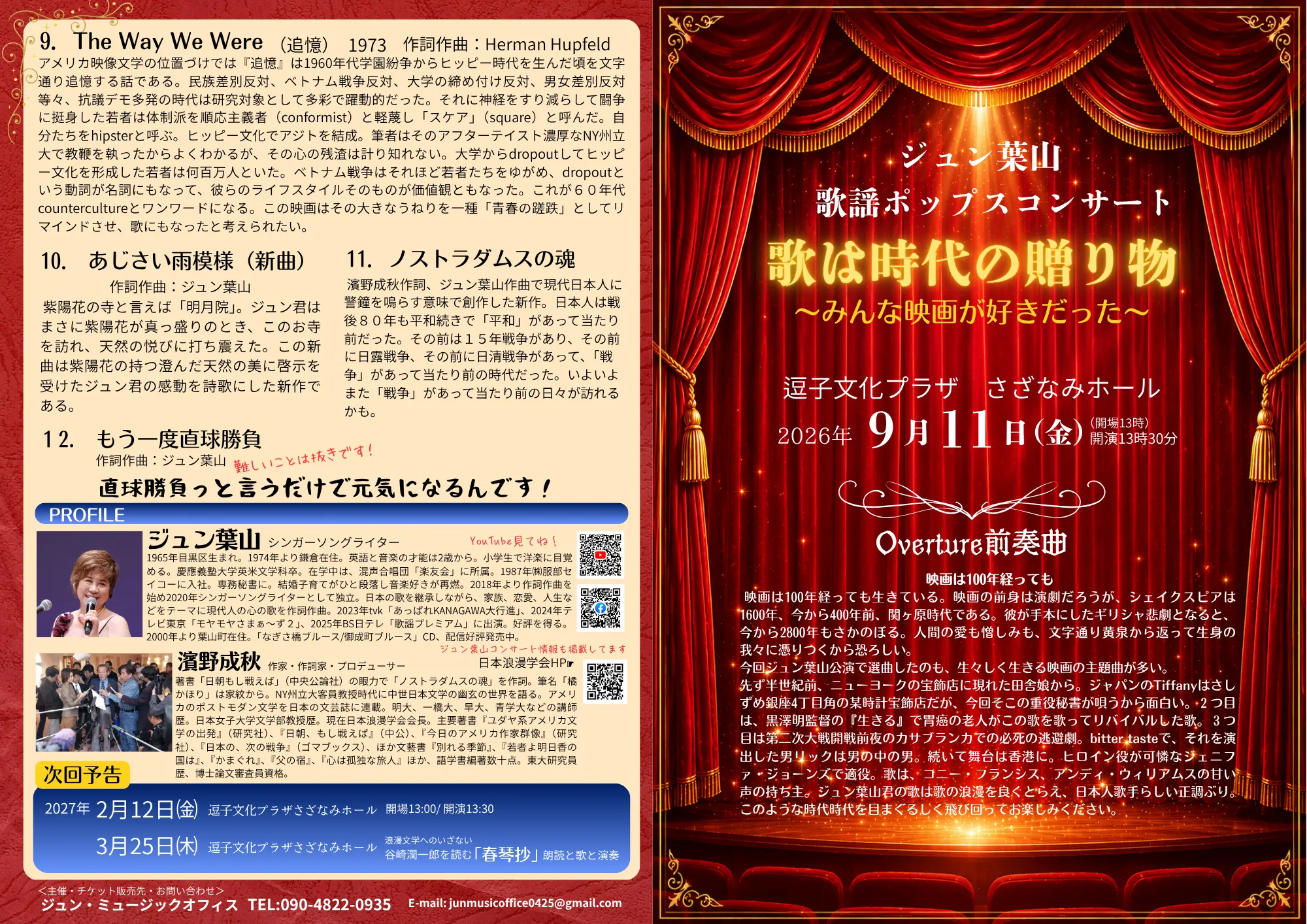
Image 1: Cover and Program, Continued
Overture — Prelude
A Film Lives On, Even after a Hundred Years
Films live on even after a hundred years. Their predecessor was theater, of course. Shakespeare belongs to 1600, four hundred years ago, the age of Sekigahara. The Greek tragedies he worked with go back 2,800 years from today. Human love and hatred return, quite literally, from the underworld and possess us in the flesh: terrifying.
Many of the selections in this Jun Hayama performance are themes from films that remain vibrantly alive. We begin half a century ago with a country girl appearing in a New York jewelry shop. Japan's Tiffany is, of course, the clock shop at Ginza 4-chome; it is amusing that this executive's secretary will be singing today. The second is a song sung by an old man with stomach cancer in director 黒澤明's 『生きる』, reviving it for a new audience. The third is a desperate flight for life in Casablanca, a foreign land just before the Second World War. With a bitter taste, Rick, the man who plays it, is a man's man. Then the scene moves to Hong Kong. William Holden is perfectly cast as the lonely journalist. The singer is Connie Francis, with a sweet voice like Andy Williams's. Jun Hayama grasps the romance of these song waves, singing in the authentic manner of a Japanese singer. Enjoy traveling at a dizzying pace through these eras.
Program 9. The Way We Were (追憶) — 1973
Words and music: Herman Hupfeld
In the context of American literature on screen, 『追憶』 is a story that literally recalls the period from the campus conflicts of the 1960s to the hippie era. Protests against racial discrimination, the Vietnam War, university restrictions and sex discrimination made those years a diverse and dynamic subject of study. Young people who wore down their nerves and devoted themselves to the struggle scorned supporters of the establishment as “conformist” and called them “square.” They called themselves hipster and formed bases in hippie culture. I understand this well because I taught at the State University of New York amid its thick aftertaste, but the psychological residue is immeasurable. Millions of young people would dropout from university and form hippie culture. The Vietnam War distorted young people to that extent. The verb dropout became a noun, and their very lifestyle took on value. This was brought together in the single word counterculture of the sixties. Please understand the film as recalling that great surge as a kind of youthful stumbling, which also became a song.
10. あじさい雨模様 — New Song
Words and music: Jun Hayama
The temple of hydrangeas is Meigetsuin. Jun visited when its hydrangeas were in full bloom and trembled with the delight of nature. This new song gives poetic form to Jun's emotion, inspired by the clear natural beauty of the flowers.
11. ノストラダムスの魂
A new work with words by Seishu Hamano and music by Jun Hayama, created to sound an alarm for Japanese people today. With eighty years of peace after the war, Japanese people came to take peace for granted. Before that came the Fifteen-Year War; before that the Russo-Japanese War, and before that the Sino-Japanese War: an age in which war was taken for granted. Days when war again seems ordinary may be approaching.
12. もう一度直球勝負
Words and music: Jun Hayama
Leave complicated things aside! Just saying “meet it head-on” makes you feel energized!
PROFILE
Jun Hayama — Singer-Songwriter
Born in Meguro in 1965. Lived in Kamakura from 1974. Her gifts for English and music emerged at two; she became aware of Western music in elementary school. Graduated from the English and American Literature major at Keio University's Faculty of Letters. While a student, she belonged to the mixed chorus 「楽友会」. Joined 服部セイコー Co., Ltd. in 1987 and served as secretary to an executive director. Marriage and bringing up children reached a stage of greater ease, and her love of music returned. She began writing words and music in 2018 and became independent as a singer-songwriter in 2020. While inheriting Japanese song traditions, she writes contemporary songs of the heart on family, love and life. She appeared on tvk's 「あっぱれKANAGAWA大行進」 in 2023, TV Tokyo's 「モヤモヤさまぁ〜ず2」 in 2024 and BS Nippon TV's 「歌謡プレミアム」 in 2025, receiving favorable responses. She has lived in Hayama since 2000. The CD 「なぎさ橋ブルース/御成町ブルース」 is on sale and available for streaming.
Watch on YouTube!
Seishu Hamano — Writer, Lyricist and Producer
Wrote the lyrics for 「ノストラダムスの魂」 from the perspective of the author of 『日朝もし戦えば』 (中央公論社). The name 「橘かほり」 comes from his family crest. During his time as a visiting professor at the State University of New York, he spoke of the ghostly world of medieval Japanese literature. He contributed serial articles on American postmodern literature to Japanese literary magazines. He has lectured at Meiji University, Hitotsubashi University, Waseda University and Aoyama Gakuin University, among others. Former Professor in the Department of Literature, Japan Women's University; now President of the Japan Romanticism Academia. Major works include 『ユダヤ系アメリカ文学の出発』 (研究社), 『日朝、もし戦えば』 (中公), 『今日のアメリカ作家群像』 (研究社), and 『日本の、次の戦争』 (ゴマブックス); literary works include 『別れる季節』, 『若者よ明日香の国は』, 『かまぐれ』, 『父の宿』 and 『心は孤独な旅人』. He has also written numerous language-learning books, held a research post at the University of Tokyo, and holds qualification to examine doctoral dissertations.
Japan Romanticism Academia website — Jun Hayama concert information is also posted.
Next Events Announced in the Program
- Friday, February 12, 2027: Sazanami Hall, Zushi Cultural Plaza. Doors 13:00; performance 13:30.
- Thursday, March 25: Sazanami Hall, Zushi Cultural Plaza. An invitation to romantic literature: reading 谷崎潤一郎's 『春琴抄』, with recitation, songs and instrumental performance.
Organizer, ticket sales and inquiries: Jun Music Office. TEL: 090-4822-0935. E-mail: [email protected].
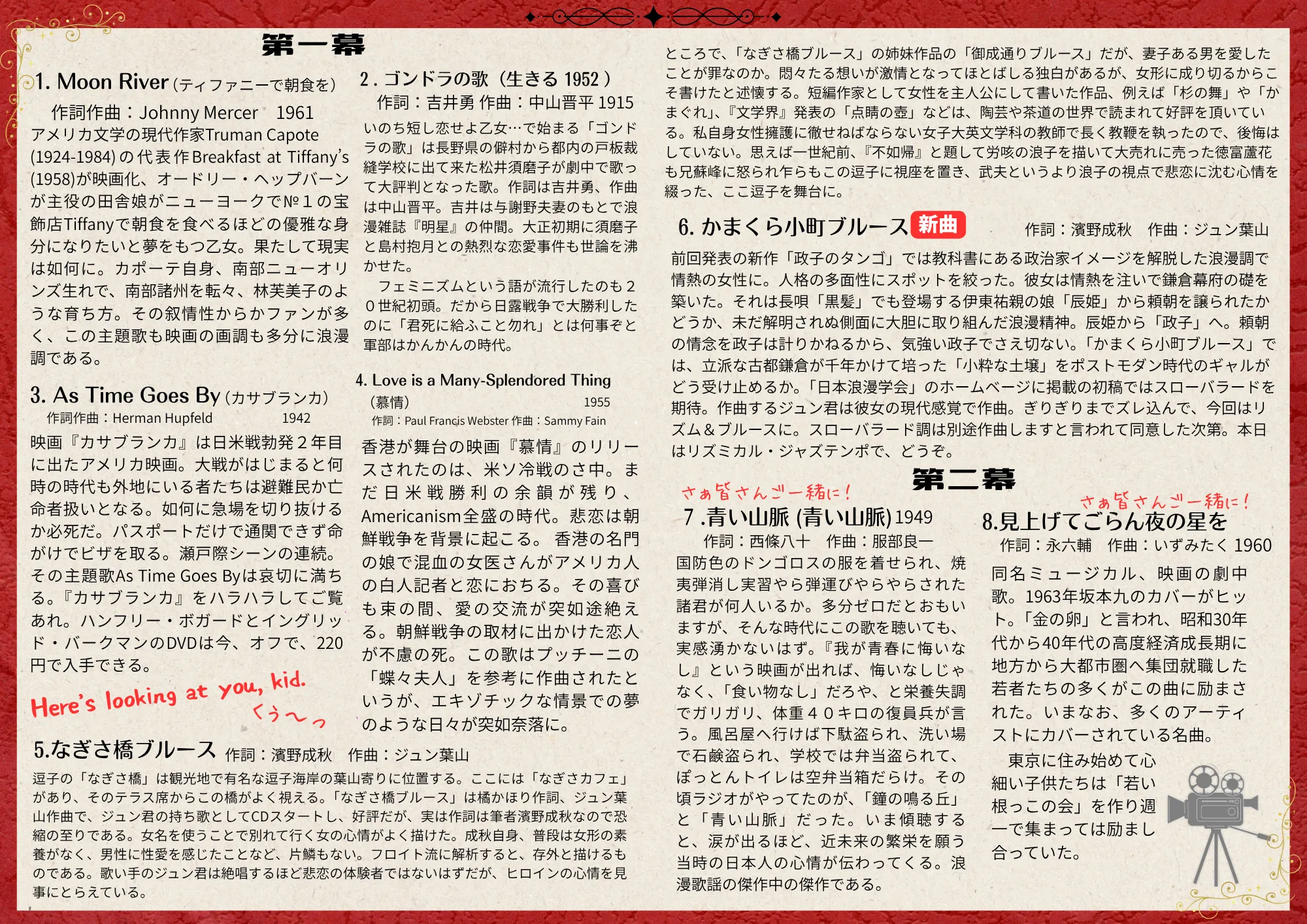
Image 2: Act I and Act II
Act I
1. Mon River (ティファニーで朝食を) — 1961
Words and music: Johnny Mercer
Truman Capote (1924-1984), a contemporary American writer, had his representative work Breakfast at Tiffany’s (1958) adapted for the screen. Audrey Hepburn plays a country girl who dreams of attaining the elegant position of eating breakfast at Tiffany, New York's No. 1 jewelry shop. What will reality bring? Capote himself was a southerner from New Orleans, moving among southern states as he grew up, rather like 林芙美子. That lyricism has won him many admirers; both this theme song and the film's dialogue have a strongly romantic quality.
2. ゴンドラの歌 (生きる 1952)
Lyrics: 吉井勇. Music: 中山晋平. 1915.
「ゴンドラの歌」 begins いのち短し恋せよ乙女…. 松井須磨子, who came from a rural part of Nagano to the 戸板 dressmaking school in Tokyo, sang it in a play, making it a tremendous success. The lyricist was 吉井勇 and the composer 中山晋平. 吉井 was a member of the romantic magazine 『明星』 under the Yosano couple. In the early Taisho years, 須磨子's passionate affair with 島村抱月 also stirred public opinion.
The word feminism became fashionable at the beginning of the twentieth century. Even though Japan had won a great victory in the Russo-Japanese War, the military was furious with romanticism for saying 「君死に給ふこと勿れ」.
3. As Time Goes By (カサブランカ) — 1942
Words and music: Herman Hupfeld
『カサブランカ』 was an American film released in the second year of the Japan–US war. Whenever a great war begins, those abroad become refugees or exiles. How can they survive the immediate crisis, or else die? Lives able to cross borders with a passport alone struggle desperately for visas. In this succession of brink-of-disaster scenes, the theme song As Time Goes By is full of sorrow. Watch 『カサブランカ』 with your heart in your mouth. A DVD with Humphrey Bogart and Ingrid Bergman can now be obtained at Off for ¥220.
Here's looking at you, kid.
Ah, that gets to you!
4. Love is a Many-Splendored Thing (慕情) — 1955
Lyrics: Paul Francis Webster. Music: Sammy Fain.
『慕情』, set in Hong Kong, was released in the midst of the US–Soviet Cold War. The afterglow of victory in the Japan–US war lingered, and Americanism was in full bloom. Its tragic love story unfolds against the background of the Korean War. A female doctor of mixed ancestry, the daughter of a distinguished Hong Kong family, falls in love with a white American journalist. Their joy is brief; the exchange of love is suddenly cut off. Her lover, sent to report on the Korean War, dies unexpectedly. The song is said to have been composed with reference to Puccini's 『蝶々夫人』: dreamlike days in an exotic setting suddenly plunge into an abyss.
5. なぎさ橋ブルース
Lyrics: Seishu Hamano. Music: Jun Hayama.
Zushi's Nagisa Bridge lies toward Hayama at the tourist destination Zushi Beach. Nagisa Cafe is here, with a clear view of the bridge from its terrace. 「なぎさ橋ブルース」 began on CD as a signature song for Jun, credited under the lyricist name 橘かほり, with music by Jun Hayama. It has been well received, but I am almost embarrassed: the lyricist is actually I, Seishu Hamano. Using a female name, I portrayed well the feelings of a woman going away after a separation. In ordinary life, 成秋 has no training as a performer of female roles, nor the slightest memory of feeling sexual love for a man. Yet analyzed in Freudian terms, such writing is possible. Jun Hayama surely has not experienced a tragic love affair to the point of singing out in extremis, but captures the heroine's feelings splendidly.
As for its sister work 「御成通りブルース」, is it a sin to have loved a married man? A monologue erupts as stifled thoughts become passion; I explain that I could write it precisely by becoming a female character. Short stories written with women as protagonists—for example, 「杉の舞」, 「かまぐれ」, or 「点睛の壺」 published in 『文学界』—are read and appreciated in pottery and tea-ceremony circles. I feel no guilt, since I taught for many years in the Department of English Literature at Japan Women's University, where advocacy for women is essential. A century ago, 徳富蘆花 portrayed the consumptive 浪子 in 『不如帰』, which sold tremendously, although his elder brother 蘇峰 scolded him. Here too, I placed the viewpoint in Zushi and expressed the feelings of tragic love from 浪子's perspective rather than 武夫's. Let us put Zushi onstage.
6. かまくら小町ブルース — New Song
Lyrics: Seishu Hamano. Music: Jun Hayama.
In the previously announced new work 「政子のタンゴ」, romanticism was used to detach 政子 from the political image in textbooks and reveal a passionate woman. The focus was on the many facets of personality. She poured her passion into laying the foundations of the Kamakura shogunate. Had 頼朝 been yielded to her by 辰姫, the daughter of 伊東祐親 who also appears in the nagauta piece 『黒髪』? A romantic spirit boldly tackles aspects that remain unresolved. From 辰姫 to 政子. 政子 cannot tolerate 頼朝's infidelity, and even her forceful spirit turns poignant. In 「かまくら小町ブルース」, how will a girl of the postmodern age receive the “sophisticated ground” cultivated by the splendid ancient capital of Kamakura over a thousand years? In the first manuscript on the Japan Romanticism Academia website, I anticipated a slow ballad, but Jun composed with her contemporary sensibility, pushing energetically into it, and this time it has become rhythm and blues. When she said she would compose a separate slow-ballad version, I agreed. Today, enjoy it in a rhythmic jazz tempo.
Act II
7. 青い山脈 (青い山脈) — 1949
Lyrics: 西條八十. Music: 服部良一.
Everyone, join in!
How many of you were made to wear khaki canvas clothing, practice extinguishing incendiary bombs and carry ammunition? Probably none, I think. But hearing this song in those days would have felt unreal. If a film called 『我が青春に悔いなし』 appeared, an emaciated, malnourished demobilized soldier weighing forty kilograms would say, “Never mind ‘no regrets’—we have no food!” Go to the bathhouse and your clogs were stolen; in the washing area, your soap was stolen; at school, your lunch was stolen, leaving the pit latrine full of empty lunch boxes. That was when the radio played 「鐘の鳴る丘」 and 「青い山脈」. Listen now, and the feelings of Japanese people then, wishing for prosperity in the near future, come through so powerfully that they bring tears. It is a masterpiece among masterpieces of romantic popular song.
8. 見上げてごらん夜の星を — 1960
Lyrics: 永六輔. Music: いずみたく.
Everyone, join in!
A song from the musical and film of the same title. 坂本九's 1963 cover was a hit. Many young people nicknamed the “golden eggs,” who moved in groups from rural regions to the big cities for work during the rapid economic growth of the Showa thirties and forties, were encouraged by this song. Even now, many artists cover this renowned number.
Feeling lonely after beginning life in Tokyo, these young people formed the 「若い根っこの会」 and gathered once a week to encourage one another.
Translation note: this translates the web notice and both complete program images, including profiles and the subsequent-event notices. Song and work titles are retained in their original wording; quoted lyric phrases remain Japanese. English spellings and credits such as “Mon River,” “Herman Hupfeld” for “The Way We Were,” and the dates printed in the program are preserved without correction. The profile says 御成町ブルース while the commentary says 御成通りブルース; both are retained. The program refers to Jun as 彼女; its honorific 君 is not treated as a masculine pronoun. Prices, biographical descriptions and subsequent-event announcements reflect the supplied program, not a new verification. No year is added to the March 25 notice.
Event details
· Japan Standard Time
Sazanami Hall, Zushi Cultural Plaza
This event has taken place. This page is kept as an activity record.
Concert flyers
Original source materials in Japanese. Select an image to view it at full size.
Original wording, author credits, notes and source materials are preserved there.